What is the "right" amount of government spending to "fix" a problem? Where ought government not...
What is the "right" amount of government spending to "fix" a problem? Where ought government not be active in the economy?
Homework Answers
When there is a problem of "deficit demand",i.e. when aggregate demand is less than the aggregate supply then government should create demand by spending amount equal to the difference between the aggregate demand and aggregate supply. This would increase the demand and equilibrium could be attained because of which full employment situation could be maintained, otherwise unemployment could take place due to deficient demand.
Government should not intervene when equilibrium is maintained by the market forces of demand and supply, by the way of market mechanism.
Market mechanism creates equilibrium by pushing Demand curve and the supply curve towards the equilibrium with the gradual changes in prices and quantities.
Add Answer to:
What is the "right" amount of government spending to "fix" a
problem? Where ought government not...
The government of an economy has increased its spending and taxes by the same amount. What...
The government of an economy has increased its spending and taxes by the same amount. What is the effect on investment?
Does the amount of government spending in an economy respond directly to changes in aggregate income,...
Does the amount of government spending in an economy respond directly to changes in aggregate income, wealth, or interest rates? Does it respond indirectly to changes in these variables?
(11) The amount by which annual government spending exceeds annual government tax revenue is called the...
(11) The amount by which annual government spending exceeds annual government tax revenue is called the deficit. the debt. the dividend. M1. (12) Suppose a law was passed to authorize more spending on roads, but several months later the first dollar had not been spent. This delay is an example of a(n) recognition lag. political lag. administration lag. operational lag. (13) Which of the following is an example of an unintended effect of fiscal...
(1) Calculate the government spending multiplier if, an increase in government spending by $5 million increases...
(1) Calculate the government spending multiplier if, an increase in government spending by $5 million increases real GDP by $20 million. Group of answer choices 0.20 0.25 2 5 4 (2) A major benefit of automatic stabilizers is that they: Group of answer choices guarantee a balanced budget over the course of the business cycle. have a tendency to reduce the national debt. moderate the effect of fluctuations in the business cycle. require legislative review by Congress before they can...
The aggregate supply curve will shift to the right when: A: government spending increases B: the...
The aggregate supply curve will shift to the right when: A: government spending increases B: the capital stock of the economy decreases C: the nominal wage rate increases D: energy prices fall. I am thinking the answer is D--is this correct? B and C are leftward shifts, and I believe A affects Aggregate Demand rather than Aggregate Supply.
The government can fix this negative externality with a per-unit tax in what amount? Carefully follow all numeric direct...
 The government can fix this negative externality with a per-unit
tax in what amount? Carefully follow all numeric directions; enter
only a number.
We were unable to transcribe this image11 II - * V- 361 -------- 120 150 Quantity The government can fix this negative externality with a per-unit tax in what amount? Carefully follow all numeric directions; enter only a number. Nov
The government can fix this negative externality with a per-unit
tax in what amount? Carefully follow all numeric directions; enter
only a number.
We were unable to transcribe this image11 II - * V- 361 -------- 120 150 Quantity The government can fix this negative externality with a per-unit tax in what amount? Carefully follow all numeric directions; enter only a number. Nov
Suppose a government decides to reduce spending and (lump-sum) income taxes by the same amount. Using...
Suppose a government decides to reduce spending and (lump-sum) income taxes by the same amount. Using the long-run model of the economy, graphically illustrate the impact of the equal reductions in spending and taxes. Be sure to label: i. the axes; ii. the curves; iii. the initial equilibrium values; iv. The direction the curves shift; and v. the terminal equilibrium values. b. State in words what happens to: i. the real interest rate; ii. national saving; iii. investment; iv. consumption;...
Consider the following economy: Autonomous Spending: $1,000 Investment: $2,000 Government Spending: $3,000 Exports: $500 C1: .55...
Consider the following economy: Autonomous Spending: $1,000 Investment: $2,000 Government Spending: $3,000 Exports: $500 C1: .55 Tax Rate: .22 Marginal Propensity to Import: .09 a. What is Output (Y) in this economy? __________________ b. What is the multiplier? _________________________ c. What is the autonomous component of this economy (y-intercept): _______________ d. If Investment drops by 20%, by how much must Government spending change to offset the drop in Y: $__________ ($ change in spending) __________% (% change in spending) e....
Q2. In the Keynesian cross model, equilibrium in the economy is obtained where planned spending equals...
Q2. In the Keynesian cross model, equilibrium in the economy is obtained where planned spending equals actual spending. (a) Explain what planned spending and actual spending are (b) Graphically present the equilibrium condition of the economy in the Keynesian cross model. (c) Explain how the economy adjusts to equilibrium if the economy finds itself with a level of planned spending which is less than actual spending (3 marks) (d) Explain why an increase in government spending leads to a greater...
Consider the diagram to the right, which applies to a nation with no government spending, taxes,...
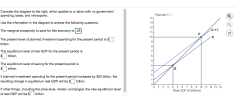 Consider the diagram to the right, which applies to a nation with no government spending, taxes, and net exports. Use the information in the diagram to answer the following questions. The marginal propensity to save for this economy is .25 Planned C, 1 147 13- 12- 11- F 10- 9-1 The present level of planned investment spending for the present period is $ trillion. The equilibrium level of real GDP for the present period is trillion. 8- 7- G $...
 The government can fix this negative externality with a per-unit
tax in what amount? Carefully follow all numeric directions; enter
only a number.
We were unable to transcribe this image11 II - * V- 361 -------- 120 150 Quantity The government can fix this negative externality with a per-unit tax in what amount? Carefully follow all numeric directions; enter only a number. Nov
The government can fix this negative externality with a per-unit
tax in what amount? Carefully follow all numeric directions; enter
only a number.
We were unable to transcribe this image11 II - * V- 361 -------- 120 150 Quantity The government can fix this negative externality with a per-unit tax in what amount? Carefully follow all numeric directions; enter only a number. Nov
 Consider the diagram to the right, which applies to a nation with no government spending, taxes, and net exports. Use the information in the diagram to answer the following questions. The marginal propensity to save for this economy is .25 Planned C, 1 147 13- 12- 11- F 10- 9-1 The present level of planned investment spending for the present period is $ trillion. The equilibrium level of real GDP for the present period is trillion. 8- 7- G $...
Most questions answered within 3 hours.
-
Where is the error in this code sequence?
String s1 = "Hello";
String s2 = "ello";...
asked 11 months ago -
Financial data for Joel de Paris, Inc., for last year
follow:
Joel de Paris, Inc.
Balance...
asked 11 months ago -
Consider this reaction:
Al2(SO4)3 (aq)+ BaCl3
(aq) Al2Cl6 (aq)- +
3BaSO4(s) . What is the...
asked 11 months ago -
Suppose that Savneet is considering increasing her
recent random sample from 20 car rentals to 40...
asked 11 months ago -
Trucks arrive at an unloading terminal at an average rate of 120
per hour.
Trucks arrive...
asked 11 months ago -
Why are methanol and ethanol completely soluble in water while
octanol is not very little soluble....
asked 11 months ago -
A facilities manager at a university reads in a research report
that the mean amount of...
asked 11 months ago -
When the CuSO4 is rehydrated by adding water to the anhydrous
compound, is this an endothermic...
asked 11 months ago -
A ray of sunlight is passing from diamond into crown glass; the
angle of incidence is...
asked 11 months ago -
A block of mass 0.249 kg is placed on top of a light, vertical
spring of...
asked 11 months ago -
how do the kidneys compensate in the presences of acidosis
a) trigger hyperventilate
b) reserve acid...
asked 11 months ago -
Question 501 pts
The rental rate of capital to the firm increases. Which of the
following...
asked 11 months ago