Intermediate Microeconomics. Please show work for each section. Thank you.
Homework Answers
Due to the change in pices of the goods consumed, a utility receiver by the consumer from the consumption of these goods can be affected.For example,in a two normal good economy and fixed income with monotonic preferences for both goods, increase in the price of one of the goods would lead to less consumption of that good which may decrease the consumer utility.
Compensating variation, is the adjust in income that returns the consumer to the original utility after an economic change has occured.Equivalent variation is a slightly different concept which suggests the amount of income adjustment that should be made with the consumer before the price change to give himthe oiginal level of utility as well be after the change in price.Consumer surplus is defined as the difference between maximum willingness to pay for a good by the consumer and the price that he actually ends up paying for it.
Add Answer to:
Intermediate Microeconomics. Please show work for each section.
Thank you.
EXERCISE 3 Consider a consumer who...
please show all math work EXERCISE 3 Consider a consumer who consumes two goods and has...
 please show all math work
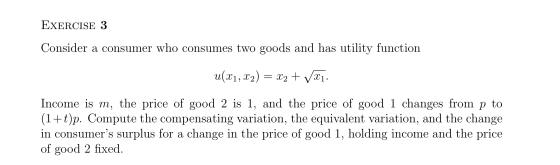
EXERCISE 3 Consider a consumer who consumes two goods and has utility function u(x1, x2) = x2 + VX1. Income is m, the price of good 2 is 1, and the price of good 1 changes from p to (1+t)p. Compute the compensating variation, the equivalent variation, and the change in consumer's surplus for a change in the price of good 1, holding income and the price of good 2 fixed.
please show all math work
EXERCISE 3 Consider a consumer who consumes two goods and has utility function u(x1, x2) = x2 + VX1. Income is m, the price of good 2 is 1, and the price of good 1 changes from p to (1+t)p. Compute the compensating variation, the equivalent variation, and the change in consumer's surplus for a change in the price of good 1, holding income and the price of good 2 fixed.
Consider a consumer whose preferences over bundles of non-negative amounts of each of two commodities can...
 Consider a consumer whose preferences over bundles of non-negative amounts of each of two commodities can be represented by a utility function of the form U (, x2) - 4x +2 20x1 Suppose that this consumer is a price taker who faces a finite constant per-unit price for commodity The consumer is endowed with income of y. Throughout this question you may assume one of pi 0 and a finite constant per-unit price for commodity two of p2 > 0....
Consider the utilityfunction u(x1,x2) = 2lnx1+lnx2. Initially, the prices are p1 = $2 and p2 =...
Consider the utilityfunction u(x1,x2) = 2lnx1+lnx2. Initially, the prices are p1 = $2 and p2 = $1 per unit. The consumer has an income of $18. Then, the price of good x1 increases to p'1 = $3 per unit. State the consumer's maximization problem and use this problem to derive his demand functions for the two goods. Determine whether the two goods are ordinary or Giffen. Determine whether the demand functions for the two goods are elastic, inelastic or unit...
EXERCISE 2 Consider a consumer who consumes two goods and has utility function u(x1, x2) =...
 EXERCISE 2 Consider a consumer who consumes two goods and has utility function u(x1, x2) = x, + 1x1 The price of good 2 is 1, the price of good 1 is p, and income is m. Derive the ordinary demand functions of good l and good 2. For what values of p and m is: a. good l normal? b. good 2 normal? c. good 1 an ordinary good? d. good 2 a gross substitute for good 1?
Consider two goods, good 1 and good 2. The consumer’s utility function is given by U(x1,x2)=V(x1)+x2....
Consider two goods, good 1 and good 2. The consumer’s utility function is given by U(x1,x2)=V(x1)+x2. Derive the ordinary demand function of good 1. When the market price of good 1 is given P1=P1' , derive the consumer’s surplus. If the price is changed to P1=P1", prove that the change measured by consumer’s surplus is the same as the Compensating variation. Also prove that it is the same as Equivalent variation.
Consumer's surplus: A consumer has the utility function U(x,y) =e^((ln(X)+Y)^1/3) where X is the good in...
Consumer's surplus: A consumer has the utility function U(x,y) =e^((ln(X)+Y)^1/3) where X is the good in concern and Y is the money that can be spent on all other goods. (So the price of Y is normalized to be 1). The income of this consumer is 100. (a) (10pts) Derive the demand function of x for this consumer. Make sure that at every price of x, the consumer always has enough income to buy the amount of x as indicated...
1. Suppose that a consumer has a utility function U(x1,x2) = x0.5x0.5 . Initial prices are...
 1. Suppose that a consumer has a utility function U(x1,x2) = x0.5x0.5 . Initial prices are P1=1 and P2 = 1, and income is m 100. Now, the price of good 1 increases to 2. (a) On the graph, please show initial choice (in black), new choice (in blue), compen- sating variation (in green) and equivalent variation (in red). (b) What is amount of the compensating variation? How to interpret it? (C) What is amount of the equivalent variation? How...
Question 13 0/1 pts respectively, and income is M, what is the Consider a consumer with...
 Question 13 0/1 pts respectively, and income is M, what is the Consider a consumer with a utility function u = 1/2 3/2. If the prices for goods 1 and 2 arep, and consumer's optimal consumption of good 1? x1 = M/(3p2) Correct Answer xi = M/(41) You Answered x1 = 3M/(41) x = 4MP1/(p2) None of the above Question 14 1/1 pts Consider a consumer with a utility function y = x1/23/2. If the prices for goods 1 and...
Suppose that a consumer has a utility function given by u(x1, x2) = 2x1 + x2. Initially the consumer faces prices (2, 2) and has income 24. i. Graph the budget constraint and indifference curves. Find...
Suppose that a consumer has a utility function given by u(x1, x2) = 2x1 + x2. Initially the consumer faces prices (2, 2) and has income 24. i. Graph the budget constraint and indifference curves. Find the initial optimal bundle. ii. If the prices change to (6, 2), find the new optimal bundle. Show this in your graph in (i). iii. How much of the change in demand for x1 is due to the substitution effect? How much due to...
can you please explain this deeply? thank you Question 7 Consider a consumer with preferences over...
 can you please explain this deeply? thank you
Question 7 Consider a consumer with preferences over two goods 1 and 2. Assume that the horizontal axis pertains to the amount of good 1 and the vertical axis pertains to the amount of good 2. Suppose that, given the consumption bundle r = 10 and y = 10, a consumer's MRS (marginal rate of substitution) is equal (in absolute value) to 4. The price of good 1 is $1, the price...
can you please explain this deeply? thank you
Question 7 Consider a consumer with preferences over two goods 1 and 2. Assume that the horizontal axis pertains to the amount of good 1 and the vertical axis pertains to the amount of good 2. Suppose that, given the consumption bundle r = 10 and y = 10, a consumer's MRS (marginal rate of substitution) is equal (in absolute value) to 4. The price of good 1 is $1, the price...
 please show all math work
EXERCISE 3 Consider a consumer who consumes two goods and has utility function u(x1, x2) = x2 + VX1. Income is m, the price of good 2 is 1, and the price of good 1 changes from p to (1+t)p. Compute the compensating variation, the equivalent variation, and the change in consumer's surplus for a change in the price of good 1, holding income and the price of good 2 fixed.
please show all math work
EXERCISE 3 Consider a consumer who consumes two goods and has utility function u(x1, x2) = x2 + VX1. Income is m, the price of good 2 is 1, and the price of good 1 changes from p to (1+t)p. Compute the compensating variation, the equivalent variation, and the change in consumer's surplus for a change in the price of good 1, holding income and the price of good 2 fixed.
 Consider a consumer whose preferences over bundles of non-negative amounts of each of two commodities can be represented by a utility function of the form U (, x2) - 4x +2 20x1 Suppose that this consumer is a price taker who faces a finite constant per-unit price for commodity The consumer is endowed with income of y. Throughout this question you may assume one of pi 0 and a finite constant per-unit price for commodity two of p2 > 0....
 EXERCISE 2 Consider a consumer who consumes two goods and has utility function u(x1, x2) = x, + 1x1 The price of good 2 is 1, the price of good 1 is p, and income is m. Derive the ordinary demand functions of good l and good 2. For what values of p and m is: a. good l normal? b. good 2 normal? c. good 1 an ordinary good? d. good 2 a gross substitute for good 1?
 1. Suppose that a consumer has a utility function U(x1,x2) = x0.5x0.5 . Initial prices are P1=1 and P2 = 1, and income is m 100. Now, the price of good 1 increases to 2. (a) On the graph, please show initial choice (in black), new choice (in blue), compen- sating variation (in green) and equivalent variation (in red). (b) What is amount of the compensating variation? How to interpret it? (C) What is amount of the equivalent variation? How...
 Question 13 0/1 pts respectively, and income is M, what is the Consider a consumer with a utility function u = 1/2 3/2. If the prices for goods 1 and 2 arep, and consumer's optimal consumption of good 1? x1 = M/(3p2) Correct Answer xi = M/(41) You Answered x1 = 3M/(41) x = 4MP1/(p2) None of the above Question 14 1/1 pts Consider a consumer with a utility function y = x1/23/2. If the prices for goods 1 and...
 can you please explain this deeply? thank you
Question 7 Consider a consumer with preferences over two goods 1 and 2. Assume that the horizontal axis pertains to the amount of good 1 and the vertical axis pertains to the amount of good 2. Suppose that, given the consumption bundle r = 10 and y = 10, a consumer's MRS (marginal rate of substitution) is equal (in absolute value) to 4. The price of good 1 is $1, the price...
can you please explain this deeply? thank you
Question 7 Consider a consumer with preferences over two goods 1 and 2. Assume that the horizontal axis pertains to the amount of good 1 and the vertical axis pertains to the amount of good 2. Suppose that, given the consumption bundle r = 10 and y = 10, a consumer's MRS (marginal rate of substitution) is equal (in absolute value) to 4. The price of good 1 is $1, the price...
Most questions answered within 3 hours.
-
Where is the error in this code sequence?
String s1 = "Hello";
String s2 = "ello";...
asked 10 months ago -
Financial data for Joel de Paris, Inc., for last year
follow:
Joel de Paris, Inc.
Balance...
asked 10 months ago -
Consider this reaction:
Al2(SO4)3 (aq)+ BaCl3
(aq) Al2Cl6 (aq)- +
3BaSO4(s) . What is the...
asked 10 months ago -
Suppose that Savneet is considering increasing her
recent random sample from 20 car rentals to 40...
asked 10 months ago -
Trucks arrive at an unloading terminal at an average rate of 120
per hour.
Trucks arrive...
asked 10 months ago -
Why are methanol and ethanol completely soluble in water while
octanol is not very little soluble....
asked 10 months ago -
A facilities manager at a university reads in a research report
that the mean amount of...
asked 10 months ago -
When the CuSO4 is rehydrated by adding water to the anhydrous
compound, is this an endothermic...
asked 10 months ago -
A ray of sunlight is passing from diamond into crown glass; the
angle of incidence is...
asked 10 months ago -
A block of mass 0.249 kg is placed on top of a light, vertical
spring of...
asked 10 months ago -
how do the kidneys compensate in the presences of acidosis
a) trigger hyperventilate
b) reserve acid...
asked 10 months ago -
Question 501 pts
The rental rate of capital to the firm increases. Which of the
following...
asked 10 months ago