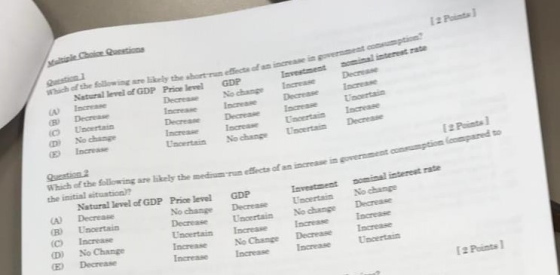
What is the difference between the short run and the medium run in these two questions when there is an increase in gov't consumption? Also what is the difference between the natural level of GDP and GDP.
Homework Answers
(1) In short run, higher government consumption increases aggregate demand, shifting AD curve to right. Real GDP and price level increases, decreasing unemployment. So:
Natural level of GDP - No change
Price level - Increase
GDP - Increase
Investment - Increase (since output will increase)
Nominal interest rate - Increase (since higher investment will shifting investment curve rightward in savings-investment graph, increasing interest rate)
(2) In medium run, higher price level will decrease aggregate supply, shifting AS curve leftward until it intersects new AD curve at further higher price level, but restoring real GDP to original level. So:
Natural level of GDP - No change
Price level - Increase
GDP - No change
Investment - No change (since higher interest rate in short run will decrease investment)
Nominal interest rate - No change
Add Answer to:
What is the difference between the short run and the medium run
in these two questions...
PROBLEM NO 2. An Open Economy in the Short Run and The Medium Run (25 Points)...
 PROBLEM NO 2. An Open Economy in the Short Run and The Medium Run (25 Points) a. Indonesia's equilibrium condition of goods and services market can be expressed by the following equation: Y = CAY - T) + (Y, r) +G-IMY, )) { + X(Y*, £) where: Y=domestic output; Y*= foreign output; C= consumption: T=tax; l=investment, r=real interest rate; G=government spending, € = Real Exchange Rate. If it is assumed that the Marshall-Lerner condition holds. Explain in words the effects...
in output WHAT SHIFTS THE SHORT-RUN AGGREGATE SUPPLY CURVE? SRAS, SRAS, BRAS, 1. Determine whether each...
 in output WHAT SHIFTS THE SHORT-RUN AGGREGATE SUPPLY CURVE? SRAS, SRAS, BRAS, 1. Determine whether each change listed in the table below will cause an increase, decreased or no change in Aggregate Supply (AS). Always start with SEASO. 2. IN column 1, list which component of AS is affected: input prices or productivity 3. IN column 2, draw an up arrow if the change will cause an increase in AS, a down arrow if it will cause a decrease in...
In the short run, a decrease in consumption will cause a(n) a) increase in price and...
In the short run, a decrease in consumption will cause a(n) a) increase in price and output levels b) decrease in price and output levels c) decrease in the price level and no change in output d) increase in the price level and a decrease in output
6. Why the aggregate supply curve slopes upward in the short run In the short run,...
 6. Why the aggregate supply curve slopes upward in the short run In the short run, the quantity of output that firms supply can deviate from the natural level of output if the actual price level in the economy deviates from the expected price level. Several theories explain how this might happen. For example, the sticky-price theory asserts that the output prices of some goods and services adjust slowly to changes in the price level. Suppose firms announce the prices...
Why the aggregate supply curve slopes upward in the short run quantity of output that firms suppl...
 Why the aggregate supply curve slopes upward in the short run quantity of output that firms supply can deviate from the natural level of output if the actual price level in the economy devi om the expected price level. Several theories explain how this might happen or example, the sticky-price theory asserts that the output prices of some goods and services adjust slowhy irms announce the prices for their products in advance, based on an expected price level of poods...
1. . (Figure: Determining SRAS Shifts) If there are advances in technology, the short-run aggregate supply...
 1.
.
(Figure: Determining SRAS Shifts) If there are advances in
technology, the short-run aggregate supply curve will shift from
SRAS0 to _____ and the price level will shift to
_____.
SRAS1; P0
SRAS2; P2
SRAS2; P1
SRAS1; P1
2.
Simultaneous recession and deflation can be explained by:
a decrease in aggregate supply.
an increase in aggregate supply.
a decrease in aggregate demand.
an increase in aggregate demand.
3.
Which is a determinant of aggregate supply?
household expectations
prices of...
1.
.
(Figure: Determining SRAS Shifts) If there are advances in
technology, the short-run aggregate supply curve will shift from
SRAS0 to _____ and the price level will shift to
_____.
SRAS1; P0
SRAS2; P2
SRAS2; P1
SRAS1; P1
2.
Simultaneous recession and deflation can be explained by:
a decrease in aggregate supply.
an increase in aggregate supply.
a decrease in aggregate demand.
an increase in aggregate demand.
3.
Which is a determinant of aggregate supply?
household expectations
prices of...
Why the aggregate supply curve slopes upward in the short run
 Why the aggregate supply curve slopes upward in the short run In the short run, the quantity of output that firms supply can deviate from the natural level of output if the actual price level in the economy deviates from the expected price level. Several theories explain how this might happen. For example, the sticky-price theory asserts that the output prices of some goods and services adjust slowly to changes in the price level. Suppose firms announce the prices for their products...
3. Assume that country J is in a situation of short and medium run equilibrium. Assume...
 3. Assume that country J is in a situation of short and medium run equilibrium. Assume that the government of J wants to foster output without increasing public expenditures. i. Which policy should the govern ment adopt? [2p] ii. Explain the short-run effects of this policy on interest rate, investments and money supply. [4p] iii. Explain the medium-run effects of the policy on the price level and on the real money supply.[3p] iv. What happens to the nominal exchange rate...
Application: (20 points) The Expenditure-Output Model below shows a hypothetical economy in the short run. Use...
 Application: (20 points) The Expenditure-Output Model below shows a hypothetical economy in the short run. Use the information in the diagram to answer the questions that follow Aggregate Expenditures (5 billions) 210 45°-line AE =C+I+G+ NX Consumption Function 30 0 30 60 90 120 150 180 210 Real GDP ($ billions) (A) (2 points) What is the equilibrium level of Real GDP in this economy? (B) Suppose this economy initially had produced a Real GDP level of $30 billion. (a)...
23. The difference between a price increase and a decrease in income is that: A. a...
23. The difference between a price increase and a decrease in income is that: A. a decrease in income does not affect the slope of the budget line, while an increase in price does change the slope. B. a price increase does not affect the consumption of other goods, while a decrease in income does. C. a price increase will increase real income, while a decrease in income will increase real income. D. None of the preceding statements is correct.
 PROBLEM NO 2. An Open Economy in the Short Run and The Medium Run (25 Points) a. Indonesia's equilibrium condition of goods and services market can be expressed by the following equation: Y = CAY - T) + (Y, r) +G-IMY, )) { + X(Y*, £) where: Y=domestic output; Y*= foreign output; C= consumption: T=tax; l=investment, r=real interest rate; G=government spending, € = Real Exchange Rate. If it is assumed that the Marshall-Lerner condition holds. Explain in words the effects...
 in output WHAT SHIFTS THE SHORT-RUN AGGREGATE SUPPLY CURVE? SRAS, SRAS, BRAS, 1. Determine whether each change listed in the table below will cause an increase, decreased or no change in Aggregate Supply (AS). Always start with SEASO. 2. IN column 1, list which component of AS is affected: input prices or productivity 3. IN column 2, draw an up arrow if the change will cause an increase in AS, a down arrow if it will cause a decrease in...
 6. Why the aggregate supply curve slopes upward in the short run In the short run, the quantity of output that firms supply can deviate from the natural level of output if the actual price level in the economy deviates from the expected price level. Several theories explain how this might happen. For example, the sticky-price theory asserts that the output prices of some goods and services adjust slowly to changes in the price level. Suppose firms announce the prices...
 Why the aggregate supply curve slopes upward in the short run quantity of output that firms supply can deviate from the natural level of output if the actual price level in the economy devi om the expected price level. Several theories explain how this might happen or example, the sticky-price theory asserts that the output prices of some goods and services adjust slowhy irms announce the prices for their products in advance, based on an expected price level of poods...
 1.
.
(Figure: Determining SRAS Shifts) If there are advances in
technology, the short-run aggregate supply curve will shift from
SRAS0 to _____ and the price level will shift to
_____.
SRAS1; P0
SRAS2; P2
SRAS2; P1
SRAS1; P1
2.
Simultaneous recession and deflation can be explained by:
a decrease in aggregate supply.
an increase in aggregate supply.
a decrease in aggregate demand.
an increase in aggregate demand.
3.
Which is a determinant of aggregate supply?
household expectations
prices of...
1.
.
(Figure: Determining SRAS Shifts) If there are advances in
technology, the short-run aggregate supply curve will shift from
SRAS0 to _____ and the price level will shift to
_____.
SRAS1; P0
SRAS2; P2
SRAS2; P1
SRAS1; P1
2.
Simultaneous recession and deflation can be explained by:
a decrease in aggregate supply.
an increase in aggregate supply.
a decrease in aggregate demand.
an increase in aggregate demand.
3.
Which is a determinant of aggregate supply?
household expectations
prices of...
 3. Assume that country J is in a situation of short and medium run equilibrium. Assume that the government of J wants to foster output without increasing public expenditures. i. Which policy should the govern ment adopt? [2p] ii. Explain the short-run effects of this policy on interest rate, investments and money supply. [4p] iii. Explain the medium-run effects of the policy on the price level and on the real money supply.[3p] iv. What happens to the nominal exchange rate...
 Application: (20 points) The Expenditure-Output Model below shows a hypothetical economy in the short run. Use the information in the diagram to answer the questions that follow Aggregate Expenditures (5 billions) 210 45°-line AE =C+I+G+ NX Consumption Function 30 0 30 60 90 120 150 180 210 Real GDP ($ billions) (A) (2 points) What is the equilibrium level of Real GDP in this economy? (B) Suppose this economy initially had produced a Real GDP level of $30 billion. (a)...
Most questions answered within 3 hours.
-
Where is the error in this code sequence?
String s1 = "Hello";
String s2 = "ello";...
asked 10 months ago -
Financial data for Joel de Paris, Inc., for last year
follow:
Joel de Paris, Inc.
Balance...
asked 10 months ago -
Consider this reaction:
Al2(SO4)3 (aq)+ BaCl3
(aq) Al2Cl6 (aq)- +
3BaSO4(s) . What is the...
asked 10 months ago -
Suppose that Savneet is considering increasing her
recent random sample from 20 car rentals to 40...
asked 10 months ago -
Trucks arrive at an unloading terminal at an average rate of 120
per hour.
Trucks arrive...
asked 10 months ago -
Why are methanol and ethanol completely soluble in water while
octanol is not very little soluble....
asked 10 months ago -
A facilities manager at a university reads in a research report
that the mean amount of...
asked 10 months ago -
When the CuSO4 is rehydrated by adding water to the anhydrous
compound, is this an endothermic...
asked 10 months ago -
A ray of sunlight is passing from diamond into crown glass; the
angle of incidence is...
asked 10 months ago -
A block of mass 0.249 kg is placed on top of a light, vertical
spring of...
asked 10 months ago -
how do the kidneys compensate in the presences of acidosis
a) trigger hyperventilate
b) reserve acid...
asked 10 months ago -
Question 501 pts
The rental rate of capital to the firm increases. Which of the
following...
asked 10 months ago