
Homework Answers
Add Answer to:
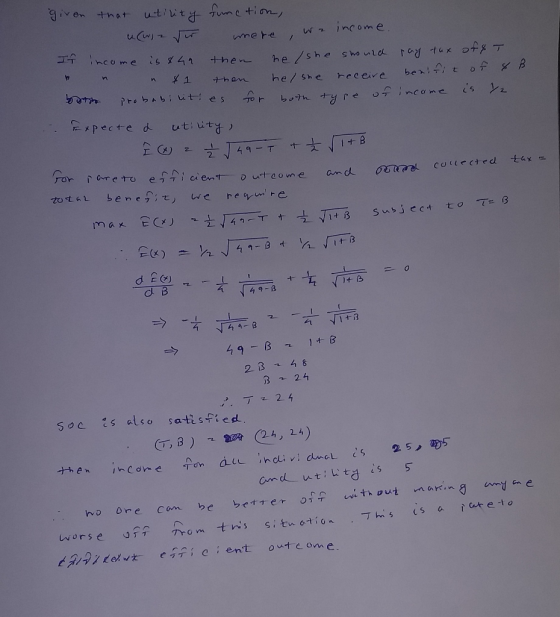
3) Consider a community with a very large number of agents. Each agent earns a random...
Pure Exchange Model 1. Consider a Pure Exchange Economy with two agents A and B and...
 Pure Exchange Model 1. Consider a Pure Exchange Economy with two agents A and B and two goods X and Y in which each agent acts competitively. Their preferences are given by the following utility function U(X,Y)=X13*Y23 Their initial endowments are as follows W=(5,20) w- (25,10) a) Calculate the demand functions for Good X and Good Y for each agent. b) State the equilibrium conditions for this economy. c) Using these conditions and the demand functions found in part a)...
Charlotte and Wilber are two agents in a two-agent, two-commodity pure exchange economy where apples and...
 Charlotte and Wilber are two agents in a two-agent, two-commodity pure exchange economy where apples and bananas are the two commodities. Charlotte loves apples and hates bananas. Her utility function is Ucu, b) = u 5 , where a is the number of apples she consumes and b in the number of bananas she consumes. Wilber likes both apples and bananas. His utility function is Uca, b) = a +2Vb. Charlotte has an initial endowment of no apples and 8...
Suppose that all agents in the economy have the following utility function U(c,l)=( c(1-θ) /(1- θ...
Suppose that all agents in the economy have the following utility function U(c,l)=( c(1-θ) /(1- θ ))-l where c is consumption, l is the supply of labor, and θ a fixed parameter. Suppose that individuals only have labor income, with an hourly wage of w and a tax rate of t. Thus, the budget constraint of the agent is w(1-t) l=c . We will assume here that θ = 0.5 and w = 1. The elasticity of the labor supply with...
Problem #-Samuelson Public Good Econ 330- YJY 1.. Consider a community consisting of three voters, Al,...
Problem #-Samuelson Public Good Econ 330- YJY 1.. Consider a community consisting of three voters, Al, Bob and Cathy. The Marginal Benefit function for each person is, for lighthouse service G is; MBa = 40 – 4G for Al, MBb = 20 – 2G for Bob, and MBc = 10 – G for Cathy. (Interpret this as demand function.) The marginal cost of producing the government service is MC= 24. (i).. Draw a diagram to show the marginal benefit functions...
2. Consider an economy of identical individuals who earn a wage w while working and nothing...
2. Consider an economy of identical individuals who earn a wage w while working and nothing when they don't. With probability 0 < p < 1, the individuals become unemployed and earn nothing. When unemployed, individuals get an employment insurance (EI) benefit of b from the government. When working, individuals pay a tax of t ∗ w to ?nance the EI program. Assume that agents have no other source of consumption in either state. Let u(c) = ln(c) denote the...
1. Consider an agent who values consumption in period 0 and 1 according to the following...
 1. Consider an agent who values consumption in period 0 and 1 according to the following utility function: u(co, C)In(Co)+8 In(c1) is a discount factor (5 < 1) which indicates that the agnet prefers to consume today more than he can tomorrow. Suppose that the agent is given a total wealth today of w and that he may save any portion of this money in order to consume tomorrow. If he saves money he is paid interest r. Thus the...
thank you Consider an agent who has an original income of 100. The gent now faces...
 thank you
Consider an agent who has an original income of 100. The gent now faces an uncertain situation with two states, each state occurring with probability in state 1, the weat faces a safe situation and incurs no cost to his original income. In state 2, the agent suffers an accident that imposes a loss of L=75. Hence in state 1, the agent's income is 100 while in state 2. his income is 100 - 75 = 25. The...
thank you
Consider an agent who has an original income of 100. The gent now faces an uncertain situation with two states, each state occurring with probability in state 1, the weat faces a safe situation and incurs no cost to his original income. In state 2, the agent suffers an accident that imposes a loss of L=75. Hence in state 1, the agent's income is 100 while in state 2. his income is 100 - 75 = 25. The...
1. Consider an Arrow-Debreu model with 2 periods (1 and 2) and 2 states of the world (1 and 2) in period 2. The home agent has income Y1 = 0, Y2(1) 200, Y2(2) = 50; the probabilities for the differen...
 1. Consider an Arrow-Debreu model with 2 periods (1 and 2) and 2 states of the world (1 and 2) in period 2. The home agent has income Y1 = 0, Y2(1) 200, Y2(2) = 50; the probabilities for the different states are π(1) and π(2) = 름 . Th = 100,坋(1) 0,坋(2) = 0; the probabilities for the different states are (1)and *(2) foreign agents have utility function: Ui In(G) +r(1) In(C (1)) + π(2) In(C(2)). Further assume that...
Competitive Equilibrium (10 pts) Consider an economy with a representative consumer, a representative firm, and a...
Competitive Equilibrium (10 pts) Consider an economy with a representative consumer, a representative firm, and a government. • The consumer can work up to h hours at an hourly rate of w. She only gets utility from consumption and does not care about how much she works. Their preferences are represented by the utility function U(C, l) = ln(C). The consumer also owns an exogenously given K units of capital, which they can rent to the firms at a price...
Here are all the information. You don't have to finish all the questions. You can just...
 Here are all the information. You don't have to finish all the
questions. You can just do the parts you know.
3. Consider a person who chooses an amount of consumption c and non-working or leisure time R to maximize the utility function U(R,c) = 100R – R2 + c subject to the constraint c+wR=wL+M, where L is the maximum amount of time available (i.e., the maximum amount of leisure and labor supply possible) and M is the initial income...
Here are all the information. You don't have to finish all the
questions. You can just do the parts you know.
3. Consider a person who chooses an amount of consumption c and non-working or leisure time R to maximize the utility function U(R,c) = 100R – R2 + c subject to the constraint c+wR=wL+M, where L is the maximum amount of time available (i.e., the maximum amount of leisure and labor supply possible) and M is the initial income...
 Pure Exchange Model 1. Consider a Pure Exchange Economy with two agents A and B and two goods X and Y in which each agent acts competitively. Their preferences are given by the following utility function U(X,Y)=X13*Y23 Their initial endowments are as follows W=(5,20) w- (25,10) a) Calculate the demand functions for Good X and Good Y for each agent. b) State the equilibrium conditions for this economy. c) Using these conditions and the demand functions found in part a)...
 Charlotte and Wilber are two agents in a two-agent, two-commodity pure exchange economy where apples and bananas are the two commodities. Charlotte loves apples and hates bananas. Her utility function is Ucu, b) = u 5 , where a is the number of apples she consumes and b in the number of bananas she consumes. Wilber likes both apples and bananas. His utility function is Uca, b) = a +2Vb. Charlotte has an initial endowment of no apples and 8...
 1. Consider an agent who values consumption in period 0 and 1 according to the following utility function: u(co, C)In(Co)+8 In(c1) is a discount factor (5 < 1) which indicates that the agnet prefers to consume today more than he can tomorrow. Suppose that the agent is given a total wealth today of w and that he may save any portion of this money in order to consume tomorrow. If he saves money he is paid interest r. Thus the...
 thank you
Consider an agent who has an original income of 100. The gent now faces an uncertain situation with two states, each state occurring with probability in state 1, the weat faces a safe situation and incurs no cost to his original income. In state 2, the agent suffers an accident that imposes a loss of L=75. Hence in state 1, the agent's income is 100 while in state 2. his income is 100 - 75 = 25. The...
thank you
Consider an agent who has an original income of 100. The gent now faces an uncertain situation with two states, each state occurring with probability in state 1, the weat faces a safe situation and incurs no cost to his original income. In state 2, the agent suffers an accident that imposes a loss of L=75. Hence in state 1, the agent's income is 100 while in state 2. his income is 100 - 75 = 25. The...
 1. Consider an Arrow-Debreu model with 2 periods (1 and 2) and 2 states of the world (1 and 2) in period 2. The home agent has income Y1 = 0, Y2(1) 200, Y2(2) = 50; the probabilities for the different states are π(1) and π(2) = 름 . Th = 100,坋(1) 0,坋(2) = 0; the probabilities for the different states are (1)and *(2) foreign agents have utility function: Ui In(G) +r(1) In(C (1)) + π(2) In(C(2)). Further assume that...
 Here are all the information. You don't have to finish all the
questions. You can just do the parts you know.
3. Consider a person who chooses an amount of consumption c and non-working or leisure time R to maximize the utility function U(R,c) = 100R – R2 + c subject to the constraint c+wR=wL+M, where L is the maximum amount of time available (i.e., the maximum amount of leisure and labor supply possible) and M is the initial income...
Here are all the information. You don't have to finish all the
questions. You can just do the parts you know.
3. Consider a person who chooses an amount of consumption c and non-working or leisure time R to maximize the utility function U(R,c) = 100R – R2 + c subject to the constraint c+wR=wL+M, where L is the maximum amount of time available (i.e., the maximum amount of leisure and labor supply possible) and M is the initial income...
Most questions answered within 3 hours.
-
Where is the error in this code sequence?
String s1 = "Hello";
String s2 = "ello";...
asked 10 months ago -
Financial data for Joel de Paris, Inc., for last year
follow:
Joel de Paris, Inc.
Balance...
asked 10 months ago -
Consider this reaction:
Al2(SO4)3 (aq)+ BaCl3
(aq) Al2Cl6 (aq)- +
3BaSO4(s) . What is the...
asked 10 months ago -
Suppose that Savneet is considering increasing her
recent random sample from 20 car rentals to 40...
asked 10 months ago -
Trucks arrive at an unloading terminal at an average rate of 120
per hour.
Trucks arrive...
asked 10 months ago -
Why are methanol and ethanol completely soluble in water while
octanol is not very little soluble....
asked 10 months ago -
A facilities manager at a university reads in a research report
that the mean amount of...
asked 10 months ago -
When the CuSO4 is rehydrated by adding water to the anhydrous
compound, is this an endothermic...
asked 10 months ago -
A ray of sunlight is passing from diamond into crown glass; the
angle of incidence is...
asked 10 months ago -
A block of mass 0.249 kg is placed on top of a light, vertical
spring of...
asked 10 months ago -
how do the kidneys compensate in the presences of acidosis
a) trigger hyperventilate
b) reserve acid...
asked 10 months ago -
Question 501 pts
The rental rate of capital to the firm increases. Which of the
following...
asked 10 months ago