
Homework Answers

Add Answer to:
3. For each of the utility functions below, compute expressions for the marginal utility with respect...
Could someone help with this chart The table below contains seven utility functions. For each utility...
 Could someone help with this chart
The table below contains seven utility functions. For each utility function please compute the marginal utility with respect to X, and the marginal utility with respect to Xz. Use your expressions for the marginal utilities to find the marginal rate of substitution (MRS = Make sure you simplify the expression. Finally, state the level of utility for the consumption bundle (5,8) rounded to 1 d. You are not required to show your work in...
Could someone help with this chart
The table below contains seven utility functions. For each utility function please compute the marginal utility with respect to X, and the marginal utility with respect to Xz. Use your expressions for the marginal utilities to find the marginal rate of substitution (MRS = Make sure you simplify the expression. Finally, state the level of utility for the consumption bundle (5,8) rounded to 1 d. You are not required to show your work in...
For each of these utility functions, b. Compute the MRS. c. Do these tastes have...
 For each of these utility functions,
b. Compute the MRS.
c. Do these tastes have diminishing marginal rates of
substitution? Are they convex?
d. Construct an indifference curve for each of these functions
for utility numbers U1 = 10 , U2 = 100 , U3 = 200 .
e. Do these utility functions represent different preference
orderings?
1. Consider the following utility functions: (i) U(x,y)- 6xy, (ii) U(x,y)=(1/5)xy, MU,--y and MU,--x ii) U(x,y)-(2xy)M 8xy2 and MUy -8x2y MU,-6y and...
For each of these utility functions,
b. Compute the MRS.
c. Do these tastes have diminishing marginal rates of
substitution? Are they convex?
d. Construct an indifference curve for each of these functions
for utility numbers U1 = 10 , U2 = 100 , U3 = 200 .
e. Do these utility functions represent different preference
orderings?
1. Consider the following utility functions: (i) U(x,y)- 6xy, (ii) U(x,y)=(1/5)xy, MU,--y and MU,--x ii) U(x,y)-(2xy)M 8xy2 and MUy -8x2y MU,-6y and...
2. For each of the three utility functions below, answer these questions: Does the marginal utility...
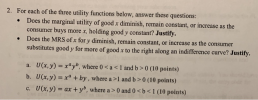 2. For each of the three utility functions below, answer these questions: Does the marginal utility of good x diminish, remain constant, or increase as the consumer buys more x, holding good y constant? Justify. Does the MRS of x for y diminish, remain constant, or increase as the consumer substitutes good y for more of good x to the right along an indifference curve? Justify. . . a. U(x, y)xyb, where 0 < a < 1 and b> 0...
2. For each of the three utility functions below, answer these questions: Does the marginal utility...
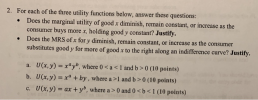 2. For each of the three utility functions below, answer these questions: Does the marginal utility of good x diminish, remain constant, or increase as the consumer buys more x, holding good y constant? Justify. Does the MRS of x for y diminish, remain constant, or increase as the consumer substitutes good y for more of good x to the right along an indifference curve? Justify. . . a. U(x, y)xyb, where 0 < a < 1 and b> 0...
Find the Marginal Utility of X; the Marginal Utility of Y; the ratio MUx / MUy...
Find the Marginal Utility of X; the Marginal Utility of Y; the ratio MUx / MUy for each of the following: a. U(x,y) = 15x.2y.3 b. U(x,y)=.5xy c. U(x,y)=6x.4y.5 d. U(x,y)=3x.5y.8
Use the following table to indicate whether the marginal rate of substitution (MRS) of each utility...
 Use the following table to indicate whether the marginal rate of substitution (MRS) of each utility function increases, decreases, or is constant as x increases. MRS Increases with Utility Function Ux,y)- 3x y U(x,y) = MRS Decreases with x Constant MRS MRS Increases withx x-y U(x,y) = For a utility function for two goods, U xy to have a strictly diminishing MRS ie, to be strictly quasi concave), the following condition must hold: Use the following table to indicate whether...
Natalia and her sister, Gina, have the following utility functions on the number of slices of...
Natalia and her sister, Gina, have the following utility functions on the number of slices of pizza (x) and cans of soda (y) they consume in the semester. Natalia’s is U(x,y)=3x+2y and Gina’s is V(x,y)=4x+2y. Then, among the bundles that are indifferent to (2,0) for Natalia, the only bundle that gives Gina a utility of 7 is? a. (7, 0) b. (0, 7/2) c. (7/4,0) d. (0, 3/2) e. (1, 3/2)
2. For each of the three utility functions below, answer these questions: • Does the marginal...
2. For each of the three utility functions below, answer these questions: • Does the marginal utility of good x diminish, remain constant, or increase as the consumer buys more x, holding good y constant? Justify. • Does the MRS of x for y diminish, remain constant, or increase as the consumer substitutes good y for more of good x to the right along an indifference curve? Justify. a. ?(?, ?) = ? ?? ? , where 0 < a...
Question 1 For the following utility functions (3 pts each for a, b, and c): •...
Question 1 For the following utility functions (3 pts each for a, b, and c): • Find the marginal utility of each good at the point (5, 5) and at the point (5, 15) • Determine whether the marginal utility decreases as consumption of each good increases (i.e., does the utility function exhibit diminishing marginal utility in each good?) • Find the marginal rate of substitution at the point (5, 5) and at the point (5, 15) • Discuss how...
2. Show that each of the following utility functions has a diminishing MRS. Do they exhibit...
 2. Show that each of the following utility functions has a diminishing MRS. Do they exhibit constant, increasing, or decreasing marginal utility? Is the shape of the marginal utility function an indicator of the convexity of indifference curve? a. (2) U(X,Y) = XY b. (2) U(X,Y) = x2y2 c. (2) U(X,Y) = In X + In Y
 Could someone help with this chart
The table below contains seven utility functions. For each utility function please compute the marginal utility with respect to X, and the marginal utility with respect to Xz. Use your expressions for the marginal utilities to find the marginal rate of substitution (MRS = Make sure you simplify the expression. Finally, state the level of utility for the consumption bundle (5,8) rounded to 1 d. You are not required to show your work in...
Could someone help with this chart
The table below contains seven utility functions. For each utility function please compute the marginal utility with respect to X, and the marginal utility with respect to Xz. Use your expressions for the marginal utilities to find the marginal rate of substitution (MRS = Make sure you simplify the expression. Finally, state the level of utility for the consumption bundle (5,8) rounded to 1 d. You are not required to show your work in...
 For each of these utility functions,
b. Compute the MRS.
c. Do these tastes have diminishing marginal rates of
substitution? Are they convex?
d. Construct an indifference curve for each of these functions
for utility numbers U1 = 10 , U2 = 100 , U3 = 200 .
e. Do these utility functions represent different preference
orderings?
1. Consider the following utility functions: (i) U(x,y)- 6xy, (ii) U(x,y)=(1/5)xy, MU,--y and MU,--x ii) U(x,y)-(2xy)M 8xy2 and MUy -8x2y MU,-6y and...
For each of these utility functions,
b. Compute the MRS.
c. Do these tastes have diminishing marginal rates of
substitution? Are they convex?
d. Construct an indifference curve for each of these functions
for utility numbers U1 = 10 , U2 = 100 , U3 = 200 .
e. Do these utility functions represent different preference
orderings?
1. Consider the following utility functions: (i) U(x,y)- 6xy, (ii) U(x,y)=(1/5)xy, MU,--y and MU,--x ii) U(x,y)-(2xy)M 8xy2 and MUy -8x2y MU,-6y and...
 2. For each of the three utility functions below, answer these questions: Does the marginal utility of good x diminish, remain constant, or increase as the consumer buys more x, holding good y constant? Justify. Does the MRS of x for y diminish, remain constant, or increase as the consumer substitutes good y for more of good x to the right along an indifference curve? Justify. . . a. U(x, y)xyb, where 0 < a < 1 and b> 0...
 2. For each of the three utility functions below, answer these questions: Does the marginal utility of good x diminish, remain constant, or increase as the consumer buys more x, holding good y constant? Justify. Does the MRS of x for y diminish, remain constant, or increase as the consumer substitutes good y for more of good x to the right along an indifference curve? Justify. . . a. U(x, y)xyb, where 0 < a < 1 and b> 0...
 Use the following table to indicate whether the marginal rate of substitution (MRS) of each utility function increases, decreases, or is constant as x increases. MRS Increases with Utility Function Ux,y)- 3x y U(x,y) = MRS Decreases with x Constant MRS MRS Increases withx x-y U(x,y) = For a utility function for two goods, U xy to have a strictly diminishing MRS ie, to be strictly quasi concave), the following condition must hold: Use the following table to indicate whether...
 2. Show that each of the following utility functions has a diminishing MRS. Do they exhibit constant, increasing, or decreasing marginal utility? Is the shape of the marginal utility function an indicator of the convexity of indifference curve? a. (2) U(X,Y) = XY b. (2) U(X,Y) = x2y2 c. (2) U(X,Y) = In X + In Y
Most questions answered within 3 hours.
-
Where is the error in this code sequence?
String s1 = "Hello";
String s2 = "ello";...
asked 10 months ago -
Financial data for Joel de Paris, Inc., for last year
follow:
Joel de Paris, Inc.
Balance...
asked 10 months ago -
Consider this reaction:
Al2(SO4)3 (aq)+ BaCl3
(aq) Al2Cl6 (aq)- +
3BaSO4(s) . What is the...
asked 10 months ago -
Suppose that Savneet is considering increasing her
recent random sample from 20 car rentals to 40...
asked 10 months ago -
Trucks arrive at an unloading terminal at an average rate of 120
per hour.
Trucks arrive...
asked 10 months ago -
Why are methanol and ethanol completely soluble in water while
octanol is not very little soluble....
asked 10 months ago -
A facilities manager at a university reads in a research report
that the mean amount of...
asked 10 months ago -
When the CuSO4 is rehydrated by adding water to the anhydrous
compound, is this an endothermic...
asked 10 months ago -
A ray of sunlight is passing from diamond into crown glass; the
angle of incidence is...
asked 10 months ago -
A block of mass 0.249 kg is placed on top of a light, vertical
spring of...
asked 10 months ago -
how do the kidneys compensate in the presences of acidosis
a) trigger hyperventilate
b) reserve acid...
asked 10 months ago -
Question 501 pts
The rental rate of capital to the firm increases. Which of the
following...
asked 10 months ago