how does the managerial accountant determine the department sequence in the step-down method? How are ties...
how does the managerial accountant determine the department sequence in the step-down method? How are ties handled?
Homework Answers
The sequence of allocation generally starts with the service department that has incurred the greatest costs. After this department’s costs have been allocated, the service department with the next highest costs has its costs allocated, and so forth until the service department with the lowest costs has had its costs allocated. Costs are not allocated back to a department that has already had all of its costs allocated.An alternative approach is to start with the service department that provides the highest percentage of its’ service to other service departments. In determining the sequence of allocations, ties can be broken by using the alternative approach. If there is still a tie, then choose the department with the largest dollar amount of service provided to the other service departments. In the step-down method, no costs are allocated (or reallocated) back to a service department once the service department’s costs have been allocated.
The step-down method is accomplished in two steps. In the first step, a set of equations is developed to represent the relationships between the service departments and the other departments, i.e., both sets of equations [1] and [2]. Then the equations for the service departments [1] must be solved before the allocations to the producing departments [2] can be completed. The service department equations reflect the fact that the number of allocations to each service department changes as the departments are closed in sequence. If there are "n" service departments numbered according to the sequence in which they are closed, then there would be no allocations to the first service department closed, therefore S1 = D1; only one allocation to service department 2, therefore S2 = D2 + K1,2; two allocations to service department 3, therefore S3 = D3 + K1,3 + K2,3 and finally n-1 allocations to the last (nth) service department.
Add Answer to:
how does the managerial accountant determine the department
sequence in the step-down method? How are ties...
Certified Management Accountant (CMA) How does this certification benefit the managerial accountant? How does an accountant...
Certified Management Accountant (CMA) How does this certification benefit the managerial accountant? How does an accountant with this certification benefit the organization? What organization sponsor’s the certification? What is the history of this organization (Date established, why was it established, founded by whom, etc.)? Who is the current leader/chairman of the organization What regulations and/or standards do they establish and/or enforce? What publications do they produce? What continuing education requirement do they have? What is the certification process and requirements?
Which of the following statements is true of the step-down method? a) The step-down method begins...
Which of the following statements is true of the step-down method? a) The step-down method begins with the department that provides the least amount of service to other service departments. b) The step-down method does not allocate service department costs to operating departments. c) When the step-down method is used, the allocation base attributable to a service department that has already been allocated is ignored. d) The order of cost allocation does not have any significance under the step-down method....
Since there are no regulations governing managerial accounting, how does an accounting department determine what reporting...
Since there are no regulations governing managerial accounting, how does an accounting department determine what reporting to present to management?
Certified Management Accountant (CMA) How does this certification benefit the managerial account...
Certified Management Accountant (CMA) How does this certification benefit the managerial accountant? How does an accountant with this certification benefit the organization? What organization sponsor’s the certification? What is the history of this organization (Date established, why was it established, founded by whom, etc.)? Who is the current leader/chairman of the organization What regulations and/or standards do they establish and/or enforce? What publications do they produce? What continuing education requirement do they have? What is the certification process and requirements?
How does analyzing financial statements help a managerial accountant or manager make decisions? Can these be...
How does analyzing financial statements help a managerial accountant or manager make decisions? Can these be used to compare one company to another? What are the benefits and limitations? Is it better to compare industry averages? It is stated that ratios are the starting point rather than the end. Are there other non-accounting factors to consider in analysis and decision making? State them and give your rationale.
In at least 225 words answer the following: How does an accounting department determine what reporting...
In at least 225 words answer the following: How does an accounting department determine what reporting to present to management, since there are no regulations governing managerial accounting
Because managerial accounting reports rarely solve decision problems, what function does a managerial accountant use to...
Because managerial accounting reports rarely solve decision problems, what function does a managerial accountant use to assist managers in understanding issues contained within the information produced? Internal business solution function. Learning and growth function. Theoretical capacity function. Customer function. Attention directing function.
Samantha Galloway is a managerial accountant in the accounting department of Mustang Industries, Inc. Samantha has...
 Samantha Galloway is a managerial accountant in the accounting department of Mustang Industries, Inc. Samantha has just discovered evidence that some of the corporation's marketing managers have been wrongfully inflating their expense reports in order to obtain higher reimbursements from the firm. According to the Institute of Management Accountants Standards of Ethical Conduct, what should Samantha do upon discovering this evidence? Multiple Choice О O Ignore the evidence because she is not part of the Marketing Department Notify the president...
When allocating costs using the step-down method (sequential), do we also consider the costs that have...
When allocating costs using the step-down method (sequential), do we also consider the costs that have incurred to the service departments themselves? For example, Does the cleaning department also considers its own cleaning costs? So basically the cleaning costs of the cleaning department.
the ABC company is using the step-down method to allocate it's support department (A,B &C) costs...
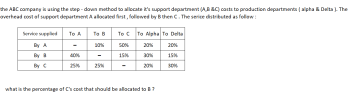 the ABC company is using the step-down method to allocate it's support department (A,B &C) costs to production departments ( alpha & Delta ). The overhead cost of support department A allocated first, followed by B then C. The serice distributed as follow : Service supplied | То А. To B To C To Alpha To Delta By A 10% 50% 20% 20% By B 40% 15% 30% 15% By C 25% 25% - 20% 30% what is the percentage...
 Samantha Galloway is a managerial accountant in the accounting department of Mustang Industries, Inc. Samantha has just discovered evidence that some of the corporation's marketing managers have been wrongfully inflating their expense reports in order to obtain higher reimbursements from the firm. According to the Institute of Management Accountants Standards of Ethical Conduct, what should Samantha do upon discovering this evidence? Multiple Choice О O Ignore the evidence because she is not part of the Marketing Department Notify the president...
 the ABC company is using the step-down method to allocate it's support department (A,B &C) costs to production departments ( alpha & Delta ). The overhead cost of support department A allocated first, followed by B then C. The serice distributed as follow : Service supplied | То А. To B To C To Alpha To Delta By A 10% 50% 20% 20% By B 40% 15% 30% 15% By C 25% 25% - 20% 30% what is the percentage...
Most questions answered within 3 hours.
-
Where is the error in this code sequence?
String s1 = "Hello";
String s2 = "ello";...
asked 10 months ago -
Financial data for Joel de Paris, Inc., for last year
follow:
Joel de Paris, Inc.
Balance...
asked 10 months ago -
Consider this reaction:
Al2(SO4)3 (aq)+ BaCl3
(aq) Al2Cl6 (aq)- +
3BaSO4(s) . What is the...
asked 10 months ago -
Suppose that Savneet is considering increasing her
recent random sample from 20 car rentals to 40...
asked 10 months ago -
Trucks arrive at an unloading terminal at an average rate of 120
per hour.
Trucks arrive...
asked 10 months ago -
Why are methanol and ethanol completely soluble in water while
octanol is not very little soluble....
asked 10 months ago -
A facilities manager at a university reads in a research report
that the mean amount of...
asked 10 months ago -
When the CuSO4 is rehydrated by adding water to the anhydrous
compound, is this an endothermic...
asked 10 months ago -
A ray of sunlight is passing from diamond into crown glass; the
angle of incidence is...
asked 10 months ago -
A block of mass 0.249 kg is placed on top of a light, vertical
spring of...
asked 10 months ago -
how do the kidneys compensate in the presences of acidosis
a) trigger hyperventilate
b) reserve acid...
asked 10 months ago -
Question 501 pts
The rental rate of capital to the firm increases. Which of the
following...
asked 10 months ago