
Homework Answers
Hi
Let me know in case you face any issue:
Add Answer to:
Problem 3. Questions 6 through 10 use the below fact pattern. Problem 3, Question 10. Company...
Problem 3. Questions 6 through 10 use the below fact pattern. Problem 3, Question 6. Company...
 Problem 3. Questions 6 through 10 use the below fact pattern. Problem 3, Question 6. Company C had the following investment. Help them determine the financial statement implications of the investment. Tax rate 21% Estimated tax payment 21,000 Investment cost and ending fair values for 20X1 and 20X2: 20X1 2 0X2 Cost 100,000 100,000 Fair value 110,000 134,000 Total gain 10,000 34,000 20X1 income statement information: Sales 1,670,200 Expenses 1,536,600 6) What is net income for 20X1 assuming the investment...
21% Problem 3. Questions 6 through 10 use the below fact pattern. Problem 3, Question 9....
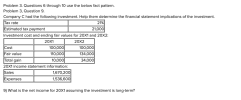 21% Problem 3. Questions 6 through 10 use the below fact pattern. Problem 3, Question 9. Company C had the following investment. Help them determine the financial statement implications of the investment. Tax rate Estimated tax payment 21,000 Investment cost and ending fair values for 20X1 and 20X2: 20X1 2 0X2 Cost 100,000 100,000 Fair value 110,000 134,000 Total gain 10,000 34,000 20X1 income statement information: Sales 1,670,200 Expenses 1,536,600 9) What is the net income for 20X1 assuming the...
Also, what is deferred taxes payable for 20X1 assuming it's short-term? Problem 3. Questions 6 through...
 Also, what is deferred taxes payable for 20X1 assuming it's
short-term?
Problem 3. Questions 6 through 10 use the below fact pattern. Problem 3, Question 7. Company C had the following investment. Help them determine the financial statement implications of the investment. Tax rate 21% Estimated tax payment 21,000 Investment cost and ending fair values for 20X1 and 20X2: 20X1 20x2 Cost 100,000 100,000 Fair value 110,000 134,000 Total gain 10,000 34,000 20X1 income statement information: Sales 1,670,200 Expenses 1,536,600...
Also, what is deferred taxes payable for 20X1 assuming it's
short-term?
Problem 3. Questions 6 through 10 use the below fact pattern. Problem 3, Question 7. Company C had the following investment. Help them determine the financial statement implications of the investment. Tax rate 21% Estimated tax payment 21,000 Investment cost and ending fair values for 20X1 and 20X2: 20X1 20x2 Cost 100,000 100,000 Fair value 110,000 134,000 Total gain 10,000 34,000 20X1 income statement information: Sales 1,670,200 Expenses 1,536,600...
3 Same fact pattern as Questions 1 and 2. Problem 1, Question 3. Company A started...
 3 Same fact pattern as Questions 1 and 2. Problem 1, Question 3. Company A started business on January 1, 20X1, and bought the following piece of equipment. Cost of asset $150,000 Salvage 30,000 Useful life Tax rate 21% 20X1 estimated tax payment 1,800 Depreciation for book and tax purposes is as follows: Book Tax 20x1 40,000 100,000 20X2 40,000 20,000 40,000 0 20X1 income statement information: Sales 638,000 Expenses (does not include depreciation expense and tax expense) 510,000 20X3...
3 Same fact pattern as Question 1. Problem 1, Question 2. Company A started business on...
 3 Same fact pattern as Question 1. Problem 1, Question 2. Company A started business on January 1, 20x1, and bought the following piece of equipment. Cost of asset $150,000 Salvage 30,000 Useful life Tax rate 21% 20X1 estimated tax payment 1,800 Depreciation for book and tax purposes is as follows: Book Tax 20X1 40,000 100,000 20x2 4 0,000 20,000 20x3 40,000 20X1 income statement information: Sales 638,000 Expenses (does not include depreciation expense and tax expense) 510,000 2) What...
Questions 4 and 5 use the below fact pattern. Problem 2, Question 5. Company B acquired...
 Questions 4 and 5 use the below fact pattern. Problem 2, Question 5. Company B acquired the following piece of equipment. Your staff accountant computed the book and tax depreciation. It is up to you to determine the deferred tax amounts. Equipment cost $50,000 Salvage 5,000 Useful life Tax rate 21% Depreciation for book and tax purposes is as follows: Book 20X1 9 ,000 20,000 20x2 9,000 12,000 20X3 9,000 7,200 20X4 9,000 4,320 20X5 9,000 1,480 Tax 5) What...
21% The next three questions use the below information. Problem 1, Question 1. Company A started...
 21% The next three questions use the below information. Problem 1, Question 1. Company A started business on January 1, 20X1, and bought the following piece of equipment. Cost of asset $150,000 Salvage 30,000 Useful life Tax rate 20X1 estimated tax payment 1,800 Depreciation for book and tax purposes is as follows: Book Tax 20x1 40,000 100,000 20x2 1 4 0,000 20,000 20x3 40,000 20x1 income statement information: Sales 638,000 Expenses (does not include depreciation expense and tax expense) 510,000...
Questions 4 and 5 use the below fact pattern. Problem 2, Question 4. Company B acquired...
 Questions 4 and 5 use the below fact pattern. Problem 2, Question 4. Company B acquired the following piece of equipment. Your staff accountant computed the book and tax depreciation. It is up to you to determine the deferred tax amounts. Equipment cost $50,000 Salvage 5,000 Useful life Tax rate 21% Depreciation for book and tax purposes is as follows: Book Tax 20X19 ,000 20,000 20x2 9 ,000 12,000 20X3 9,000 7,200 20X4 9,000 4,320 20X5 9,000 1,480 4) What...
Discontinued Operations Problem 2. On July 1, 20x1, the David Company announced its plans to sell...
 Discontinued Operations Problem 2. On July 1, 20x1, the David Company announced its plans to sell Division X (a component of the company). By December 20x1, David Company had not sold the division and so it classifies the division as held for sale. During 20x1, David recorded the following revenues and expenses for the division. Sales Cost of goods sold Operating expenses Division X $700,000 600,000 300,000 On December 31, 20x1, Division X had $900,000 in assets and $825,000 of...
9. Refer to the following fact pattern: Star Corporation had a realized foreign exchange loss of $11,000 for the...
 9. Refer to the following fact pattern: Star Corporation had a realized foreign exchange loss of $11,000 for the year (on the collection of its accounts receivable from a foreign customer). Star had a $7,000 credit resulting from the translation to dollars of the accounts of its wholly-owned foreign subsidiary for the year. Star had an account payable to an unrelated foreign supplier to be paid in the supplier's local currency. The dollar equivalent of the payable was $60,000 on...
 Problem 3. Questions 6 through 10 use the below fact pattern. Problem 3, Question 6. Company C had the following investment. Help them determine the financial statement implications of the investment. Tax rate 21% Estimated tax payment 21,000 Investment cost and ending fair values for 20X1 and 20X2: 20X1 2 0X2 Cost 100,000 100,000 Fair value 110,000 134,000 Total gain 10,000 34,000 20X1 income statement information: Sales 1,670,200 Expenses 1,536,600 6) What is net income for 20X1 assuming the investment...
 21% Problem 3. Questions 6 through 10 use the below fact pattern. Problem 3, Question 9. Company C had the following investment. Help them determine the financial statement implications of the investment. Tax rate Estimated tax payment 21,000 Investment cost and ending fair values for 20X1 and 20X2: 20X1 2 0X2 Cost 100,000 100,000 Fair value 110,000 134,000 Total gain 10,000 34,000 20X1 income statement information: Sales 1,670,200 Expenses 1,536,600 9) What is the net income for 20X1 assuming the...
 Also, what is deferred taxes payable for 20X1 assuming it's
short-term?
Problem 3. Questions 6 through 10 use the below fact pattern. Problem 3, Question 7. Company C had the following investment. Help them determine the financial statement implications of the investment. Tax rate 21% Estimated tax payment 21,000 Investment cost and ending fair values for 20X1 and 20X2: 20X1 20x2 Cost 100,000 100,000 Fair value 110,000 134,000 Total gain 10,000 34,000 20X1 income statement information: Sales 1,670,200 Expenses 1,536,600...
Also, what is deferred taxes payable for 20X1 assuming it's
short-term?
Problem 3. Questions 6 through 10 use the below fact pattern. Problem 3, Question 7. Company C had the following investment. Help them determine the financial statement implications of the investment. Tax rate 21% Estimated tax payment 21,000 Investment cost and ending fair values for 20X1 and 20X2: 20X1 20x2 Cost 100,000 100,000 Fair value 110,000 134,000 Total gain 10,000 34,000 20X1 income statement information: Sales 1,670,200 Expenses 1,536,600...
 3 Same fact pattern as Questions 1 and 2. Problem 1, Question 3. Company A started business on January 1, 20X1, and bought the following piece of equipment. Cost of asset $150,000 Salvage 30,000 Useful life Tax rate 21% 20X1 estimated tax payment 1,800 Depreciation for book and tax purposes is as follows: Book Tax 20x1 40,000 100,000 20X2 40,000 20,000 40,000 0 20X1 income statement information: Sales 638,000 Expenses (does not include depreciation expense and tax expense) 510,000 20X3...
 3 Same fact pattern as Question 1. Problem 1, Question 2. Company A started business on January 1, 20x1, and bought the following piece of equipment. Cost of asset $150,000 Salvage 30,000 Useful life Tax rate 21% 20X1 estimated tax payment 1,800 Depreciation for book and tax purposes is as follows: Book Tax 20X1 40,000 100,000 20x2 4 0,000 20,000 20x3 40,000 20X1 income statement information: Sales 638,000 Expenses (does not include depreciation expense and tax expense) 510,000 2) What...
 Questions 4 and 5 use the below fact pattern. Problem 2, Question 5. Company B acquired the following piece of equipment. Your staff accountant computed the book and tax depreciation. It is up to you to determine the deferred tax amounts. Equipment cost $50,000 Salvage 5,000 Useful life Tax rate 21% Depreciation for book and tax purposes is as follows: Book 20X1 9 ,000 20,000 20x2 9,000 12,000 20X3 9,000 7,200 20X4 9,000 4,320 20X5 9,000 1,480 Tax 5) What...
 21% The next three questions use the below information. Problem 1, Question 1. Company A started business on January 1, 20X1, and bought the following piece of equipment. Cost of asset $150,000 Salvage 30,000 Useful life Tax rate 20X1 estimated tax payment 1,800 Depreciation for book and tax purposes is as follows: Book Tax 20x1 40,000 100,000 20x2 1 4 0,000 20,000 20x3 40,000 20x1 income statement information: Sales 638,000 Expenses (does not include depreciation expense and tax expense) 510,000...
 Questions 4 and 5 use the below fact pattern. Problem 2, Question 4. Company B acquired the following piece of equipment. Your staff accountant computed the book and tax depreciation. It is up to you to determine the deferred tax amounts. Equipment cost $50,000 Salvage 5,000 Useful life Tax rate 21% Depreciation for book and tax purposes is as follows: Book Tax 20X19 ,000 20,000 20x2 9 ,000 12,000 20X3 9,000 7,200 20X4 9,000 4,320 20X5 9,000 1,480 4) What...
 Discontinued Operations Problem 2. On July 1, 20x1, the David Company announced its plans to sell Division X (a component of the company). By December 20x1, David Company had not sold the division and so it classifies the division as held for sale. During 20x1, David recorded the following revenues and expenses for the division. Sales Cost of goods sold Operating expenses Division X $700,000 600,000 300,000 On December 31, 20x1, Division X had $900,000 in assets and $825,000 of...
 9. Refer to the following fact pattern: Star Corporation had a realized foreign exchange loss of $11,000 for the year (on the collection of its accounts receivable from a foreign customer). Star had a $7,000 credit resulting from the translation to dollars of the accounts of its wholly-owned foreign subsidiary for the year. Star had an account payable to an unrelated foreign supplier to be paid in the supplier's local currency. The dollar equivalent of the payable was $60,000 on...
Most questions answered within 3 hours.
-
Where is the error in this code sequence?
String s1 = "Hello";
String s2 = "ello";...
asked 10 months ago -
Financial data for Joel de Paris, Inc., for last year
follow:
Joel de Paris, Inc.
Balance...
asked 10 months ago -
Consider this reaction:
Al2(SO4)3 (aq)+ BaCl3
(aq) Al2Cl6 (aq)- +
3BaSO4(s) . What is the...
asked 10 months ago -
Suppose that Savneet is considering increasing her
recent random sample from 20 car rentals to 40...
asked 10 months ago -
Trucks arrive at an unloading terminal at an average rate of 120
per hour.
Trucks arrive...
asked 10 months ago -
Why are methanol and ethanol completely soluble in water while
octanol is not very little soluble....
asked 10 months ago -
A facilities manager at a university reads in a research report
that the mean amount of...
asked 10 months ago -
When the CuSO4 is rehydrated by adding water to the anhydrous
compound, is this an endothermic...
asked 10 months ago -
A ray of sunlight is passing from diamond into crown glass; the
angle of incidence is...
asked 10 months ago -
A block of mass 0.249 kg is placed on top of a light, vertical
spring of...
asked 10 months ago -
how do the kidneys compensate in the presences of acidosis
a) trigger hyperventilate
b) reserve acid...
asked 10 months ago -
Question 501 pts
The rental rate of capital to the firm increases. Which of the
following...
asked 10 months ago