Question text If an increase in the proportion of GDP spent on health care from 4%...
Question text
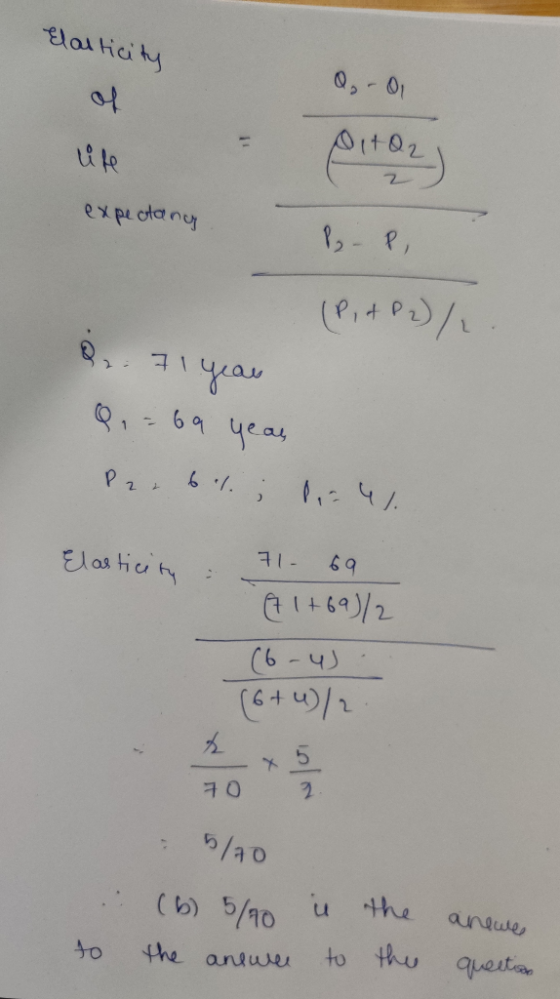
If an increase in the proportion of GDP spent on health care from 4% to 6% causes life expectancy to rise from 69 to 71 years, then the elasticity of life expectancy to health expenditures is:
Select one:
12/70
5/70
-2/70
2/70
Homework Answers
Add Answer to:
Question text
If an increase in the
proportion of GDP spent on health care from 4%...
14. According to the US Department of Health, the average life expectancy from birth for males...
 14. According to the US Department of Health, the average life expectancy from birth for males in the United States may be modeled by the function(x) = 27x + 48.3, where x is the number of years since 1900. Using the model estimate the average life expectancy of a male who was born in 1985. (a) 85 (b) 71 (c) 70 (d) 75 What value of k would make the table a function? a) 5 (b) 1 (c) 3 (d)-2
10 pts Question 5 If an increase in price from $5 to $6 causes quantity to...
 10 pts Question 5 If an increase in price from $5 to $6 causes quantity to fall from 500 to 480, calculate the price elasticity of demand. Note that economists express the price elasticity of demand as a positive number. 7.5 pts Question 6 MacBook Air
080302 Monetary neutrality implies that an increase in the quantity of money will increase employment increase...
 080302 Monetary neutrality implies that an increase in the quantity of money will increase employment increase the price level increase the incentive to save. not increase any of the above. QUESTION 5 080304 The classical dichotomy argues that changes in the money supply affect both nominal and real variables. affect neither nominal nor real variables. affect nominal variables, but not real variables. do not affect nominal variables, but do affect real variables. QUESTION 6 080305 According to the principle of...
1. What are cost-effective rations? A cost-effective model? 2. How do health care leaders/managers measure effectiveness?...
 1. What are cost-effective rations? A cost-effective model? 2. How do health care leaders/managers measure effectiveness? 3. What are quality-adjusted life years? 4. How are costs measured? 5. What are biased estimates? 6. What is a cost-benefit analysis? 7. In the Cost-Effectiveness of Health Insurance case study, what is the relationship between expenditures and age from both the insured and uninsured groups? 8. What is the relationship between quality of life, mortality and age from both the insured and uninsured...
5) In the U.S. a majority of people have health insurance. How does the increasing prices of health care from parts (2) and (3) affect the cost for health insurance companies? a. In the gra...
 5) In the U.S. a majority of people have health insurance. How does the increasing prices of health care from parts (2) and (3) affect the cost for health insurance companies? a. In the graph below, show the appropriate curve shifting, b. Explain which determinant causes the shift c. State the changes in the equilibrium price and equilibrium quantity Hint: We are now looking at the health insurance market, not the health care market Market for Health Insurance Policies (2)...
It is easy to construct a case that the US spends way too much money on health care. The US spend...
It is easy to construct a case that the US spends way too much money on health care. The US spends twice as much as the average OECD country, 90% more than the Canada and 150% more than the UK, yet the US has one of the lowest life expectancy rates and one of the highest infant mortality rates in the developed world. Some have suggested these numbers indicate that at the margin, additional health care dollars generate little in...
Opening Case Quality Health Care in the U. S. In his inauguration address, U. S. President...
Opening Case Quality Health Care in the U. S. In his inauguration address, U. S. President Barack Obama mentioned the poor state of the U. S. health care system as a fundamental issue facing the nation and his administration. The sobering truth of America's health care system is that it dramatically under-performs. In an August 2008 poll by the Commonwealth Fund, 8 of 10 adults agreed with the statement that the health care system "needs either fundamental change or complete...
decrease in personal taxes from $100 billion to 580 billion will increase real GDP 11. If...
 decrease in personal taxes from $100 billion to 580 billion will increase real GDP 11. If the MPC -0.75, a decrease in person by A) $20 billion. B) $40 billion. C) $60 billion. D) $80 billion. Table 10.1 Consumption C - $1.0+ 0.80YD Investment $1.5 Government purchases $2.2 Net exports Taxes Government transfer payments $0 (all values are in billions of dollars) 2, 12. Refer to Table 10.1. Equilibrium real GDP for this economy is equal to A) $5.75 billion....
9. Refer to the below table. For the open economy, the equilibrium GDP is domestic output...
9. Refer to the below table. For the open economy, the equilibrium GDP is domestic output AE, closed economy exports imports 200 230 30 20 250 270 30 20 300 310 30 20 350 350 30 20 400 390 30 20 450 430 30 20 500 470 30 20 A) $300 B) $350 C) $400 D) $450 10. If net exports decline from zero to some negative amount, the aggregate expenditures schedule would A) shift upward B) shift downward C)...
1. Consider the case where real GDP and population are both growing, and real GDP is growing...
1. Consider the case where real GDP and population are both growing, and real GDP is growing faster than population. Which statement below is TRUE? A Real GDP per capita would increase and faster than real GDP. B Real GDP per capita would increase but slower than real GDP. C Real GDP per capita would remain the same. D Real GDP per capita would fall. Questions 2 and 3. Both Cowen and Tabarrok (Figure 7.1) and the Hans Rosling video illustrate the robust empirical truth that the...
 14. According to the US Department of Health, the average life expectancy from birth for males in the United States may be modeled by the function(x) = 27x + 48.3, where x is the number of years since 1900. Using the model estimate the average life expectancy of a male who was born in 1985. (a) 85 (b) 71 (c) 70 (d) 75 What value of k would make the table a function? a) 5 (b) 1 (c) 3 (d)-2
 10 pts Question 5 If an increase in price from $5 to $6 causes quantity to fall from 500 to 480, calculate the price elasticity of demand. Note that economists express the price elasticity of demand as a positive number. 7.5 pts Question 6 MacBook Air
 080302 Monetary neutrality implies that an increase in the quantity of money will increase employment increase the price level increase the incentive to save. not increase any of the above. QUESTION 5 080304 The classical dichotomy argues that changes in the money supply affect both nominal and real variables. affect neither nominal nor real variables. affect nominal variables, but not real variables. do not affect nominal variables, but do affect real variables. QUESTION 6 080305 According to the principle of...
 1. What are cost-effective rations? A cost-effective model? 2. How do health care leaders/managers measure effectiveness? 3. What are quality-adjusted life years? 4. How are costs measured? 5. What are biased estimates? 6. What is a cost-benefit analysis? 7. In the Cost-Effectiveness of Health Insurance case study, what is the relationship between expenditures and age from both the insured and uninsured groups? 8. What is the relationship between quality of life, mortality and age from both the insured and uninsured...
 5) In the U.S. a majority of people have health insurance. How does the increasing prices of health care from parts (2) and (3) affect the cost for health insurance companies? a. In the graph below, show the appropriate curve shifting, b. Explain which determinant causes the shift c. State the changes in the equilibrium price and equilibrium quantity Hint: We are now looking at the health insurance market, not the health care market Market for Health Insurance Policies (2)...
 decrease in personal taxes from $100 billion to 580 billion will increase real GDP 11. If the MPC -0.75, a decrease in person by A) $20 billion. B) $40 billion. C) $60 billion. D) $80 billion. Table 10.1 Consumption C - $1.0+ 0.80YD Investment $1.5 Government purchases $2.2 Net exports Taxes Government transfer payments $0 (all values are in billions of dollars) 2, 12. Refer to Table 10.1. Equilibrium real GDP for this economy is equal to A) $5.75 billion....
Most questions answered within 3 hours.
-
Where is the error in this code sequence?
String s1 = "Hello";
String s2 = "ello";...
asked 10 months ago -
Financial data for Joel de Paris, Inc., for last year
follow:
Joel de Paris, Inc.
Balance...
asked 10 months ago -
Consider this reaction:
Al2(SO4)3 (aq)+ BaCl3
(aq) Al2Cl6 (aq)- +
3BaSO4(s) . What is the...
asked 10 months ago -
Suppose that Savneet is considering increasing her
recent random sample from 20 car rentals to 40...
asked 10 months ago -
Trucks arrive at an unloading terminal at an average rate of 120
per hour.
Trucks arrive...
asked 10 months ago -
Why are methanol and ethanol completely soluble in water while
octanol is not very little soluble....
asked 10 months ago -
A facilities manager at a university reads in a research report
that the mean amount of...
asked 10 months ago -
When the CuSO4 is rehydrated by adding water to the anhydrous
compound, is this an endothermic...
asked 10 months ago -
A ray of sunlight is passing from diamond into crown glass; the
angle of incidence is...
asked 10 months ago -
A block of mass 0.249 kg is placed on top of a light, vertical
spring of...
asked 10 months ago -
how do the kidneys compensate in the presences of acidosis
a) trigger hyperventilate
b) reserve acid...
asked 10 months ago -
Question 501 pts
The rental rate of capital to the firm increases. Which of the
following...
asked 10 months ago