
Homework Answers
a Matching
b Historical cost
c Full disclosure
d Going concern
e Control
f Economic entity
g Periodicity
h Full value and value in use
i Revenue recognition and realization
j Monetary
Add Answer to:
-20Accounting,%20Volume%201.12th%20Canadian%20Edition%20.pdf E2.6 (LO 4) videa (Foundational Principles) The foundational principles and assumptions of accounting are as...
Exercise 2-06 For each situation that follows, identify the foundational principle that best describes it. (a)...
 Exercise 2-06 For each situation that follows, identify the foundational principle that best describes it. (a) Allocates expenses to revenues in the proper period. (b) Indicates that market value changes after the purchase are not recorded in the accounts unless impairment exists. (Do not use the revenue recognition principle.) (c) Ensures that all relevant financial information is reported. (d) Is why plant assets are not reported at their liquidation value. (Do not use the historical cost principle.) Full disclosure Revenue...
Instructions Identify by number the accounting assumption, principle, or constraint that describes each situation below. Do...
 Instructions Identify by number the accounting assumption, principle, or constraint that describes each situation below. Do not use a number more than once. a. Allocates expenses to revenues in the proper period. b. Indicates that fair value changes subsequent to purchase are not recorded in the accounts. (Do not use revenue recognition principle.) c. Ensures that all relevant financial information is reported. d. Rationale why plant assets are not reported at liquidation value. (Do not use historical cost principle.) e....
E2-12 Presented below are the assumptions and principles discussed in this chapter Identify accounting assumptions and...
 E2-12 Presented below are the assumptions and principles discussed in this chapter Identify accounting assumptions and principles (LO 3), K 1. Full disclosure principle 2. Going concern assumption 3. Monetary unit assumption 4. Periodicity assumption 5. Historical cost principle 6. Economic entity assumption Instructions Identify by number the accounting assumption or principle that is described below. Do not use a number more than once. (a) Is the rationale for why plant assets are not reported at liquidation value. (Note: Do...
Which of these ten accounting assumptions, principles, or constraints has the greatest effect on a company's...
Which of these ten accounting assumptions, principles, or constraints has the greatest effect on a company's financial statements: Conservatism Economic Entity Expense recognition Revenue recognition Periodicity Monetary unit Materiality Measurement Going concern Full disclosure Please explain why.
ki , survey of Accounting, le Help System Announcements Historical cost principle Materiality Monetary unit assumption...
 ki , survey of Accounting, le Help System Announcements Historical cost principle Materiality Monetary unit assumption Exercise 4-2 Identify the accounting concept that describes each situation below. Do not use any concept more than once. Periodicity assumption (a) is the rationale for why plant assets are not reported at liquidation value. (Do not use the historical cost principle.) Revenue recognition principle (b) indicates that personal and business recordkeeping should be separately maintained. Full disclosure principle (c) Ensures that all relevant...
Exercise 1 These are the assumptions, principles, and constraints discussed in this and pre- vious chapters....
 Exercise 1 These are the assumptions, principles, and constraints discussed in this and pre- vious chapters. 1. Economic entity assumption. 2. Matching principle. 3. Monetary unit assumption. 4. Time period assumption. 5. Cost principle. 6. Materiality 7. Full disclosure principle. 8. Going concern assumption. 9. Revenue recognition principle. 10. Conservatism. Instructions Identify by number the accounting assumption, principle, or constraint that describes each situation below. Do not use a number more than once. (a) is the rationale for why plant...
P4. Listed below are several information characteristics and accounting principles and assumptions. Match the letter of...
 P4. Listed below are several information characteristics and accounting principles and assumptions. Match the letter of each with the best phrase that states its application. (Items a through k may be used more than once or not at all.) a. Economic entity assumption g. Expense recognition principle b. Going concern assumption h. Full disclosure principle c. Monetary unit assumption i. Relevance characteristic d. Periodicity assumption j. Faithful representation characteristic e. Historical cost principle k. Consistency characteristic f. Revenue recognition principle...
Listed below are several information characteristics and accounting principles and assumptions. Match the letter of each...
 Listed below are several information characteristics and accounting principles and assumptions. Match the letter of each with the appropriate phrase that states its application. (items a through k may be used more than once or not at all.) a. Economic entity assumption g. Expense recognition principle b. Going concern assumption h. Full disclosure principle C. Monetary unit assumption i. Relevance characteristic d. Periodicity assumption j. Faithful representation characteristic e. Historical cost principle k. Consistency characteristic f. Revenue recognition principle 1....
Identify the accounting assumption or principle that is described below. (a) select the accounting assumption or...
 Identify the accounting assumption or principle that is
described below.
(a)
select the accounting assumption or principle
Going Concern AssumptionMonetary Unit AssumptionPeriodicity
AssumptionHistorical Cost PrincipleEconomic Entity AssumptionFull
Disclosure Principle
Is the rationale for why plant assets are not reported at
liquidation value. (Note: Do not use the historical cost
principle.)
(b)
select the accounting assumption or principle
Historical Cost PrincipleGoing Concern AssumptionEconomic Entity
AssumptionFull Disclosure PrincipleMonetary Unit
AssumptionPeriodicity Assumption
Indicates that personal and business record-keeping should be
separately maintained.
(c)...
Identify the accounting assumption or principle that is
described below.
(a)
select the accounting assumption or principle
Going Concern AssumptionMonetary Unit AssumptionPeriodicity
AssumptionHistorical Cost PrincipleEconomic Entity AssumptionFull
Disclosure Principle
Is the rationale for why plant assets are not reported at
liquidation value. (Note: Do not use the historical cost
principle.)
(b)
select the accounting assumption or principle
Historical Cost PrincipleGoing Concern AssumptionEconomic Entity
AssumptionFull Disclosure PrincipleMonetary Unit
AssumptionPeriodicity Assumption
Indicates that personal and business record-keeping should be
separately maintained.
(c)...
The SEC's 2003 report to the Congress on "principles-based" accounting observed that the first characteristic of...
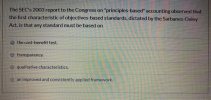 The SEC's 2003 report to the Congress on "principles-based" accounting observed that the first characteristic of objectives-based standards, dictated by the Sarbanes-Oxley Act, is that any standard must be based on the cost-benefit test. e transparency qualitative characteristics. an improved and consistently applied framework. Question 2 The Purchases account is O a temporary account. O a permanent account. O a subsidiary account. a liability account. Question 3 The Sales account is classified as a contra account. O a liability account...
 Exercise 2-06 For each situation that follows, identify the foundational principle that best describes it. (a) Allocates expenses to revenues in the proper period. (b) Indicates that market value changes after the purchase are not recorded in the accounts unless impairment exists. (Do not use the revenue recognition principle.) (c) Ensures that all relevant financial information is reported. (d) Is why plant assets are not reported at their liquidation value. (Do not use the historical cost principle.) Full disclosure Revenue...
 Instructions Identify by number the accounting assumption, principle, or constraint that describes each situation below. Do not use a number more than once. a. Allocates expenses to revenues in the proper period. b. Indicates that fair value changes subsequent to purchase are not recorded in the accounts. (Do not use revenue recognition principle.) c. Ensures that all relevant financial information is reported. d. Rationale why plant assets are not reported at liquidation value. (Do not use historical cost principle.) e....
 E2-12 Presented below are the assumptions and principles discussed in this chapter Identify accounting assumptions and principles (LO 3), K 1. Full disclosure principle 2. Going concern assumption 3. Monetary unit assumption 4. Periodicity assumption 5. Historical cost principle 6. Economic entity assumption Instructions Identify by number the accounting assumption or principle that is described below. Do not use a number more than once. (a) Is the rationale for why plant assets are not reported at liquidation value. (Note: Do...
 ki , survey of Accounting, le Help System Announcements Historical cost principle Materiality Monetary unit assumption Exercise 4-2 Identify the accounting concept that describes each situation below. Do not use any concept more than once. Periodicity assumption (a) is the rationale for why plant assets are not reported at liquidation value. (Do not use the historical cost principle.) Revenue recognition principle (b) indicates that personal and business recordkeeping should be separately maintained. Full disclosure principle (c) Ensures that all relevant...
 Exercise 1 These are the assumptions, principles, and constraints discussed in this and pre- vious chapters. 1. Economic entity assumption. 2. Matching principle. 3. Monetary unit assumption. 4. Time period assumption. 5. Cost principle. 6. Materiality 7. Full disclosure principle. 8. Going concern assumption. 9. Revenue recognition principle. 10. Conservatism. Instructions Identify by number the accounting assumption, principle, or constraint that describes each situation below. Do not use a number more than once. (a) is the rationale for why plant...
 P4. Listed below are several information characteristics and accounting principles and assumptions. Match the letter of each with the best phrase that states its application. (Items a through k may be used more than once or not at all.) a. Economic entity assumption g. Expense recognition principle b. Going concern assumption h. Full disclosure principle c. Monetary unit assumption i. Relevance characteristic d. Periodicity assumption j. Faithful representation characteristic e. Historical cost principle k. Consistency characteristic f. Revenue recognition principle...
 Listed below are several information characteristics and accounting principles and assumptions. Match the letter of each with the appropriate phrase that states its application. (items a through k may be used more than once or not at all.) a. Economic entity assumption g. Expense recognition principle b. Going concern assumption h. Full disclosure principle C. Monetary unit assumption i. Relevance characteristic d. Periodicity assumption j. Faithful representation characteristic e. Historical cost principle k. Consistency characteristic f. Revenue recognition principle 1....
 Identify the accounting assumption or principle that is
described below.
(a)
select the accounting assumption or principle
Going Concern AssumptionMonetary Unit AssumptionPeriodicity
AssumptionHistorical Cost PrincipleEconomic Entity AssumptionFull
Disclosure Principle
Is the rationale for why plant assets are not reported at
liquidation value. (Note: Do not use the historical cost
principle.)
(b)
select the accounting assumption or principle
Historical Cost PrincipleGoing Concern AssumptionEconomic Entity
AssumptionFull Disclosure PrincipleMonetary Unit
AssumptionPeriodicity Assumption
Indicates that personal and business record-keeping should be
separately maintained.
(c)...
Identify the accounting assumption or principle that is
described below.
(a)
select the accounting assumption or principle
Going Concern AssumptionMonetary Unit AssumptionPeriodicity
AssumptionHistorical Cost PrincipleEconomic Entity AssumptionFull
Disclosure Principle
Is the rationale for why plant assets are not reported at
liquidation value. (Note: Do not use the historical cost
principle.)
(b)
select the accounting assumption or principle
Historical Cost PrincipleGoing Concern AssumptionEconomic Entity
AssumptionFull Disclosure PrincipleMonetary Unit
AssumptionPeriodicity Assumption
Indicates that personal and business record-keeping should be
separately maintained.
(c)...
 The SEC's 2003 report to the Congress on "principles-based" accounting observed that the first characteristic of objectives-based standards, dictated by the Sarbanes-Oxley Act, is that any standard must be based on the cost-benefit test. e transparency qualitative characteristics. an improved and consistently applied framework. Question 2 The Purchases account is O a temporary account. O a permanent account. O a subsidiary account. a liability account. Question 3 The Sales account is classified as a contra account. O a liability account...
Most questions answered within 3 hours.
-
Where is the error in this code sequence?
String s1 = "Hello";
String s2 = "ello";...
asked 10 months ago -
Financial data for Joel de Paris, Inc., for last year
follow:
Joel de Paris, Inc.
Balance...
asked 10 months ago -
Consider this reaction:
Al2(SO4)3 (aq)+ BaCl3
(aq) Al2Cl6 (aq)- +
3BaSO4(s) . What is the...
asked 10 months ago -
Suppose that Savneet is considering increasing her
recent random sample from 20 car rentals to 40...
asked 10 months ago -
Trucks arrive at an unloading terminal at an average rate of 120
per hour.
Trucks arrive...
asked 10 months ago -
Why are methanol and ethanol completely soluble in water while
octanol is not very little soluble....
asked 10 months ago -
A facilities manager at a university reads in a research report
that the mean amount of...
asked 10 months ago -
When the CuSO4 is rehydrated by adding water to the anhydrous
compound, is this an endothermic...
asked 10 months ago -
A ray of sunlight is passing from diamond into crown glass; the
angle of incidence is...
asked 10 months ago -
A block of mass 0.249 kg is placed on top of a light, vertical
spring of...
asked 10 months ago -
how do the kidneys compensate in the presences of acidosis
a) trigger hyperventilate
b) reserve acid...
asked 10 months ago -
Question 501 pts
The rental rate of capital to the firm increases. Which of the
following...
asked 10 months ago