Consider an options trader who sets up a condor trading strategy on Boston Scientific Corp. stock....
| Consider an options trader who sets up a condor trading strategy on Boston Scientific Corp. stock. The option trader buys a call option with a strike price of $25, sells a call option with a strike price of $30, sells a call option with a strike price of $40, and buys a call option with a strike price of $45. | ||||||
| Complete the table below with the correct formulas to show the profit/loss for different values of the stock price at the expiration of the options. |
| Call option | 1 | 2 | 3 | 4 | |
| Strike price | $25 | $30 | $40 | $45 | |
| Option price | $14.05 | $9.70 | $3.15 | $1.38 | |
| Call option | |||||
| Stock price | 1 | 2 | 3 | 4 | Profit/Loss |
| $0 | -$14.05 | $9.70 | $3.15 | -$1.38 | -$2.58 |
| $1 | $0.00 | ||||
| $2 | $0.00 | ||||
| $3 | $0.00 | ||||
| $4 | $0.00 | ||||
| $5 | $0.00 | ||||
| ^^THROUGH^^ | |||||
| $50 | $0.00 |
Homework Answers
| Strike | |||||
| Price | 25 | 30 | 40 | 45 | P/L |
| 0 | -14.05 | 9.7 | 3.15 | -1.38 | -2.58 |
| 1 | -14.05 | 9.7 | 3.15 | -1.38 | -2.58 |
| 2 | -14.05 | 9.7 | 3.15 | -1.38 | -2.58 |
| 3 | -14.05 | 9.7 | 3.15 | -1.38 | -2.58 |
| 4 | -14.05 | 9.7 | 3.15 | -1.38 | -2.58 |
| 5 | -14.05 | 9.7 | 3.15 | -1.38 | -2.58 |
| 6 | -14.05 | 9.7 | 3.15 | -1.38 | -2.58 |
| 7 | -14.05 | 9.7 | 3.15 | -1.38 | -2.58 |
| 8 | -14.05 | 9.7 | 3.15 | -1.38 | -2.58 |
| 9 | -14.05 | 9.7 | 3.15 | -1.38 | -2.58 |
| 10 | -14.05 | 9.7 | 3.15 | -1.38 | -2.58 |
| 11 | -14.05 | 9.7 | 3.15 | -1.38 | -2.58 |
| 12 | -14.05 | 9.7 | 3.15 | -1.38 | -2.58 |
| 13 | -14.05 | 9.7 | 3.15 | -1.38 | -2.58 |
| 14 | -14.05 | 9.7 | 3.15 | -1.38 | -2.58 |
| 15 | -14.05 | 9.7 | 3.15 | -1.38 | -2.58 |
| 16 | -14.05 | 9.7 | 3.15 | -1.38 | -2.58 |
| 17 | -14.05 | 9.7 | 3.15 | -1.38 | -2.58 |
| 18 | -14.05 | 9.7 | 3.15 | -1.38 | -2.58 |
| 19 | -14.05 | 9.7 | 3.15 | -1.38 | -2.58 |
| 20 | -14.05 | 9.7 | 3.15 | -1.38 | -2.58 |
| 21 | -14.05 | 9.7 | 3.15 | -1.38 | -2.58 |
| 22 | -14.05 | 9.7 | 3.15 | -1.38 | -2.58 |
| 23 | -14.05 | 9.7 | 3.15 | -1.38 | -2.58 |
| 24 | -14.05 | 9.7 | 3.15 | -1.38 | -2.58 |
| 25 | -14.05 | 9.7 | 3.15 | -1.38 | -2.58 |
| 26 | -13.05 | 9.7 | 3.15 | -1.38 | -1.58 |
| 27 | -12.05 | 9.7 | 3.15 | -1.38 | -0.58 |
| 28 | -11.05 | 9.7 | 3.15 | -1.38 | 0.42 |
| 29 | -10.05 | 9.7 | 3.15 | -1.38 | 1.42 |
| 30 | -9.05 | 9.7 | 3.15 | -1.38 | 2.42 |
| 31 | -8.05 | 8.7 | 3.15 | -1.38 | 2.42 |
| 32 | -7.05 | 7.7 | 3.15 | -1.38 | 2.42 |
| 33 | -6.05 | 6.7 | 3.15 | -1.38 | 2.42 |
| 34 | -5.05 | 5.7 | 3.15 | -1.38 | 2.42 |
| 35 | -4.05 | 4.7 | 3.15 | -1.38 | 2.42 |
| 36 | -3.05 | 3.7 | 3.15 | -1.38 | 2.42 |
| 37 | -2.05 | 2.7 | 3.15 | -1.38 | 2.42 |
| 38 | -1.05 | 1.7 | 3.15 | -1.38 | 2.42 |
| 39 | -0.05 | 0.7 | 3.15 | -1.38 | 2.42 |
| 40 | 0.95 | -0.3 | 3.15 | -1.38 | 2.42 |
| 41 | 1.95 | -1.3 | 2.15 | -1.38 | 1.42 |
| 42 | 2.95 | -2.3 | 1.15 | -1.38 | 0.42 |
| 43 | 3.95 | -3.3 | 0.15 | -1.38 | -0.58 |
| 44 | 4.95 | -4.3 | -0.85 | -1.38 | -1.58 |
| 45 | 5.95 | -5.3 | -1.85 | -1.38 | -2.58 |
| 46 | 6.95 | -6.3 | -2.85 | -0.38 | -2.58 |
| 47 | 7.95 | -7.3 | -3.85 | 0.62 | -2.58 |
| 48 | 8.95 | -8.3 | -4.85 | 1.62 | -2.58 |
| 49 | 9.95 | -9.3 | -5.85 | 2.62 | -2.58 |
| 50 | 10.95 | -10.3 | -6.85 | 3.62 | -2.58 |
Formula of above is given below
| Strike | |||||
| Price | 25 | 30 | 40 | 45 | P/L |
| 0 | MAX(($A3-B$2),0)-14.05 | .- (MAX(($A3-C$2),0)-9.7) | .-(MAX(($A3-D$2),0)-3.15) | MAX(($A3-E$2),0)-1.38 | SUM(B3:E3) |
Add Answer to:
Consider an options trader who sets up a condor
trading strategy on Boston Scientific Corp. stock....
A trader buys 2 call options on a stock with a strike price of $35 and...
A trader buys 2 call options on a stock with a strike price of $35 and a put option on the same stock with a strike price of $30. Both call and put options have the same maturity. The call costs $2 and the put costs $1. What are the stock prices the trader will break-even at? $27.5 and $35 $25 and $40 $25 and $37.5 $30 and $35
4. A trader buys a European call option and sells a European put option. The options...
 4. A trader buys a European call option and sells a European put option. The options have the same underlying asset, strike price and maturity. Show that the trader's position is equivalent to a forward contract with delivery price that is equal to the strike price of the options.
A trader conducts a trading strategy by selling a call option with a strike price of...
A trader conducts a trading strategy by selling a call option with a strike price of $50 for $3 and selling a put option with a strike price of $40 for $4. Please draw a profit diagram of this strategy and identify the maximum gain, maximum loss, and break-even point. Hint: Write down a profit analysis matrix to help you draw the payoff lines.
A trader buys a European call option and sells (short) a European put option. The options...
A trader buys a European call option and sells (short) a European put option. The options have the same underlying asset, strike price, and maturity. Describe the trader’s position. The trader monitors the market continuously and finds at one point that the call is significantly overpriced relative to fair value. What strategy is available for the trader to lock in a profit at current prices?
8. The price of a stock on February 1 is $48. A trader sells 200 put...
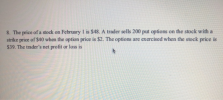 8. The price of a stock on February 1 is $48. A trader sells 200 put options on the stock with a strike price of $40 when the option price is $2. The options are exercised when the stock price is $39. The trader's net profit or loss is
A trader buys 100 European call options (i.e., he buys one option contract) with a strike...
A trader buys 100 European call options (i.e., he buys one option contract) with a strike price of $20 and a time to maturity of one year. The cost of each option is $4. The price of the underlying asset proves to be $25 in one year. What is the trader’s profit?(with the solution process)
4. A trader buys a call option and sells a put option. The options have the...
 4. A trader buys a call option and sells a put option. The options have the same underlying asset, strike price, and maturity. Describe the trader's position. What is the advantage to making such a trade?
1. A trader shorts 10,000 shares of non-dividend-paying stock XYZ and plans to purchase them in...
 1. A trader shorts 10,000 shares of non-dividend-paying stock XYZ and plans to purchase them in one month. The trader wants to purchase some call options to hedge the risk of the increasing in the stock price. The spot price of stock XYZ is HKS2.55 per share. A 1-month call option on stock XYZ with a strike price of HKS2.75 costs HK$0.025. Each option contract consists of 100 options. (a) Suppose that the stock price increases to HK$2.7 after one...
Determine the profit or loss to call buyer and call writer for the following call options...
Determine the profit or loss to call buyer and call writer for the following call options when the stock is selling at $32 just prior to expiration of the options and the option premium is $2.50. a. $25 strike price b. $30 strike price c. $35 strike price
The price of a stock is $67. A trader sells 5 put option contracts on the stock with a strike price of $70 when the opti...
The price of a stock is $67. A trader sells 5 put option contracts on the stock with a strike price of $70 when the option price is $4. The options are exercised when the stock price is $69. What is the trader’s net profit or loss? Please show work! I know the answer is “gain of $1,500”
 4. A trader buys a European call option and sells a European put option. The options have the same underlying asset, strike price and maturity. Show that the trader's position is equivalent to a forward contract with delivery price that is equal to the strike price of the options.
 8. The price of a stock on February 1 is $48. A trader sells 200 put options on the stock with a strike price of $40 when the option price is $2. The options are exercised when the stock price is $39. The trader's net profit or loss is
 4. A trader buys a call option and sells a put option. The options have the same underlying asset, strike price, and maturity. Describe the trader's position. What is the advantage to making such a trade?
 1. A trader shorts 10,000 shares of non-dividend-paying stock XYZ and plans to purchase them in one month. The trader wants to purchase some call options to hedge the risk of the increasing in the stock price. The spot price of stock XYZ is HKS2.55 per share. A 1-month call option on stock XYZ with a strike price of HKS2.75 costs HK$0.025. Each option contract consists of 100 options. (a) Suppose that the stock price increases to HK$2.7 after one...
Most questions answered within 3 hours.
-
Where is the error in this code sequence?
String s1 = "Hello";
String s2 = "ello";...
asked 10 months ago -
Financial data for Joel de Paris, Inc., for last year
follow:
Joel de Paris, Inc.
Balance...
asked 10 months ago -
Consider this reaction:
Al2(SO4)3 (aq)+ BaCl3
(aq) Al2Cl6 (aq)- +
3BaSO4(s) . What is the...
asked 10 months ago -
Suppose that Savneet is considering increasing her
recent random sample from 20 car rentals to 40...
asked 10 months ago -
Trucks arrive at an unloading terminal at an average rate of 120
per hour.
Trucks arrive...
asked 10 months ago -
Why are methanol and ethanol completely soluble in water while
octanol is not very little soluble....
asked 10 months ago -
A facilities manager at a university reads in a research report
that the mean amount of...
asked 10 months ago -
When the CuSO4 is rehydrated by adding water to the anhydrous
compound, is this an endothermic...
asked 10 months ago -
A ray of sunlight is passing from diamond into crown glass; the
angle of incidence is...
asked 10 months ago -
A block of mass 0.249 kg is placed on top of a light, vertical
spring of...
asked 10 months ago -
how do the kidneys compensate in the presences of acidosis
a) trigger hyperventilate
b) reserve acid...
asked 10 months ago -
Question 501 pts
The rental rate of capital to the firm increases. Which of the
following...
asked 10 months ago