Let Jennifer's utility function be U(C,L) = log(C)+4log(L). Let T denote time available to split between...
Let Jennifer's utility function be U(C,L) = log(C)+4log(L). Let T denote time available to split between leisure and work, w denote the wage rate and V ≥ 0 denote non-labor income (as in class). Derive her optimal choice as a function of w, T , and V . Calculate the ?rst derivative of her optimal leisure choice with respect to w. Does the substitution e?ect dominate the income e?ect? (Hint: hours worked = T − L so the change in hours has the opposite sign as the derivative you calculate.) Is this also true if V = 0?
Homework Answers
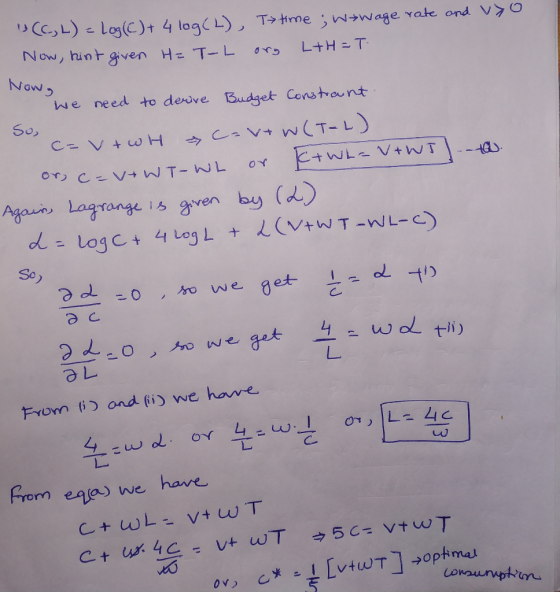
![دہی - =444 et Crows] = WowT). optimal Leisure Choice Now, derivative of Lt. So, this means as the mage Increase, then amount](http://img.homeworklib.com/questions/21fbd2a0-7967-11ea-9884-a5269446a49e.png?x-oss-process=image/resize,w_560)
Add Answer to:
Let Jennifer's utility function be U(C,L) = log(C)+4log(L). Let
T denote time available to split between...
Let Tom's utility function be U(C, L) =C2+X×L2. Suppose he has 100 hours to split between...
Let Tom's utility function be U(C, L) =C2+X×L2. Suppose he has 100 hours to split between work and leisure and he has no non-labor income. Derive Tom's optimal choice of consumption and leisure as a function of the wage and X. What is Tom's reservation wage?(Hint:Graphing an indierence curve before solving the problem might be useful.) *This is the correct utility function, copied directly from the homework.
Suppose a consumer values income (m) and leisure (l) with utility function U(m,l)=ml. The consumer has T hours per week...
Suppose a consumer values income (m) and leisure (l) with utility function U(m,l)=ml. The consumer has T hours per week to allocate between labor and leisure with an hourly wage rate of w. The consumer's weekly time constraint is (m/w)+l=T. Use a Lagrangian to maximize the consumer's utility subject to the weekly time constraint. What is the optimal amount of leisure? what is the optimal amount of labor (L=T-l)
1. CRRA Utility Function: Constant relative risk aversion, or CRRA, utility function has been extensively used...
 1. CRRA Utility Function: Constant relative risk aversion, or CRRA, utility function has been extensively used in macroeconomic analysis to represent consumer behavior. It takes the following general form u(x)- where σ is known as the curvature parameter. For the remainder of this question assume that σ>0. Assume that a representative household in a one-period model has the following preferences over consumption and leisure where l is leisure. The budget constraint is (in nominal terms) Pc nominal wage and n...
Problem 5 Assume that a worker has the Utility Function U(C,L) C "C" refers to consumption in dollars and &...
 Problem 5 Assume that a worker has the Utility Function U(C,L) C "C" refers to consumption in dollars and "L" to hours of leisure in a day. The worker has an offered wage of $10 per hour, 20 hours available for leisure or work per day, and $30 dollars a day from non- labour income. o 8.60 L (a) Find the budget constraint equation of the individual. (b) Find the optimal choice for the individual in terms of units of...
John’s utility function is represented by the following: U(C,L) = (C-400)*(L-100), where C is expenditure on consumption...
John’s utility function is represented by the following: U(C,L) = (C-400)*(L-100), where C is expenditure on consumption goods and L is hours of leisure time. Suppose that John receives $150 per week in investment income regardless of how much he works. He earns a wage of $20 per hour. Assume that John has 110 non-sleeping hours a week that could be devoted to work. a. Graph John’s budget constraint. b. Find John’s optimal amount of consumption and leisure. c. John...
4. Let a person's utility function over consumption, X, and leisure, L, be given by U...
 4. Let a person's utility function over consumption, X, and leisure, L, be given by U = XL2, SO MUx = L2 and MUL = 2xL.The individual may work up to 24 hours per day at wage rate, w = $10 per hour, and he has non-labor income of $50 per day. The price of x, px, is $5. (a) Find the utility-maximizing x and L. (b) Show that at the utility- maximizing quantities of x and L, the consumer's...
3. Jade is deciding how much to work in 2020. She derives utility from consumption,C, but...
3. Jade is deciding how much to work in 2020. She derives utility from consumption,C, but she also really likes taking leisure time L. She must divide her available hours between work and leisure. For every hour of leisure she takes, she must work one fewer hours (meaning that the price of leisure is her hourly wage). The function that describes her preferences is given by The marginal utilities are U(C, L) = C(1/2)L(1/2) MUC = 1C(−1/2)L(1/2)2 MUL = 1C(1/2)L(−1/2)2...
Suppose Tom has a utility function U=C*L C= consumption L= hours of leisure Tom has 100...
Suppose Tom has a utility function U=C*L C= consumption L= hours of leisure Tom has 100 hours to divide between work and leisure per week wage is $20/hr 1. Write down budget constraint in terms of consumption and hours of work 2.Tom make decisions on hours of work, leisure and consumption to max. utility. Explain why we can collapse this problem to one in which he chooses hours of leisure only 3. Find optimal hours of work and total consumption...
A worker's preferences over consumption (c) and leisure (l) can be represented by U(cl) = cl....
 A worker's preferences over consumption (c) and leisure (l) can be represented by U(cl) = cl. The price of consumption is given by p = 1 and the wage by w=1 (a) Suppose we measure leisure in hours per day such that the maximum value I can take is 24. Let's represent hours worked by h; then we have h = 24-1. Write the Budget Constraint of this worker in terms of c and l. (b) Explain briefly why w/p...
7. ) Shelly's preferences for consumption and leisure can be expressed as U(C, L) (C-100) x...
 7. ) Shelly's preferences for consumption and leisure can be expressed as U(C, L) (C-100) x (L-40). This utility function implies that Shelly's marginal utility of leisure is C- 100 and her marginal utility of consumption is L - 40. There are 110 (non-sleeping) hours in the week available to split between work and leisure. Shelly earns S10 per hour after taxes. She also receives $320 worth of welfare benefits each week regardless of how much she works a) Graph...
 1. CRRA Utility Function: Constant relative risk aversion, or CRRA, utility function has been extensively used in macroeconomic analysis to represent consumer behavior. It takes the following general form u(x)- where σ is known as the curvature parameter. For the remainder of this question assume that σ>0. Assume that a representative household in a one-period model has the following preferences over consumption and leisure where l is leisure. The budget constraint is (in nominal terms) Pc nominal wage and n...
 Problem 5 Assume that a worker has the Utility Function U(C,L) C "C" refers to consumption in dollars and "L" to hours of leisure in a day. The worker has an offered wage of $10 per hour, 20 hours available for leisure or work per day, and $30 dollars a day from non- labour income. o 8.60 L (a) Find the budget constraint equation of the individual. (b) Find the optimal choice for the individual in terms of units of...
 4. Let a person's utility function over consumption, X, and leisure, L, be given by U = XL2, SO MUx = L2 and MUL = 2xL.The individual may work up to 24 hours per day at wage rate, w = $10 per hour, and he has non-labor income of $50 per day. The price of x, px, is $5. (a) Find the utility-maximizing x and L. (b) Show that at the utility- maximizing quantities of x and L, the consumer's...
 A worker's preferences over consumption (c) and leisure (l) can be represented by U(cl) = cl. The price of consumption is given by p = 1 and the wage by w=1 (a) Suppose we measure leisure in hours per day such that the maximum value I can take is 24. Let's represent hours worked by h; then we have h = 24-1. Write the Budget Constraint of this worker in terms of c and l. (b) Explain briefly why w/p...
 7. ) Shelly's preferences for consumption and leisure can be expressed as U(C, L) (C-100) x (L-40). This utility function implies that Shelly's marginal utility of leisure is C- 100 and her marginal utility of consumption is L - 40. There are 110 (non-sleeping) hours in the week available to split between work and leisure. Shelly earns S10 per hour after taxes. She also receives $320 worth of welfare benefits each week regardless of how much she works a) Graph...
Most questions answered within 3 hours.
-
Where is the error in this code sequence?
String s1 = "Hello";
String s2 = "ello";...
asked 10 months ago -
Financial data for Joel de Paris, Inc., for last year
follow:
Joel de Paris, Inc.
Balance...
asked 10 months ago -
Consider this reaction:
Al2(SO4)3 (aq)+ BaCl3
(aq) Al2Cl6 (aq)- +
3BaSO4(s) . What is the...
asked 10 months ago -
Suppose that Savneet is considering increasing her
recent random sample from 20 car rentals to 40...
asked 10 months ago -
Trucks arrive at an unloading terminal at an average rate of 120
per hour.
Trucks arrive...
asked 10 months ago -
Why are methanol and ethanol completely soluble in water while
octanol is not very little soluble....
asked 10 months ago -
A facilities manager at a university reads in a research report
that the mean amount of...
asked 10 months ago -
When the CuSO4 is rehydrated by adding water to the anhydrous
compound, is this an endothermic...
asked 10 months ago -
A ray of sunlight is passing from diamond into crown glass; the
angle of incidence is...
asked 10 months ago -
A block of mass 0.249 kg is placed on top of a light, vertical
spring of...
asked 10 months ago -
how do the kidneys compensate in the presences of acidosis
a) trigger hyperventilate
b) reserve acid...
asked 10 months ago -
Question 501 pts
The rental rate of capital to the firm increases. Which of the
following...
asked 10 months ago