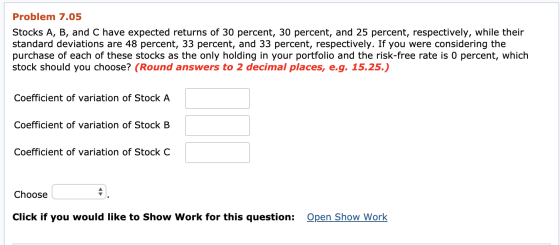
please explain how you got answer
Homework Answers
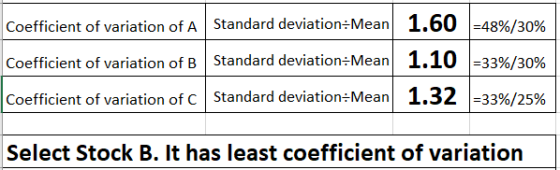
*Please rate thumbs up
Add Answer to:
please explain how you got answer
Problem 7.05 Stocks A, B, and C have expected returns...
Single-asset portfolios: Stocks A, B, and C have expected returns of 15 percent, 15 percent, and...
Single-asset portfolios: Stocks A, B, and C have expected returns of 15 percent, 15 percent, and 12 percent, respectively, while their standard deviations are 45 percent, 30 percent, and 30 percent, respectively. If you were considering the purchase of each of these stocks as the only holding in your portfolio and the risk-free rate is 0 percent, which stock should you choose?
Suppose the expected returns and standard deviations of Stocks A and B are E(RA) = .088,...
 Suppose the expected returns and standard
deviations of Stocks A and B are E(RA) = .088, E(RB) = .148, σA =
.358, and σB = .618.
Suppose the expected returns and standard deviations of Stocks A and B are E(RA) = .088, E(RB) = .148, 0A = .358, and 0B = .618. a-1. Calculate the expected return of a portfolio that is composed of 33 percent A and 67 percent B when the correlation between the returns on A and...
Suppose the expected returns and standard
deviations of Stocks A and B are E(RA) = .088, E(RB) = .148, σA =
.358, and σB = .618.
Suppose the expected returns and standard deviations of Stocks A and B are E(RA) = .088, E(RB) = .148, 0A = .358, and 0B = .618. a-1. Calculate the expected return of a portfolio that is composed of 33 percent A and 67 percent B when the correlation between the returns on A and...
Stocks A & B have the expected returns and standard deviations shown in the table below:...
 Stocks A & B have the expected returns and standard deviations shown in the table below: Stock E(R) 12% 30% 19% 50% The correlation between A and B is 0.4. The risk-free rate is 3% and you have a risk-aversion parameter of 2. What is the proportion of your investment in A and B, respectively, in your optimal risky portfolio?
Stocks A and B have the following probability distributions of expected future returns: Probability A B...
Stocks A and B have the following probability distributions of expected future returns: Probability A B .1 (13%) (40%) .1 5 0 .5 15 21 .2 22 30 .1 33 48 a.) Calculate the expected rate of return for Stock B ( = 14.40%.) Do not round intermediate calculations. Round your answer to two decimal places. b.) Calculate the standard deviation of expected returns, σA, for Stock A (σB = 22.17%.) Do not round intermediate calculations. Round your answer to...
12.5% O 15.8% 17.2% Question 4 The expected returns for Stocks A, B, C, D, and...
 12.5% O 15.8% 17.2% Question 4 The expected returns for Stocks A, B, C, D, and E are 7 percent, 10 percent, 12 percent, 25 percent, and 18 percent, respectively. The corresponding standard deviations for these stocks are 12 percent, 18 percent, 15 percent, 23 percent, and 15 percent, respectively. Which one of the securities should a risk-averse investor purchase if the investment will be held in isolation (by itself? ОА Ов oc OD 5 pts Question 5 The market...
Sample Test Problem 7.03 You have just invested in a portfolio of three stocks. The amount...
 Sample Test Problem 7.03 You have just invested in a portfolio of three stocks. The amount of money that you invested in each stock and its beta are summarized below Stock Investment Beta $188,000 1.51 А 282,000 0.52 В 470,000 1.35 с Calculate the beta of the portfolio and use the Capital Asset Pricing Model (CAPM) to compute the expected rate of return for the portfolio. Assume that the expected rate of return on the market is 18 percent and...
QUESTION 28 The expected returns, standard deviation, and coefficient variation of Stocks A and B are...
 QUESTION 28 The expected returns, standard deviation, and coefficient variation of Stocks A and B are given below. If you are risk adverse investor, which stock will you buy? | Stocks | Expected Return Std. Deviation Coefficient Variation, CV A 15% 4% 0.27 B 12% 3% 0.25 O Stock A since expected return is higher Stock B since standard deviation is lower O Stock A since coefficient variation is higher Stock B since coefficient variation is lower O Need additional...
8-6 EXPECTED RETURNS Stocks A and B have the following probability distributions of expected future returns:...
 8-6 EXPECTED RETURNS Stocks A and B have the following probability distributions of expected future returns: Probability B 0.1 0.2 A (10%) 2 12 20 38 (35%) 0 20 0.4 0.2 0.1 45 a. Calculate the expected rate of return, fe, for Stock B (f = 12%). b. Calculate the standard deviation of expected returns, o , for Stock A (o, = 20.35%). Now calculate the coefficient of variation for Stock B. Is it possible that most investors will regard...
letter b please You have estimated the following probability distribution of returns for two stocks: Stock...
 letter b please
You have estimated the following probability distribution of returns for two stocks: Stock N Stock O Probability 0.20 0.30 Return 8% Probability 0.20 0.30 0.30 Return 26% 12 0.30 0.20 -4 0.20 -4 Calculate the expected rate of return and standard deviation for cach stock If the correlation between the returns on the two stocks is -0.40, calculate the portfolio returm and the standard deviation for portfolios containing 100%, 75 % , 50 % , 25 %...
letter b please
You have estimated the following probability distribution of returns for two stocks: Stock N Stock O Probability 0.20 0.30 Return 8% Probability 0.20 0.30 0.30 Return 26% 12 0.30 0.20 -4 0.20 -4 Calculate the expected rate of return and standard deviation for cach stock If the correlation between the returns on the two stocks is -0.40, calculate the portfolio returm and the standard deviation for portfolios containing 100%, 75 % , 50 % , 25 %...
Consider the following information for three stocks, A, B, and C. The stocks' returns are positively...
 Consider the following information for three stocks, A, B, and C. The stocks' returns are positively but not perfectly positively correlated with one another, i.e., the correlations are all between O and 1 ExpectedStandard Stock Retum Deviation Beta 1.0 10% 1.0 1.4 10% B10% 12% 20% 12% Portfolio AB has half of its funds invested in Stock A and half in Stock B. Portfolio ABC has one third of its funds invested in each of the three stocks. The risk-free...
 Suppose the expected returns and standard
deviations of Stocks A and B are E(RA) = .088, E(RB) = .148, σA =
.358, and σB = .618.
Suppose the expected returns and standard deviations of Stocks A and B are E(RA) = .088, E(RB) = .148, 0A = .358, and 0B = .618. a-1. Calculate the expected return of a portfolio that is composed of 33 percent A and 67 percent B when the correlation between the returns on A and...
Suppose the expected returns and standard
deviations of Stocks A and B are E(RA) = .088, E(RB) = .148, σA =
.358, and σB = .618.
Suppose the expected returns and standard deviations of Stocks A and B are E(RA) = .088, E(RB) = .148, 0A = .358, and 0B = .618. a-1. Calculate the expected return of a portfolio that is composed of 33 percent A and 67 percent B when the correlation between the returns on A and...
 Stocks A & B have the expected returns and standard deviations shown in the table below: Stock E(R) 12% 30% 19% 50% The correlation between A and B is 0.4. The risk-free rate is 3% and you have a risk-aversion parameter of 2. What is the proportion of your investment in A and B, respectively, in your optimal risky portfolio?
 12.5% O 15.8% 17.2% Question 4 The expected returns for Stocks A, B, C, D, and E are 7 percent, 10 percent, 12 percent, 25 percent, and 18 percent, respectively. The corresponding standard deviations for these stocks are 12 percent, 18 percent, 15 percent, 23 percent, and 15 percent, respectively. Which one of the securities should a risk-averse investor purchase if the investment will be held in isolation (by itself? ОА Ов oc OD 5 pts Question 5 The market...
 Sample Test Problem 7.03 You have just invested in a portfolio of three stocks. The amount of money that you invested in each stock and its beta are summarized below Stock Investment Beta $188,000 1.51 А 282,000 0.52 В 470,000 1.35 с Calculate the beta of the portfolio and use the Capital Asset Pricing Model (CAPM) to compute the expected rate of return for the portfolio. Assume that the expected rate of return on the market is 18 percent and...
 QUESTION 28 The expected returns, standard deviation, and coefficient variation of Stocks A and B are given below. If you are risk adverse investor, which stock will you buy? | Stocks | Expected Return Std. Deviation Coefficient Variation, CV A 15% 4% 0.27 B 12% 3% 0.25 O Stock A since expected return is higher Stock B since standard deviation is lower O Stock A since coefficient variation is higher Stock B since coefficient variation is lower O Need additional...
 8-6 EXPECTED RETURNS Stocks A and B have the following probability distributions of expected future returns: Probability B 0.1 0.2 A (10%) 2 12 20 38 (35%) 0 20 0.4 0.2 0.1 45 a. Calculate the expected rate of return, fe, for Stock B (f = 12%). b. Calculate the standard deviation of expected returns, o , for Stock A (o, = 20.35%). Now calculate the coefficient of variation for Stock B. Is it possible that most investors will regard...
 letter b please
You have estimated the following probability distribution of returns for two stocks: Stock N Stock O Probability 0.20 0.30 Return 8% Probability 0.20 0.30 0.30 Return 26% 12 0.30 0.20 -4 0.20 -4 Calculate the expected rate of return and standard deviation for cach stock If the correlation between the returns on the two stocks is -0.40, calculate the portfolio returm and the standard deviation for portfolios containing 100%, 75 % , 50 % , 25 %...
letter b please
You have estimated the following probability distribution of returns for two stocks: Stock N Stock O Probability 0.20 0.30 Return 8% Probability 0.20 0.30 0.30 Return 26% 12 0.30 0.20 -4 0.20 -4 Calculate the expected rate of return and standard deviation for cach stock If the correlation between the returns on the two stocks is -0.40, calculate the portfolio returm and the standard deviation for portfolios containing 100%, 75 % , 50 % , 25 %...
 Consider the following information for three stocks, A, B, and C. The stocks' returns are positively but not perfectly positively correlated with one another, i.e., the correlations are all between O and 1 ExpectedStandard Stock Retum Deviation Beta 1.0 10% 1.0 1.4 10% B10% 12% 20% 12% Portfolio AB has half of its funds invested in Stock A and half in Stock B. Portfolio ABC has one third of its funds invested in each of the three stocks. The risk-free...
Most questions answered within 3 hours.
-
Where is the error in this code sequence?
String s1 = "Hello";
String s2 = "ello";...
asked 10 months ago -
Financial data for Joel de Paris, Inc., for last year
follow:
Joel de Paris, Inc.
Balance...
asked 10 months ago -
Consider this reaction:
Al2(SO4)3 (aq)+ BaCl3
(aq) Al2Cl6 (aq)- +
3BaSO4(s) . What is the...
asked 10 months ago -
Suppose that Savneet is considering increasing her
recent random sample from 20 car rentals to 40...
asked 10 months ago -
Trucks arrive at an unloading terminal at an average rate of 120
per hour.
Trucks arrive...
asked 10 months ago -
Why are methanol and ethanol completely soluble in water while
octanol is not very little soluble....
asked 10 months ago -
A facilities manager at a university reads in a research report
that the mean amount of...
asked 10 months ago -
When the CuSO4 is rehydrated by adding water to the anhydrous
compound, is this an endothermic...
asked 10 months ago -
A ray of sunlight is passing from diamond into crown glass; the
angle of incidence is...
asked 10 months ago -
A block of mass 0.249 kg is placed on top of a light, vertical
spring of...
asked 10 months ago -
how do the kidneys compensate in the presences of acidosis
a) trigger hyperventilate
b) reserve acid...
asked 10 months ago -
Question 501 pts
The rental rate of capital to the firm increases. Which of the
following...
asked 10 months ago