
Homework Answers
1. Equilibrium under Autarky
For home:
qs = qd
100 + 200p = 1900 – 400p
p = $3
q = 700
For foreign:
qs* = qd*
100p = 600 – 200p
p = $2
q = 200
2. To find which country will export and which will import the good we need to find the world price of good.
World demand (Qd) = qd + qd*
= 2500 – 600p
World supply (Qs) = qs + qs*
= 100 + 300p
Qd = Qs
2500 – 600p = 100 + 300p
900p = 2400
P = 2.66
At this price domestic demand and supply are:
qd = 1900 – 400(2.66) = 836
qs = 100 + 200(2.66) = 632
Foreign demand and supply
qd* = 600 – 200(2.66) = 68
qs = 100(2.66) = 266
Thus, there is excess demand in home and excess supply in foreign.
Therefore, home will import and foreign will export.
3. Free trade world price is $2.66 and quantity (Q) is
Q = 2500 – 600(2.66) = 904
4.
In the home country consumer surplus (CS), producer surplus (PS), and total surplus (TS)
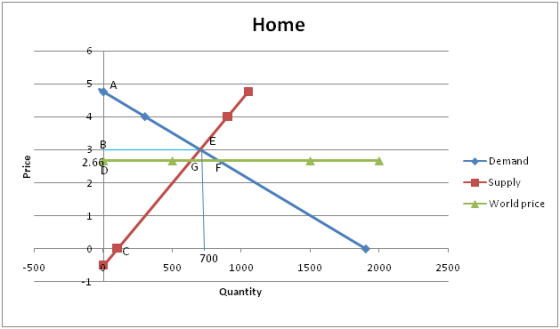
Before trade is:
CS = area (ABE) = 0.5 * 700 * 2 = 700
PS = area (OCEB) = 0.5 * (100 + 700) * 3 = 1200
TS = CS + PS = 1900
After trade is:
CS = area (AFD) = 0.5 * 836 * 2.34 = 978.12
PS = area (OCGD) = 0.5 (100+ 632) * 2.66 = 973.56
TS = CS + PS = 1951.68
In the foreign country:
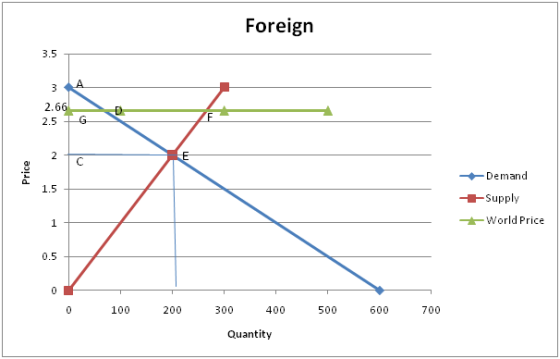
Before trade:
CS = area (AEC) = 0.5 * 200 * 1 = 100
PS = area (OEC) = 0.5 * 200 * 2 = 200
TS = CS + PS = 300
After Trade:
CS = area (ADG) = 0.5 * 68 * 0.34 = 11.56
PS = area (OFG) = 0.5 * 266 * 2.66 = 353.78
TS = CS + PS = 365.34
Add Answer to:
Consider two countries and a single good produced competitively. At Home, the supply and demand curves...
We have the following demand and supply curves for clothing for the home and foreign economies....
We have the following demand and supply curves for clothing for the home and foreign economies. Home Foreign Supply QC = -20 + 10P QC* = -20 + 20P* Demand DC = 100 - 10 P DC* = 100 - 20P* a. Compute the autarky price and quantities for both countries. b. Compute the world price and quantity traded under free trade. Also compute the quantities supplied and demanded for the home and foreign country individually. c. Draw two graphs,...
Consider international trade in a world with two countries, Home and Foreign, and a single good....
 Consider international trade in a world with two countries, Home and Foreign, and a single good. At Home, the demand is D = 500 - 2P and the supply is S = 200 + 4P. At Foreign the demand is D*= 600 – 2P and the supply is S* = 360 + 2P. What is the autarky price at Home? Answer: 50 What is the autarky price at Foreign? 60 Answer: What is the consumer surplus at Home, in autarky?...
Consider a model world consisting of two countries: A and B. The countries trade some e good in the international market. The respective suppy and demand curves of the wP and are described by - 4...
 Consider a model world consisting of two countries: A and B. The countries trade some e good in the international market. The respective suppy and demand curves of the wP and are described by - 480-12P and Q 280+8P(for country Ay lar necessary either work B92+ 6P (for country B). Please answer the following questions; wheren with fractions or round to the fourth decimal place trade some generic (a) In the absence of international trade, find domestic equilibria in the...
Problem IV. Demand and supply curves for two large countries are given by figure 1. Answer...
 Problem IV. Demand and supply curves for two large countries are given by figure 1. Answer the following 1. Consider the autarky situation. (a) Calculate CS, PS, GS, and TS for both countries (3 points) 2. Now, suppo countries open to trade (a) Which country imports and which exports? (0.5 point) (b) Derive import demand for importer and export supply for exporter. You can either drawe both curves with appropriate labeling and placing numbers or write equations. ( points) (e)...
GS eans government surplus Problem IV. Demand and supply curves for two large countries are given...
 GS
eans government surplus
Problem IV. Demand and supply curves for two large countries are given by figure 1. Answer the following questions. (38 points) 1. Consider the autarky situation. (a) Calculate CS, PS, GS, and TS for both countries. (3 povints) 2. Now, suppose countries open to trade. (a) Which country imports and which exports? (0.5 point) (1) Derive import demand for importer and export supply for exporter. You can either draw both curves with appropriate labeling and placing...
GS
eans government surplus
Problem IV. Demand and supply curves for two large countries are given by figure 1. Answer the following questions. (38 points) 1. Consider the autarky situation. (a) Calculate CS, PS, GS, and TS for both countries. (3 povints) 2. Now, suppose countries open to trade. (a) Which country imports and which exports? (0.5 point) (1) Derive import demand for importer and export supply for exporter. You can either draw both curves with appropriate labeling and placing...
Problem IV. Demand and supply curves for two large countries are given by figure 1. Answer...
 Problem IV. Demand and supply curves for two large countries are given by figure 1. Answer the following questions. (38 points) 1. Consider the autarky situation. (a) Calculate CS, PS, GS, and TS for both countries. (3 povints) 2. Now, suppose countries open to trade. (a) Which country imports and which exports? (0.5 point) (1) Derive import demand for importer and export supply for exporter. You can either draw both curves with appropriate labeling and placing numbers or write equations....
Roblem 2: Trade Policy. demand for cars in Home is q 30 - P and the supply of cars in Home is q -...
 E-H ONLY. THERE ARE THREE PICTURES
updated figure 2
roblem 2: Trade Policy. demand for cars in Home is q 30 - P and the supply of cars in Home is q -P. The demand for cars in Foreign is q 20-P and the supply of cars in Foreign is q P. a) Calculate the equilibrium price and quantity in each country under isolation. b) Who is the importer of cars and who is the exporter? c) Write the import...
E-H ONLY. THERE ARE THREE PICTURES
updated figure 2
roblem 2: Trade Policy. demand for cars in Home is q 30 - P and the supply of cars in Home is q -P. The demand for cars in Foreign is q 20-P and the supply of cars in Foreign is q P. a) Calculate the equilibrium price and quantity in each country under isolation. b) Who is the importer of cars and who is the exporter? c) Write the import...
a. Draw the supply and demand curves for the US market under autarky (no trade) Note...
 a. Draw the supply and demand curves for the US market under autarky (no trade) Note the equilibrium price and quantity b. Draw the supply and demand curves for the ROW market under autarky (no trade). Note the equilibrium price and quantity. Suppose that the two countries open to trade. Describe an arbitrage strategy that will allow you to profit from the price differential between the two markets. Be sure to explain how it will work d. Draw the import...
2. Variation NL For Country A the dennand and supply for food are given by Qda-520-200P and Qsa =-80 + 100P. respectively. Analogously, Qdb-900-300P and Qsb-600P are the curves for Country B. Usi...
 2. Variation NL For Country A the dennand and supply for food are given by Qda-520-200P and Qsa =-80 + 100P. respectively. Analogously, Qdb-900-300P and Qsb-600P are the curves for Country B. Using this information answer the following questions, keeping you answers as precise as possible either by working with fractions or using about 5 decimal places. (a) Find domestic equilibria (prices and quantities) before international trade starts. (b) Next, find international trade equilibrium: the international price and the quantity...
Thank you so much. Heckscher-Ohlin Model 2. There are two countries, Home and Foreign. There are...
 Thank you so much.
Heckscher-Ohlin Model 2. There are two countries, Home and Foreign. There are two goods: beer (6) and corn (C), which are produced in both countries using capital (K) and labor (L). In both countries, it takes 2 units of labor and 1 unit of capital to make beer (a Lb = 2, akb = 1); and it takes 5 units of labor and 5 units of capital to make corn (ale = 5, ako = 5)....
Thank you so much.
Heckscher-Ohlin Model 2. There are two countries, Home and Foreign. There are two goods: beer (6) and corn (C), which are produced in both countries using capital (K) and labor (L). In both countries, it takes 2 units of labor and 1 unit of capital to make beer (a Lb = 2, akb = 1); and it takes 5 units of labor and 5 units of capital to make corn (ale = 5, ako = 5)....
 Consider international trade in a world with two countries, Home and Foreign, and a single good. At Home, the demand is D = 500 - 2P and the supply is S = 200 + 4P. At Foreign the demand is D*= 600 – 2P and the supply is S* = 360 + 2P. What is the autarky price at Home? Answer: 50 What is the autarky price at Foreign? 60 Answer: What is the consumer surplus at Home, in autarky?...
 Consider a model world consisting of two countries: A and B. The countries trade some e good in the international market. The respective suppy and demand curves of the wP and are described by - 480-12P and Q 280+8P(for country Ay lar necessary either work B92+ 6P (for country B). Please answer the following questions; wheren with fractions or round to the fourth decimal place trade some generic (a) In the absence of international trade, find domestic equilibria in the...
 Problem IV. Demand and supply curves for two large countries are given by figure 1. Answer the following 1. Consider the autarky situation. (a) Calculate CS, PS, GS, and TS for both countries (3 points) 2. Now, suppo countries open to trade (a) Which country imports and which exports? (0.5 point) (b) Derive import demand for importer and export supply for exporter. You can either drawe both curves with appropriate labeling and placing numbers or write equations. ( points) (e)...
 GS
eans government surplus
Problem IV. Demand and supply curves for two large countries are given by figure 1. Answer the following questions. (38 points) 1. Consider the autarky situation. (a) Calculate CS, PS, GS, and TS for both countries. (3 povints) 2. Now, suppose countries open to trade. (a) Which country imports and which exports? (0.5 point) (1) Derive import demand for importer and export supply for exporter. You can either draw both curves with appropriate labeling and placing...
GS
eans government surplus
Problem IV. Demand and supply curves for two large countries are given by figure 1. Answer the following questions. (38 points) 1. Consider the autarky situation. (a) Calculate CS, PS, GS, and TS for both countries. (3 povints) 2. Now, suppose countries open to trade. (a) Which country imports and which exports? (0.5 point) (1) Derive import demand for importer and export supply for exporter. You can either draw both curves with appropriate labeling and placing...
 Problem IV. Demand and supply curves for two large countries are given by figure 1. Answer the following questions. (38 points) 1. Consider the autarky situation. (a) Calculate CS, PS, GS, and TS for both countries. (3 povints) 2. Now, suppose countries open to trade. (a) Which country imports and which exports? (0.5 point) (1) Derive import demand for importer and export supply for exporter. You can either draw both curves with appropriate labeling and placing numbers or write equations....
 E-H ONLY. THERE ARE THREE PICTURES
updated figure 2
roblem 2: Trade Policy. demand for cars in Home is q 30 - P and the supply of cars in Home is q -P. The demand for cars in Foreign is q 20-P and the supply of cars in Foreign is q P. a) Calculate the equilibrium price and quantity in each country under isolation. b) Who is the importer of cars and who is the exporter? c) Write the import...
E-H ONLY. THERE ARE THREE PICTURES
updated figure 2
roblem 2: Trade Policy. demand for cars in Home is q 30 - P and the supply of cars in Home is q -P. The demand for cars in Foreign is q 20-P and the supply of cars in Foreign is q P. a) Calculate the equilibrium price and quantity in each country under isolation. b) Who is the importer of cars and who is the exporter? c) Write the import...
 a. Draw the supply and demand curves for the US market under autarky (no trade) Note the equilibrium price and quantity b. Draw the supply and demand curves for the ROW market under autarky (no trade). Note the equilibrium price and quantity. Suppose that the two countries open to trade. Describe an arbitrage strategy that will allow you to profit from the price differential between the two markets. Be sure to explain how it will work d. Draw the import...
 2. Variation NL For Country A the dennand and supply for food are given by Qda-520-200P and Qsa =-80 + 100P. respectively. Analogously, Qdb-900-300P and Qsb-600P are the curves for Country B. Using this information answer the following questions, keeping you answers as precise as possible either by working with fractions or using about 5 decimal places. (a) Find domestic equilibria (prices and quantities) before international trade starts. (b) Next, find international trade equilibrium: the international price and the quantity...
 Thank you so much.
Heckscher-Ohlin Model 2. There are two countries, Home and Foreign. There are two goods: beer (6) and corn (C), which are produced in both countries using capital (K) and labor (L). In both countries, it takes 2 units of labor and 1 unit of capital to make beer (a Lb = 2, akb = 1); and it takes 5 units of labor and 5 units of capital to make corn (ale = 5, ako = 5)....
Thank you so much.
Heckscher-Ohlin Model 2. There are two countries, Home and Foreign. There are two goods: beer (6) and corn (C), which are produced in both countries using capital (K) and labor (L). In both countries, it takes 2 units of labor and 1 unit of capital to make beer (a Lb = 2, akb = 1); and it takes 5 units of labor and 5 units of capital to make corn (ale = 5, ako = 5)....
Most questions answered within 3 hours.
-
Where is the error in this code sequence?
String s1 = "Hello";
String s2 = "ello";...
asked 10 months ago -
Financial data for Joel de Paris, Inc., for last year
follow:
Joel de Paris, Inc.
Balance...
asked 10 months ago -
Consider this reaction:
Al2(SO4)3 (aq)+ BaCl3
(aq) Al2Cl6 (aq)- +
3BaSO4(s) . What is the...
asked 10 months ago -
Suppose that Savneet is considering increasing her
recent random sample from 20 car rentals to 40...
asked 10 months ago -
Trucks arrive at an unloading terminal at an average rate of 120
per hour.
Trucks arrive...
asked 10 months ago -
Why are methanol and ethanol completely soluble in water while
octanol is not very little soluble....
asked 10 months ago -
A facilities manager at a university reads in a research report
that the mean amount of...
asked 10 months ago -
When the CuSO4 is rehydrated by adding water to the anhydrous
compound, is this an endothermic...
asked 10 months ago -
A ray of sunlight is passing from diamond into crown glass; the
angle of incidence is...
asked 10 months ago -
A block of mass 0.249 kg is placed on top of a light, vertical
spring of...
asked 10 months ago -
how do the kidneys compensate in the presences of acidosis
a) trigger hyperventilate
b) reserve acid...
asked 10 months ago -
Question 501 pts
The rental rate of capital to the firm increases. Which of the
following...
asked 10 months ago