
Homework Answers
7)
Given,
Initial deposit = $ 9000
Compounding periods (n) = 2 per year
First year interest rate = 8.25%
Semi annual rate (r1) = 8.25%  2 = 4.125% or 0.04125
Second year interest rate = 0.50%
Semi annual rate (r2) = 0.50%
2 = 0.25% or 0.0025
Third year interest rate = 2.75%
Semi annual rate (r3) = 2.75%
2 = 1.375% or 0.01375
Solution :-
![First year – Initial Interest deposite - $9000/(1+0.0412S)? -;] = $9000 [[1.041255-1] = $9000 (1.08470156 - ] = $ 9000 (0.084](http://img.homeworklib.com/questions/f4f17ec0-796d-11ea-9817-9de4d7e9656e.png?x-oss-process=image/resize,w_560)
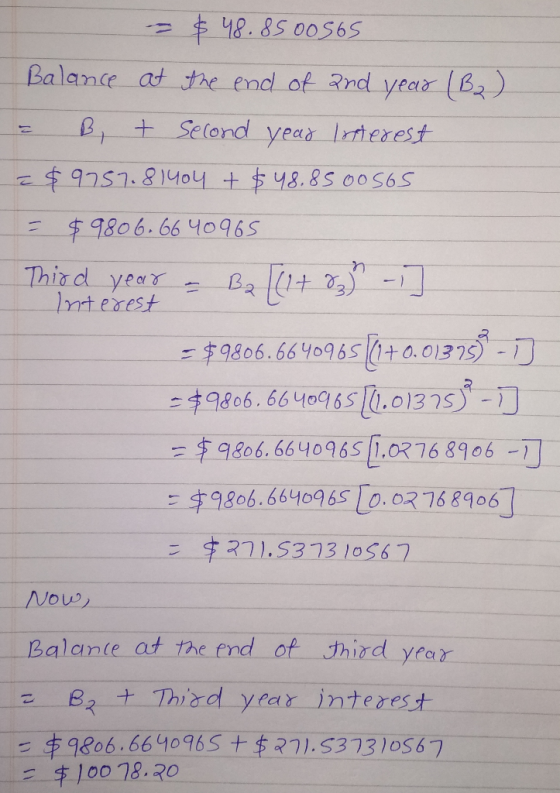
Thus, at the end of three years, Alice will have in her bank account a total balance of $ 10078.20
Add Answer to:
7) Alice deposits 50,000.00 in her bank account. Interest is calculated and compounded semi-annually. The interest...
eBook Bank A pays 7% interest compounded annually on deposits, while Bank B pays 6.5% compounded...
eBook Bank A pays 7% interest compounded annually on deposits, while Bank B pays 6.5% compounded daily. a. Based on the EAR (or EFF%), which bank should you use? b. Could your choice of banks be influenced by the fact that you might want to withdraw your funds during the year as opposed to at the end of the year? Assume that your funds must be left on deposit during an entire compounding period in order to receive any interest
3) Effective versus nominal interest rates. Bank A pays 4% interest compounded annually on deposits, Bank...
 3) Effective versus nominal interest rates. Bank A pays 4% interest compounded annually on deposits, Bank B pays 3.75% compounded semiannually, and Bank C pays 3.5% compounded daily. a) Which bank would you use? Why? b) If you deposited $5,000 in each bank today, how much would you have at the end of 2 years? c) What nominal rate would cause Banks B and C to provide the same effective annual rate as Bank A? d) Suppose you do not...
Joel deposits $1000 in his savings account at the bank, where interest is compounded annually at...
Joel deposits $1000 in his savings account at the bank, where interest is compounded annually at 1.75%. What is the amount of interest earned in the THIRD year ALONE? A. 17.50 B. 18.11 C. 17.80
The bank offers interest rate of 5.26%, compounded semi-annually. If you put $10 in the bank...
The bank offers interest rate of 5.26%, compounded semi-annually. If you put $10 in the bank now, how much money do you have at the end of one year? (Round to the nearest cent.)
1) Carlos has borrowed $8,000 for 8 years at 6% compounded semi-annually. He will repay interest...
 1) Carlos has borrowed $8,000 for 8 years at 6% compounded semi-annually. He will repay interest every 6 months plus principal at maturity. He will also deposit X every 6 months into a sinking fund paying 5% compounded semi-annually to pay off the principal at maturity. a) Find X. Carlos goes bankrupt at the end of year 6, just after making his interest payment and sinking fund deposit. The bank confiscates the money in the sinking fund but gets no...
Universal Bank pays 6% Interest, compounded annually, on time deposits. Regional Bank pays 5% interest, compounded...
 Universal Bank pays 6% Interest, compounded annually, on time deposits. Regional Bank pays 5% interest, compounded quarterly a. Based on effective interest rates, in which bank would you prefer to deposit your money? 1. You would choose Regional Bank because its EAR (or EFF%) is higher. II. You would choose Regional Bank because its nominal interest rate is higher. TIL. You are indifferent between the banks and your decision will be based upon which one offers you a int for...
Bank A pays 3% interest compounded annually on deposits, while Bank B pays 2.25% compounded daily....
Bank A pays 3% interest compounded annually on deposits, while Bank B pays 2.25% compounded daily. a. Based on the EAR (or EFF%), which bank should you use? You would choose Bank A because its EAR is higher. You would choose Bank B because its EAR is higher. You would choose Bank A because its nominal interest rate is higher. You would choose Bank B because its nominal interest rate is higher. You are indifferent between the banks and your...
Bank A pays 6% interest compounded annually on deposits, while Bank B pays 5.75% compounded daily....
Bank A pays 6% interest compounded annually on deposits, while Bank B pays 5.75% compounded daily. a. Based on the EAR (or EFF%), which bank should you use? You would choose Bank A because its EAR is higher. You would choose Bank B because its EAR is higher. You would choose Bank A because its nominal interest rate is higher. You would choose Bank B because its nominal interest rate is higher. You are indifferent between the banks and your...
Effective versus nominal interest rates Bank A pays 9.5% interest compounded annually on deposits, while Bank...
 Effective versus nominal interest rates Bank A pays 9.5% interest compounded annually on deposits, while Bank B pays 9% compounded daily. a. Based on the EAR (or EFF%), which bank should you use? I. You would choose Bank A because its EAR is higher. 11. You would choose Bank B because its EAR is higher. III. You would choose Bank A because its nominal interest rate is higher IV. You would choose Bank B because its nominal interest rate is...
1. Suppose an investor deposits $2500 in an interest-bearing account at her local bank. The account...
1. Suppose an investor deposits $2500 in an interest-bearing account at her local bank. The account pays 2.5% interest compounded annually. If the investor plans on withdrawing the original principal plus accumulated interested at the end of 7 years, what is the total amount that she should expect to receive assuming interest rates do not change? Please show steps on how to calculate answer with a financial calculator.
 3) Effective versus nominal interest rates. Bank A pays 4% interest compounded annually on deposits, Bank B pays 3.75% compounded semiannually, and Bank C pays 3.5% compounded daily. a) Which bank would you use? Why? b) If you deposited $5,000 in each bank today, how much would you have at the end of 2 years? c) What nominal rate would cause Banks B and C to provide the same effective annual rate as Bank A? d) Suppose you do not...
 1) Carlos has borrowed $8,000 for 8 years at 6% compounded semi-annually. He will repay interest every 6 months plus principal at maturity. He will also deposit X every 6 months into a sinking fund paying 5% compounded semi-annually to pay off the principal at maturity. a) Find X. Carlos goes bankrupt at the end of year 6, just after making his interest payment and sinking fund deposit. The bank confiscates the money in the sinking fund but gets no...
 Universal Bank pays 6% Interest, compounded annually, on time deposits. Regional Bank pays 5% interest, compounded quarterly a. Based on effective interest rates, in which bank would you prefer to deposit your money? 1. You would choose Regional Bank because its EAR (or EFF%) is higher. II. You would choose Regional Bank because its nominal interest rate is higher. TIL. You are indifferent between the banks and your decision will be based upon which one offers you a int for...
 Effective versus nominal interest rates Bank A pays 9.5% interest compounded annually on deposits, while Bank B pays 9% compounded daily. a. Based on the EAR (or EFF%), which bank should you use? I. You would choose Bank A because its EAR is higher. 11. You would choose Bank B because its EAR is higher. III. You would choose Bank A because its nominal interest rate is higher IV. You would choose Bank B because its nominal interest rate is...
Most questions answered within 3 hours.
-
Where is the error in this code sequence?
String s1 = "Hello";
String s2 = "ello";...
asked 11 months ago -
Financial data for Joel de Paris, Inc., for last year
follow:
Joel de Paris, Inc.
Balance...
asked 11 months ago -
Consider this reaction:
Al2(SO4)3 (aq)+ BaCl3
(aq) Al2Cl6 (aq)- +
3BaSO4(s) . What is the...
asked 11 months ago -
Suppose that Savneet is considering increasing her
recent random sample from 20 car rentals to 40...
asked 11 months ago -
Trucks arrive at an unloading terminal at an average rate of 120
per hour.
Trucks arrive...
asked 11 months ago -
Why are methanol and ethanol completely soluble in water while
octanol is not very little soluble....
asked 11 months ago -
A facilities manager at a university reads in a research report
that the mean amount of...
asked 11 months ago -
When the CuSO4 is rehydrated by adding water to the anhydrous
compound, is this an endothermic...
asked 11 months ago -
A ray of sunlight is passing from diamond into crown glass; the
angle of incidence is...
asked 11 months ago -
A block of mass 0.249 kg is placed on top of a light, vertical
spring of...
asked 11 months ago -
how do the kidneys compensate in the presences of acidosis
a) trigger hyperventilate
b) reserve acid...
asked 11 months ago -
Question 501 pts
The rental rate of capital to the firm increases. Which of the
following...
asked 11 months ago