A natural disaster decreases the land available in a small country. In it, according to the...
A natural disaster decreases the land available in a small country. In it, according to the Heckscher-Ohlin mode, two goods, golf camps and balsamic vinegar, are produced with land and labour. Golf camps are land intensive and vinegare labour intensive. What is the impact on quantitities produced and the remunerations of workers and landowners of natural disasters?
Homework Answers
solution -
Infrastructure destruction is by far the most obvious type of damage that a natural disaster can cause.Hurricanes are among the natural disasters with the greatest financial impact . But regardless of the disaster type, businesses frequently face the following problems after an incident:
- Structural damage
- Lack of employee access to their place of work
- Interruptions in supply chains
- Losses of perishable goods
- Temporary business closures\
Destruction of critical agricultural assets and infrastructure and the losses in the production of crops, livestock and fisheries are not just one of few things that disasters can cause in rural areas.They can change agricultural trade flows, and cause losses in agricultural-dependent manufacturing subsectors such as the textile and food processing industries.
For climate-related disasters such as floods, droughts and tropical storms, 25 percent of all damage and losses is on the agriculture sector. Agriculture is the single most affected sector by droughts, absorbing on average about 84 percent of all the economic impact . Natural disasters like Earthquakes destroy lands owned by farmers , landowners etc. which result in huge losses for them because it takes a long of time to recover those lands ,as its loses its fertility for growing crops and they are even unable to sell this lands to others as no one is willing to buy it.
Farmers working for big landowners also lose their jobs because of the destruction of farm lands.They either remain jobless or migrate place to place to earn a livelihood.
EXAMPLES-
In Kenya, agriculture accounts for 30 percent of national GDP, it provides 60 percent of total employment and accounts for 65 percent of the country’s total exports. Droughts in Kenya have a considerable impact on livelihoods, agriculture and the national economy.
The 2008–2011 drought in the country caused a total of USD 10.7 billion in damages and losses, of which nearly USD 9 billion was on the livestock subsector alone, USD 91 million on the food processing industry, USD 1.5 billion on crops, USD 53 million on fisheries, and USD 85 million on nutrition.
Thank You
If you like this answer please give a thumbs up.
Add Answer to:
A natural disaster decreases the land available in a small
country. In it, according to the...
1) We are in two good, two country, where all of the assumptions of the Heckscher-Ohlin...
1) We are in two good, two country, where all of the assumptions of the Heckscher-Ohlin model of trade are satisfied. Suppose that in Japan there are 50 workers and 50 acres of land, while in the US there are 100 workers and 200 acres of land. Suppose furthermore that the two goods, rice, and cloth, are produced using land and labor. Rice is land intensive. Suppose the two countries open up to trade. What will be the pattern of...
1-Home produces 2 goods X and Y . Home country has two factors of production, Labor...
1-Home produces 2 goods X and Y . Home country has two factors of production, Labor and Capital. All consumers at Home have preferences over two goods that can be represented by the utility function U(X,) =XY . The factor requirements per unit of output of the two goods are also fixed and they are shown in the following table: Good X Good Y Labour 1/3 2/3 Capital 2/3 1/3 Home country has 360 units of Labour and 600 units...
This exercise analyses the effects of immigration in a Heckscher– Ohlin model. The island of Kauai...
This exercise analyses the effects of immigration in a Heckscher– Ohlin model. The island of Kauai in the Pacific Ocean produces two goods using skilled and unskilled labor. Naturally, Kauai can be considered a small economy and a wise government has led to complete trade liberalisation. (a) In the initial situation in which trade in final goods is free, Kauai produces both goods. The technology is characterized by the absence of factor intensity reversals. How can you determine the factor...
PROBLEM 1 Consider the typical HO setting: 2 countries, the United States and Canada, produce two goods,...
PROBLEM 1 Consider the typical HO setting: 2 countries, the United States and Canada, produce two goods, maiz (corn) and cloth, with two factors, land and labor. Both countries share the same tastes and the same technology. Maiz production is land intensive, and therefore cloth production is labor intensive. Furthermore, resource endowments are as follows: in the US there are 100 units of labor and 100 of land, in Canada there are 60 units of labor and 90 of land. Which...
Trade Theories, a Historical Approach Free trade refers to a situation where a government does not...
Trade Theories, a Historical Approach Free trade refers to a situation where a government does not attempt to influence through quotas or duties what its citizens can buy from another country, or what they can produce and sell to another country. The economic arguments surrounding the benefits and costs of free trade in goods and services are not abstract academic ones. International trade theory has shaped the economic policy of many nations for the past 50 years. The textbook reviews...
Assume a world of two goods, beef and cars; and two countries South Africa and Botswana....
Assume a world of two goods, beef and cars; and two countries South Africa and Botswana. Cars are capital intensive and Botswana is labour abundant. Assume the standard H-O assumptions hold. According to the Rybczynski theory, if labour doubles in Botswana how does production and consumption compare to pre-growth conditions in Botswana? Explain with the relevant diagram. b. CMU is a country that produces apples and computers, where computers are capital intensive; CMU’s PPF is bowed out (exhibits increasing relative...
Problem 1 A country (”Home”) is populated with 300 workers who produce either food (F) and/or...
 Problem 1
A country (”Home”) is populated with 300 workers who produce
either food (F) and/or clothing (C). Each food worker produces 6
units of food and each clothing worker produces 3 units of
clothing. The preferences of the consumers over food and clothing
are represented by the utility function: u(DF ,
DC) = (DF ) 2/3 (DC)
1/3
1) Assuming that at the optimum, consumers set their marginal
rate of substitution, MRSDF ,DC , to the relative price,
i.e.,...
Problem 1
A country (”Home”) is populated with 300 workers who produce
either food (F) and/or clothing (C). Each food worker produces 6
units of food and each clothing worker produces 3 units of
clothing. The preferences of the consumers over food and clothing
are represented by the utility function: u(DF ,
DC) = (DF ) 2/3 (DC)
1/3
1) Assuming that at the optimum, consumers set their marginal
rate of substitution, MRSDF ,DC , to the relative price,
i.e.,...
B2. (20 marks) Consider a small-open economy, "Home", that produces two goods: forest product (F) and manufacturing...
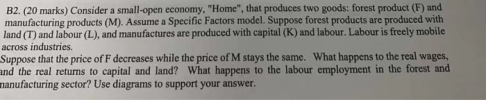 B2. (20 marks) Consider a small-open economy, "Home", that produces two goods: forest product (F) and manufacturing products (M). Assume a Specific Factors model. Suppose forest products are produced with land (T) and labour (L), and manufactures are produced with capital (K) and labour. Labour is freely mobile across industries. Suppose that the price of F decreases while the price of M stays the same. What happens to the real wages, and the real returns to capital and land? What...
Thank you so much. Heckscher-Ohlin Model 2. There are two countries, Home and Foreign. There are...
 Thank you so much.
Heckscher-Ohlin Model 2. There are two countries, Home and Foreign. There are two goods: beer (6) and corn (C), which are produced in both countries using capital (K) and labor (L). In both countries, it takes 2 units of labor and 1 unit of capital to make beer (a Lb = 2, akb = 1); and it takes 5 units of labor and 5 units of capital to make corn (ale = 5, ako = 5)....
Thank you so much.
Heckscher-Ohlin Model 2. There are two countries, Home and Foreign. There are two goods: beer (6) and corn (C), which are produced in both countries using capital (K) and labor (L). In both countries, it takes 2 units of labor and 1 unit of capital to make beer (a Lb = 2, akb = 1); and it takes 5 units of labor and 5 units of capital to make corn (ale = 5, ako = 5)....
Assume two countries Argentina and Brazil that produce two goods, corn and wine. Assume that land...
Assume two countries Argentina and Brazil that produce two goods, corn and wine. Assume that land is specific to corn, capital is specific to wine, and labor is free to move between the two industries. Assume that Brazil has a comparative advantage in corn, and Argentina has a comparative in wine. Brazil and Argentina sign a free trade agreement, and we want to study the consequences of this trade agreement. a) Is it possible that real wages move in opposite...
 Problem 1
A country (”Home”) is populated with 300 workers who produce
either food (F) and/or clothing (C). Each food worker produces 6
units of food and each clothing worker produces 3 units of
clothing. The preferences of the consumers over food and clothing
are represented by the utility function: u(DF ,
DC) = (DF ) 2/3 (DC)
1/3
1) Assuming that at the optimum, consumers set their marginal
rate of substitution, MRSDF ,DC , to the relative price,
i.e.,...
Problem 1
A country (”Home”) is populated with 300 workers who produce
either food (F) and/or clothing (C). Each food worker produces 6
units of food and each clothing worker produces 3 units of
clothing. The preferences of the consumers over food and clothing
are represented by the utility function: u(DF ,
DC) = (DF ) 2/3 (DC)
1/3
1) Assuming that at the optimum, consumers set their marginal
rate of substitution, MRSDF ,DC , to the relative price,
i.e.,...
 B2. (20 marks) Consider a small-open economy, "Home", that produces two goods: forest product (F) and manufacturing products (M). Assume a Specific Factors model. Suppose forest products are produced with land (T) and labour (L), and manufactures are produced with capital (K) and labour. Labour is freely mobile across industries. Suppose that the price of F decreases while the price of M stays the same. What happens to the real wages, and the real returns to capital and land? What...
 Thank you so much.
Heckscher-Ohlin Model 2. There are two countries, Home and Foreign. There are two goods: beer (6) and corn (C), which are produced in both countries using capital (K) and labor (L). In both countries, it takes 2 units of labor and 1 unit of capital to make beer (a Lb = 2, akb = 1); and it takes 5 units of labor and 5 units of capital to make corn (ale = 5, ako = 5)....
Thank you so much.
Heckscher-Ohlin Model 2. There are two countries, Home and Foreign. There are two goods: beer (6) and corn (C), which are produced in both countries using capital (K) and labor (L). In both countries, it takes 2 units of labor and 1 unit of capital to make beer (a Lb = 2, akb = 1); and it takes 5 units of labor and 5 units of capital to make corn (ale = 5, ako = 5)....
Most questions answered within 3 hours.
-
Where is the error in this code sequence?
String s1 = "Hello";
String s2 = "ello";...
asked 10 months ago -
Financial data for Joel de Paris, Inc., for last year
follow:
Joel de Paris, Inc.
Balance...
asked 10 months ago -
Consider this reaction:
Al2(SO4)3 (aq)+ BaCl3
(aq) Al2Cl6 (aq)- +
3BaSO4(s) . What is the...
asked 10 months ago -
Suppose that Savneet is considering increasing her
recent random sample from 20 car rentals to 40...
asked 10 months ago -
Trucks arrive at an unloading terminal at an average rate of 120
per hour.
Trucks arrive...
asked 10 months ago -
Why are methanol and ethanol completely soluble in water while
octanol is not very little soluble....
asked 10 months ago -
A facilities manager at a university reads in a research report
that the mean amount of...
asked 10 months ago -
When the CuSO4 is rehydrated by adding water to the anhydrous
compound, is this an endothermic...
asked 10 months ago -
A ray of sunlight is passing from diamond into crown glass; the
angle of incidence is...
asked 10 months ago -
A block of mass 0.249 kg is placed on top of a light, vertical
spring of...
asked 10 months ago -
how do the kidneys compensate in the presences of acidosis
a) trigger hyperventilate
b) reserve acid...
asked 10 months ago -
Question 501 pts
The rental rate of capital to the firm increases. Which of the
following...
asked 10 months ago