
Homework Answers
Initial cash outflow = Acquisition cost+transportation charges+other costs+ change in working capital-cashflow from disposal of assets
=3720000+940000+450000+4000+34000+(75000-22000)-180000 = $5141000
Operating cash flow = Net operating income-Taxes+Depreciation
Since there is no change in revenue per year or other amounts, operating cash flow would be same every year.
| Year 1 (in $) | |
| Project revenues(growth rate) | 1470000 |
| Gross profit | 1470000 |
| (Cash operating expense) | -53000 |
| (Depreciation) | 1232500 |
| Net operating income | 184500 |
| (Taxes @32%) | 59040 |
| NOPAT | 125460 |
| Depreciation | 1232500 |
| Operating cash flow | 1357960 |
Depreciation = (3720000+940000+450000 -180000)/4= $1232500
Terminal cash flow:
| Proceeds from disposal | 180000 |
| Tax Rate | 32% |
| Tax | 57600 |
| After tax proceeds | 122400 |
| Change in working capital | 53000 |
| Terminal cashflow | 175400 |
To calculate NPV, use formula :
NPV= Present value of net cash inflows-initial investment
Present value = Future value/(1+r)^t
Add Answer to:
NPV's for the two projects. (b) Using the Equivalent Annual Annuity (EAA) Approach which project is...
6. The equivalent annual annuity approach - Evaluating projects with unequal lives Aa Aa E Evaluating...
 6. The equivalent annual annuity approach - Evaluating projects with unequal lives Aa Aa E Evaluating projects with unequal lives Your company is considering starting a new project in either Spain or Mexico-these projects are mutually exclusive, so your boss has asked you to analyze the projects and then tell her which project will create more value for the company's shareholders. The Spanish project is a six-year project that is expected to produce the following cash flows: The Mexican project...
6. The equivalent annual annuity approach - Evaluating projects with unequal lives Aa Aa E Evaluating...
 6. The equivalent annual annuity approach - Evaluating projects with unequal lives Aa Aa E Evaluating projects with unequal lives Bidget Corp. is a Canadian firm that wants to expand its business internationally. It is considering potential projects in both Spain and Ukraine, and the Spanish project is expected to take six years, whereas the Ukrainian project is expected to take only three years. However, the firm plans to repeat the Ukrainian project after three years. These projects are mutually...
ABC Telecom is considering a three-year project that has a weighted average cost of capital of 12% and a NPV of $49,876. ABC Telecom can replicate this project indefinitely. What is the equivalent annual annuity (EAA) for this project?
ABC Telecom has to choose between two mutually exclusive projects. If it chooses project A, ABC Telecom will have the opportunity to make a similar investment in three years. However, if it chooses project B, it will not have the opportunity to make a second investment. The following table lists the cash flows for these projects. If the firm uses the replacement chain (common life) approach, what will be the difference between the net present value (NPV) of project A...
1) A project has annual cash flows of $5,000 for the next 10 years and then...
1) A project has annual cash flows of $5,000 for the next 10 years and then $6,500 each year for the following 10 years. The IRR of this 20-year project is 12%. If the firm's WACC is 11%, what is the project's NPV? Do not round intermediate calculations. Round your answer to the nearest cent. 2) Project S costs $12,000 and its expected cash flows would be $7,000 per year for 5 years. Mutually exclusive Project L costs $25,000 and...
CAPITAL BUDGETING CRITERIA: MUTUALLY EXCLUSIVE PROJECTS Project S costs $18,000 and its expected cash flows would...
CAPITAL BUDGETING CRITERIA: MUTUALLY EXCLUSIVE PROJECTS Project S costs $18,000 and its expected cash flows would be $6,500 per year for 5 years. Mutually exclusive Project L costs $29,500 and its expected cash flows would be $9,200 per year for 5 years. If both projects have a WACC of 12%, which project would you recommend? Select the correct answer. a. Both Projects S and L, since both projects have NPV's > 0. b. Neither Project S nor L, since each...
11-2: Net Present Value (NPV) Capital budgeting criteria: mutually exclusive projects Project Scosts $13,000 and its ex...
 11-2: Net Present Value (NPV) Capital budgeting criteria: mutually exclusive projects Project Scosts $13,000 and its expected cash flows would be $4,500 per year for 5 years. Mutually exclusive Project L costs $36,500 and its expected cash flows would be $8,100 per year for 5 years. If both projects have a WACC of 15%, which project would you recommend? Select the correct answer. O I. Both Projects S and L, since both projects have IRR's > 0. O II. Project...
Capital budgeting criteria: mutually exclusive projects Project S costs $12,000 and its expected cash flows would...
Capital budgeting criteria: mutually exclusive projects Project S costs $12,000 and its expected cash flows would be $4,500 per year for 5 years. Mutually exclusive Project L costs $49,000 and its expected cash flows would be $12,900 per year for 5 years. If both projects have a WACC of 14%, which project would you recommend? Select the correct answer. I. Project L, since the NPVL > NPVS. II. Both Projects S and L, since both projects have NPV's > 0....
Provide the missing information for the following projects using the present value of an annuity function...
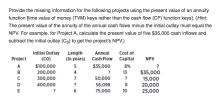 Provide the missing information for the following projects using the present value of an annuity function [time value of money (TVM) keys rather than the cash flow (CF) function keys]. (Hint: The present value of the annuity of the annual cash flows minus the initial outlay must equal the NPV. For example, for Project A, calculate the present value of five $35,000 cash inflows and subtract the initial outlay (Co) to get the project's NPV.) Inltlal Outlay (CO) Length (In...
CAPITAL BUDGETING CRITERIA 1. A firm with a 13% WACC is evaluating two projects for this...
CAPITAL BUDGETING CRITERIA 1. A firm with a 13% WACC is evaluating two projects for this year's capital budget. After-tax cash flows, including depreciation, are as follows: 0 1 2 3 4 5 Project M -$18,000 $6,000 $6,000 $6,000 $6,000 $6,000 Project N -$54,000 $16,800 $16,800 $16,800 $16,800 $16,800 Calculate NPV for each project. Round your answers to the nearest cent. Do not round your intermediate calculations. Project M $ Project N $ Calculate IRR for each project. Round your answers to...
Problem 11-11 Capital budgeting criteria: mutually exclusive projects Project S costs $16,000 and its expected cash...
 Problem 11-11 Capital budgeting criteria: mutually exclusive projects Project S costs $16,000 and its expected cash flows would be $5,500 per year for 5 years. Mutually exclusive Project L costs $35,500 and its expected cash flows would be $8,600 per year for 5 years. If both projects have a WACC of 16%, which project would you recommend? Select the correct answer. O I. Project S, since the NPVs > NPVL. O II. Both Projects S and L, since both projects...
 6. The equivalent annual annuity approach - Evaluating projects with unequal lives Aa Aa E Evaluating projects with unequal lives Your company is considering starting a new project in either Spain or Mexico-these projects are mutually exclusive, so your boss has asked you to analyze the projects and then tell her which project will create more value for the company's shareholders. The Spanish project is a six-year project that is expected to produce the following cash flows: The Mexican project...
 6. The equivalent annual annuity approach - Evaluating projects with unequal lives Aa Aa E Evaluating projects with unequal lives Bidget Corp. is a Canadian firm that wants to expand its business internationally. It is considering potential projects in both Spain and Ukraine, and the Spanish project is expected to take six years, whereas the Ukrainian project is expected to take only three years. However, the firm plans to repeat the Ukrainian project after three years. These projects are mutually...
 11-2: Net Present Value (NPV) Capital budgeting criteria: mutually exclusive projects Project Scosts $13,000 and its expected cash flows would be $4,500 per year for 5 years. Mutually exclusive Project L costs $36,500 and its expected cash flows would be $8,100 per year for 5 years. If both projects have a WACC of 15%, which project would you recommend? Select the correct answer. O I. Both Projects S and L, since both projects have IRR's > 0. O II. Project...
 Provide the missing information for the following projects using the present value of an annuity function [time value of money (TVM) keys rather than the cash flow (CF) function keys]. (Hint: The present value of the annuity of the annual cash flows minus the initial outlay must equal the NPV. For example, for Project A, calculate the present value of five $35,000 cash inflows and subtract the initial outlay (Co) to get the project's NPV.) Inltlal Outlay (CO) Length (In...
 Problem 11-11 Capital budgeting criteria: mutually exclusive projects Project S costs $16,000 and its expected cash flows would be $5,500 per year for 5 years. Mutually exclusive Project L costs $35,500 and its expected cash flows would be $8,600 per year for 5 years. If both projects have a WACC of 16%, which project would you recommend? Select the correct answer. O I. Project S, since the NPVs > NPVL. O II. Both Projects S and L, since both projects...
Most questions answered within 3 hours.
-
Where is the error in this code sequence?
String s1 = "Hello";
String s2 = "ello";...
asked 11 months ago -
Financial data for Joel de Paris, Inc., for last year
follow:
Joel de Paris, Inc.
Balance...
asked 11 months ago -
Consider this reaction:
Al2(SO4)3 (aq)+ BaCl3
(aq) Al2Cl6 (aq)- +
3BaSO4(s) . What is the...
asked 11 months ago -
Suppose that Savneet is considering increasing her
recent random sample from 20 car rentals to 40...
asked 11 months ago -
Trucks arrive at an unloading terminal at an average rate of 120
per hour.
Trucks arrive...
asked 11 months ago -
Why are methanol and ethanol completely soluble in water while
octanol is not very little soluble....
asked 11 months ago -
A facilities manager at a university reads in a research report
that the mean amount of...
asked 11 months ago -
When the CuSO4 is rehydrated by adding water to the anhydrous
compound, is this an endothermic...
asked 11 months ago -
A ray of sunlight is passing from diamond into crown glass; the
angle of incidence is...
asked 11 months ago -
A block of mass 0.249 kg is placed on top of a light, vertical
spring of...
asked 11 months ago -
how do the kidneys compensate in the presences of acidosis
a) trigger hyperventilate
b) reserve acid...
asked 11 months ago -
Question 501 pts
The rental rate of capital to the firm increases. Which of the
following...
asked 11 months ago