Eric is dividing his portfolio between two assets, a risky asset that has an expected return...
Eric is dividing his portfolio between two assets, a risky asset that has an expected return of 30% and a standard deviation of 10%, and a safe asset that has an expected return of 10% and a standard deviation of 0%.
Eric's budget constraint is rx= 2σ?+10.
Eric’s utility function is ?(??,σ?)=???(??,30−2σ?). What are his optimal values of ?? and ???
Homework Answers
utility function is u(rx,σx)=min{rx,30−2σx}
then Eric's optimal value of rx is where utility function is maximum, means where
rx = 30 - 2σx --- (1)
Given, Eric's budget constraint is rx= 2σ?+10
Put value of rx in (1), we get
2σ?+10 = 30 - 2σ?
2σ? + 2σ? = 30 - 10
4σ? = 20
σ? = 5
Piy this value in budget constraint, we get
rx = 2σ? + 10
= 2*5 + 10
= 20
So, rx = 20 and his optimal value of σx is 5
Add Answer to:
Eric is dividing his
portfolio between two assets, a risky asset that has an expected
return...
2. (Understanding optimal portfolio choice) Consider two risky assets, the expected return of asset one is...
 2. (Understanding optimal portfolio choice) Consider two risky assets, the expected return of asset one is μ-0.1, the expected return of asset two is μ2-0.15, the risk or standard deviation of asset one is σ1-0.1, the risk or standard deviation of asset two is σ2-02. The two assets also happen to have zero correlation. An investor plans to build a portfolio by investing w of his investment to asset one and the rest of his investment to asset two. Calculate...
Suppose there are three assets: A, B, and C. Asset A’s expected return and standard deviation are 1 percent and 1 percent. Asset B has the same expected return and standard deviation as Asset A. However, the correlation coefficient of Assets A and B is −0
 Suppose there are three assets: A, B, and C. Asset A’s expected return and
standard deviation are 1 percent and 1 percent. Asset B has the same expected
return and standard deviation as Asset A. However, the correlation coefficient of
Assets A and B is −0.25. Asset C’s return is independent of the other two assets.
The expected return and standard deviation of Asset C are 0.5 percent and 1
percent.
(a) Find a portfolio of the three assets that...
Suppose there are three assets: A, B, and C. Asset A’s expected return and
standard deviation are 1 percent and 1 percent. Asset B has the same expected
return and standard deviation as Asset A. However, the correlation coefficient of
Assets A and B is −0.25. Asset C’s return is independent of the other two assets.
The expected return and standard deviation of Asset C are 0.5 percent and 1
percent.
(a) Find a portfolio of the three assets that...
1. Consider a portfolio P comprised of two risky assets (A and B) whose returns have...
1. Consider a portfolio P comprised of two risky assets (A and B) whose returns have a correlation of zero. Risky asset A has an expected return of 10% and standard deviation of 15%. Risky asset B has an expected return of 7% and standard deviation of 11%. Assuming a risk-free rate of 2.5%, what is the standard deviation of returns on the optimal risky portfolio? a) 9.18% b) .918% c) .84% d) 8.42%
There is one risk-free asset that pays a return of rF=0.005. There are 3 risky assets:...
There is one risk-free asset that pays a return of rF=0.005. There are 3 risky assets: A, B and C. The expected returns of the risky assets are: μA=0.01, μB=0.02, μC=0.03. The variances are: σ2A=0.00001, σ2B=0.0004, σ2C=0.0036. The covariances are: σAB=0.0002, σAC=0, σBC=-0.0002. Combining A,B and C, we create four risky portofolios, called 1,2,3 and 4. The shares of assets A, B and C in portfolio 1 are: w1A=0.6, w1B=0.2 and w1C=0.2. Similarly, the share in portfolio 2 are: w2A=0.2,...
You manage a risky portfolio that has an expected return of 9% and a standard deviation...
You manage a risky portfolio that has an expected return of 9% and a standard deviation of returns of 12.5%. The T-bill rate is 3%. Your client wants to allocate her investment portfolio between your fund and T-bills to achieve an expected rate of return of 7%. What proportion of her portfolio should she allocate to the risky portfolio? What proportion to T-bills? What is the standard deviation of her portfolio? Another client wants to allocate his investment portfolio between...
Q2: A: Suppose that you manage a risky portfolio with an expected rate of return of...
Q2: A: Suppose that you manage a risky portfolio with an expected rate of return of 12% and a standard deviation of 25%. The T-bill rate is 3%. Your client chooses to invest 60% of a portfolio in your fund and 40% in the T-bills. What is the slope of the Capial Allocation Line (CAL)? 0.36 B: Suppose the same client in the previous problem decides to invest in your risky portfolio a proportion (y) of his total investment budget...
Consider a portfolio consisting of the following two risky assets. Asset i Hi, Return on Asset...
 Consider a portfolio consisting of the following two risky assets. Asset i Hi, Return on Asset i 7% 7% 0, Risk in Asset i 18% 14% The coefficient of correlation between the returns is p = -100%. (a) State the expected return and associated risk (as measured by the standard deviation) in terms of w if w is the weight allocation of Asset 1 in the portfolio. Hry (w) = 0.07 Or, (w) = sqrt(0.0632w^2-0.C (b) Suppose that the portfolio...
Suppose the optimal risky portfolio has an expected return of 13.25% and a standard deviation of...
Suppose the optimal risky portfolio has an expected return of 13.25% and a standard deviation of 24.57%. Mr. Jones wants an efficient portfolio with an expected return of 12%. If the optimal risky portfolio consists of 70.75% in stocks and 29.25% in bonds, what is the proportion of Mr. Jones' portfolio invested in the stock fund. the risk-free rate is 5.5%.
The universe of available securities includes two risky stocks A and B, and a risk-free asset....
The universe of available securities includes two risky stocks A and B, and a risk-free asset. The data for the universe are as follows: Assets Expected Return Standard Deviation Stock A 6% 25% Stock B 12% 42% Risk free 5% 0 The correlation coefficient between A and B is -0.2. The investor maximizes a utility function U=E(r)−σ2 (i.e. she has a coefficient of risk aversion equal to 2). Assume that to maximize his utility when there is no available risk-free...
urgent, thanks Benjamin Green manages a risky portfolio with an expected rate of return of 16%...
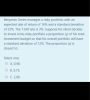 urgent, thanks
Benjamin Green manages a risky portfolio with an expected rate of return of 16% and a standard deviation of 25%. The T-bill rate is 3%. Suppose his client decides to invest in his risky portfolio a proportion (y) of his total investment budget so that his overall portfolio will have a standard deviation of 12%. The proportion (y) is closest to: Select one: O A. 0.48. OB. 0.75. O C. 2.08. Paul Lynch manages a risky portfolio with...
urgent, thanks
Benjamin Green manages a risky portfolio with an expected rate of return of 16% and a standard deviation of 25%. The T-bill rate is 3%. Suppose his client decides to invest in his risky portfolio a proportion (y) of his total investment budget so that his overall portfolio will have a standard deviation of 12%. The proportion (y) is closest to: Select one: O A. 0.48. OB. 0.75. O C. 2.08. Paul Lynch manages a risky portfolio with...
 2. (Understanding optimal portfolio choice) Consider two risky assets, the expected return of asset one is μ-0.1, the expected return of asset two is μ2-0.15, the risk or standard deviation of asset one is σ1-0.1, the risk or standard deviation of asset two is σ2-02. The two assets also happen to have zero correlation. An investor plans to build a portfolio by investing w of his investment to asset one and the rest of his investment to asset two. Calculate...
 Consider a portfolio consisting of the following two risky assets. Asset i Hi, Return on Asset i 7% 7% 0, Risk in Asset i 18% 14% The coefficient of correlation between the returns is p = -100%. (a) State the expected return and associated risk (as measured by the standard deviation) in terms of w if w is the weight allocation of Asset 1 in the portfolio. Hry (w) = 0.07 Or, (w) = sqrt(0.0632w^2-0.C (b) Suppose that the portfolio...
 urgent, thanks
Benjamin Green manages a risky portfolio with an expected rate of return of 16% and a standard deviation of 25%. The T-bill rate is 3%. Suppose his client decides to invest in his risky portfolio a proportion (y) of his total investment budget so that his overall portfolio will have a standard deviation of 12%. The proportion (y) is closest to: Select one: O A. 0.48. OB. 0.75. O C. 2.08. Paul Lynch manages a risky portfolio with...
urgent, thanks
Benjamin Green manages a risky portfolio with an expected rate of return of 16% and a standard deviation of 25%. The T-bill rate is 3%. Suppose his client decides to invest in his risky portfolio a proportion (y) of his total investment budget so that his overall portfolio will have a standard deviation of 12%. The proportion (y) is closest to: Select one: O A. 0.48. OB. 0.75. O C. 2.08. Paul Lynch manages a risky portfolio with...
Most questions answered within 3 hours.
-
Where is the error in this code sequence?
String s1 = "Hello";
String s2 = "ello";...
asked 10 months ago -
Financial data for Joel de Paris, Inc., for last year
follow:
Joel de Paris, Inc.
Balance...
asked 10 months ago -
Consider this reaction:
Al2(SO4)3 (aq)+ BaCl3
(aq) Al2Cl6 (aq)- +
3BaSO4(s) . What is the...
asked 10 months ago -
Suppose that Savneet is considering increasing her
recent random sample from 20 car rentals to 40...
asked 10 months ago -
Trucks arrive at an unloading terminal at an average rate of 120
per hour.
Trucks arrive...
asked 10 months ago -
Why are methanol and ethanol completely soluble in water while
octanol is not very little soluble....
asked 10 months ago -
A facilities manager at a university reads in a research report
that the mean amount of...
asked 10 months ago -
When the CuSO4 is rehydrated by adding water to the anhydrous
compound, is this an endothermic...
asked 10 months ago -
A ray of sunlight is passing from diamond into crown glass; the
angle of incidence is...
asked 10 months ago -
A block of mass 0.249 kg is placed on top of a light, vertical
spring of...
asked 10 months ago -
how do the kidneys compensate in the presences of acidosis
a) trigger hyperventilate
b) reserve acid...
asked 10 months ago -
Question 501 pts
The rental rate of capital to the firm increases. Which of the
following...
asked 10 months ago