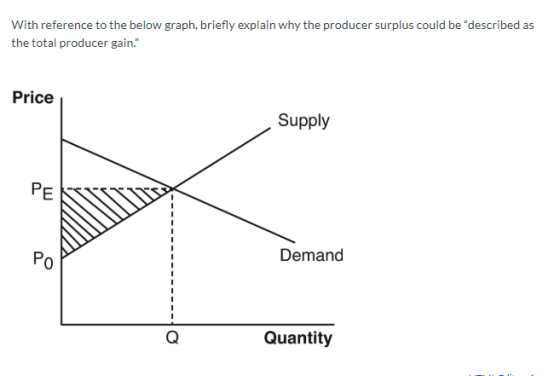
With reference to the below graph, briefly explain why the producer surplus could be “described as the total producer gain.”
HAVE TO TALK ABOUT THIS GRAPHIC!
Homework Answers
Producer surplus here is the shaded area i.e. the area between the price line and the supply curve. Producer surplus is the difference between the actual price received and the minimum acceptable price by the seller. Therefore, producer surplus is the total gain a producer receives and this gain is given by the area between supply curve and the price line.
Add Answer to:
With reference to the below graph, briefly explain why
the producer surplus could be “described as...
i know answer is B but could you explain why Figure: Gain In Producer Surplus Price...
 i know answer is B but could you explain why
Figure: Gain In Producer Surplus Price Quantity Refer to Figure: Gain in Producer Surplus. Identify the area or areas that represent the total change in consumer surplus when the price floor at P1 is lifted and the market reaches equilibrium price (i.e., market clearing price). a. A and B b. B and C price cant be below a certain point 4. D and E d. A, B, and C laborib
i know answer is B but could you explain why
Figure: Gain In Producer Surplus Price Quantity Refer to Figure: Gain in Producer Surplus. Identify the area or areas that represent the total change in consumer surplus when the price floor at P1 is lifted and the market reaches equilibrium price (i.e., market clearing price). a. A and B b. B and C price cant be below a certain point 4. D and E d. A, B, and C laborib
Assume there is a reduction in the price of materials needed to produce computers hardware such as graphic cards. Use a supply-and-demand diagram (draw a graph) to show what happens to price, quantity, consumer surplus, producer surplus, and total surplus
Assume there is a reduction in the price of materials needed to produce computers hardware such as graphic cards. Use a supply-and-demand diagram (draw a graph) to show what happens to price, quantity, consumer surplus, producer surplus, and total surplus in the market for computers graphic cards. And give five explanations for what had happened.
a. In the graph below, identify the areas of consumer surplus and producer surplus. Instructions: Use...
 a. In the graph below, identify the areas of consumer surplus and producer surplus. Instructions: Use the tool provided PS' to identify the area of producer surplus. This will drop a small triangle with 3 endpoints onto the graph. Drag the endpoints to the appropriate positions to identify the area of producer surplus. Then, use the tool provided CS and follow the same process for consumer surplus 0.26 points Tools Supply cs PS Demand Quantity b-lf the supply curve shifts...
QUESTION 38 On a graph, producer surplus is represented by the area A. below the demand...
 QUESTION 38 On a graph, producer surplus is represented by the area A. below the demand curve and above price. O B. between the demand and supply curves. C. below the price and above the supply curve. D. below the supply curve and to the left of equilibrium quantity.
Illustrate (draw a graph) consumer and producer surplus using demand and supply graph and explain how total surplus (consumer surplus plus producer surplus) can be maximised at the equilibrium level.
Illustrate (draw a graph) consumer and producer surplus using demand and supply graph and explain how total surplus (consumer surplus plus producer surplus) can be maximised at the equilibrium level.
5. Consumer surplus, producer surplus, and deadweight loss with quantity restrictions The following graph shows the...
 5. Consumer surplus, producer surplus, and deadweight loss with quantity restrictions The following graph shows the supply of (orange curve) and demand for (blue curve) DVD players. Determine the equilibrium price and quantity of DVD players. Based on this, use the green triangle (triangle symbols) to shade the area representing consumer surplus at the equilibrium price. Then, use the purple triangle (diamond symbols) to shade the area representing producer surplus at the equilibrium price. 200 180 Demand Consumer Surplus Producer...
Producer surplus is: a. Found on a graph as the area under the equilibrium price and...
Producer surplus is: a. Found on a graph as the area under the equilibrium price and above the supply curve. b. The net gain in economic well-being associated with producing and selling the equilibrium quantity of a good. c. Used to measure the impact of a change in price on the economic well-being of producers. d. All of the above. Please explain. Thank you!
Explain the impacts to the consumer surplus, producer surplus, and deadweight loss if the price floor...
 Explain the impacts to the consumer surplus, producer surplus, and deadweight loss if the price floor is below the equilibrium price? w Market demand is given as Qd 100 - 2P and market supply is given as Qs = P + 10. The equilibrium price is $30 and the equilibrium quantity is 40 units. At a price ceiling of $19, calculate the deadweight loss. Answer:
Use the graph below to answer this question. What is the producer surplus when the market...
 Use the graph below to answer this question. What is the producer surplus when the market is in equilibrium? 8 $12 8.15* Supply 5 229***e. 365 2 Demand 220 400 Quantity Paragraph ▼ IBI
6. On the first graph, show the initial consumer and producers' surplus. On the second graph,...
 6. On the first graph, show the initial consumer and producers' surplus. On the second graph, show how the producer and consumers surplus changes when supply increases. On the third graph, show how the producer and consumers surplus changes when demand increases Price rice Supply Supply Supply Demand Domand Demand Quantity Quantit) Quantity
 i know answer is B but could you explain why
Figure: Gain In Producer Surplus Price Quantity Refer to Figure: Gain in Producer Surplus. Identify the area or areas that represent the total change in consumer surplus when the price floor at P1 is lifted and the market reaches equilibrium price (i.e., market clearing price). a. A and B b. B and C price cant be below a certain point 4. D and E d. A, B, and C laborib
i know answer is B but could you explain why
Figure: Gain In Producer Surplus Price Quantity Refer to Figure: Gain in Producer Surplus. Identify the area or areas that represent the total change in consumer surplus when the price floor at P1 is lifted and the market reaches equilibrium price (i.e., market clearing price). a. A and B b. B and C price cant be below a certain point 4. D and E d. A, B, and C laborib
 a. In the graph below, identify the areas of consumer surplus and producer surplus. Instructions: Use the tool provided PS' to identify the area of producer surplus. This will drop a small triangle with 3 endpoints onto the graph. Drag the endpoints to the appropriate positions to identify the area of producer surplus. Then, use the tool provided CS and follow the same process for consumer surplus 0.26 points Tools Supply cs PS Demand Quantity b-lf the supply curve shifts...
 QUESTION 38 On a graph, producer surplus is represented by the area A. below the demand curve and above price. O B. between the demand and supply curves. C. below the price and above the supply curve. D. below the supply curve and to the left of equilibrium quantity.
 5. Consumer surplus, producer surplus, and deadweight loss with quantity restrictions The following graph shows the supply of (orange curve) and demand for (blue curve) DVD players. Determine the equilibrium price and quantity of DVD players. Based on this, use the green triangle (triangle symbols) to shade the area representing consumer surplus at the equilibrium price. Then, use the purple triangle (diamond symbols) to shade the area representing producer surplus at the equilibrium price. 200 180 Demand Consumer Surplus Producer...
 Explain the impacts to the consumer surplus, producer surplus, and deadweight loss if the price floor is below the equilibrium price? w Market demand is given as Qd 100 - 2P and market supply is given as Qs = P + 10. The equilibrium price is $30 and the equilibrium quantity is 40 units. At a price ceiling of $19, calculate the deadweight loss. Answer:
 Use the graph below to answer this question. What is the producer surplus when the market is in equilibrium? 8 $12 8.15* Supply 5 229***e. 365 2 Demand 220 400 Quantity Paragraph ▼ IBI
 6. On the first graph, show the initial consumer and producers' surplus. On the second graph, show how the producer and consumers surplus changes when supply increases. On the third graph, show how the producer and consumers surplus changes when demand increases Price rice Supply Supply Supply Demand Domand Demand Quantity Quantit) Quantity
Most questions answered within 3 hours.
-
Where is the error in this code sequence?
String s1 = "Hello";
String s2 = "ello";...
asked 10 months ago -
Financial data for Joel de Paris, Inc., for last year
follow:
Joel de Paris, Inc.
Balance...
asked 10 months ago -
Consider this reaction:
Al2(SO4)3 (aq)+ BaCl3
(aq) Al2Cl6 (aq)- +
3BaSO4(s) . What is the...
asked 10 months ago -
Suppose that Savneet is considering increasing her
recent random sample from 20 car rentals to 40...
asked 10 months ago -
Trucks arrive at an unloading terminal at an average rate of 120
per hour.
Trucks arrive...
asked 10 months ago -
Why are methanol and ethanol completely soluble in water while
octanol is not very little soluble....
asked 10 months ago -
A facilities manager at a university reads in a research report
that the mean amount of...
asked 10 months ago -
When the CuSO4 is rehydrated by adding water to the anhydrous
compound, is this an endothermic...
asked 10 months ago -
A ray of sunlight is passing from diamond into crown glass; the
angle of incidence is...
asked 10 months ago -
A block of mass 0.249 kg is placed on top of a light, vertical
spring of...
asked 10 months ago -
how do the kidneys compensate in the presences of acidosis
a) trigger hyperventilate
b) reserve acid...
asked 10 months ago -
Question 501 pts
The rental rate of capital to the firm increases. Which of the
following...
asked 10 months ago