Case Report:
A 56-year-old male anatomy professor at a well-known university in North Hollywood was brought to the emergency room at the UCLA Ronald Reagan Medical Center. His chief complaint was right flank pain.
History of present Illness:
One day prior to admission, the patient developed a change in the color of his urine from pale yellow to red in color. There was no associated fever, painful urination, or penile discharge. He decided to consult with his primary physician the following day.
One hour prior to admission, the patient developed severe right flank pain associated with nausea. His wife was brought him to the UCLA Ronald Reagan Medical Center. Upon admission, the patient was noted by the ER physician to be in severe pain, with a pain scale of 9 from a visual analog pain scale from 1 to 10. On physical exam, patient had the following findings:
- Vital Signs BP: 140/90
- Heart rate: 110/minute
- Respiration rate: 15/minute patient was afebrile
- All exam findings for the head, neck, heart, lungs, and abdomen were normal.
- On examination of the back, patient had tenderness on the right flank upon palpation.
- On examination of the genitalia, there was no penile discharge.
- Note of a 1 x 1 cm tophus on right big toe.
The following diagnostic exams were ordered:
- CBC with WBC differential count
- Urinalysis
- Serum uric acid
- KUB x-ray
- MRI Scan abdominopelvic area
He was immediately injected by IV with a strong analgesic to relieve the pain.
Past Medical History:
- Diagnosed with gout one year prior to admission
- On medication with allopurinol
- No heart and lung disease
- No diabetes or hypertension
Click here to review the results of the diagnostic exam.
Questions and topics for discussion:
- What would be the clinical diagnosis in this patient? Please explain in detail the pathogenesis of this disease.
- What are the clinical manifestations: signs, symptoms of this particular disease?
- Discuss and explain the results of the CBC, serum uric acid, and urinalysis.
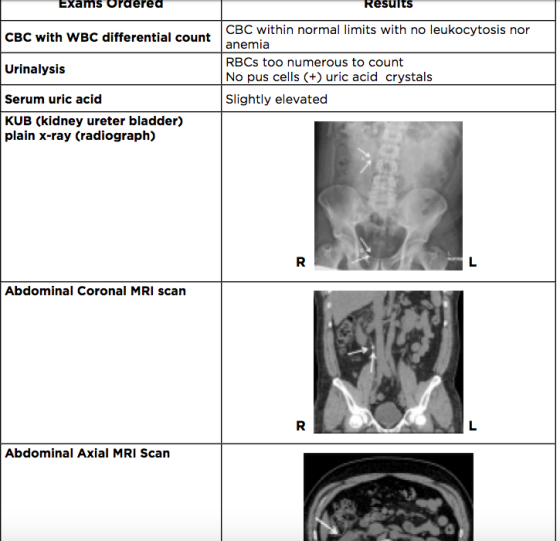
- What do you see in the plain KUB and the coronal MRI scan of the abdomen where the 2 upper arrows are located? Identify this particular lesion, where is it located, and the specific organs involved.
- Review the patient’s medical history. With this in mind, what is the specific type of lesion that you should expect to see and why?
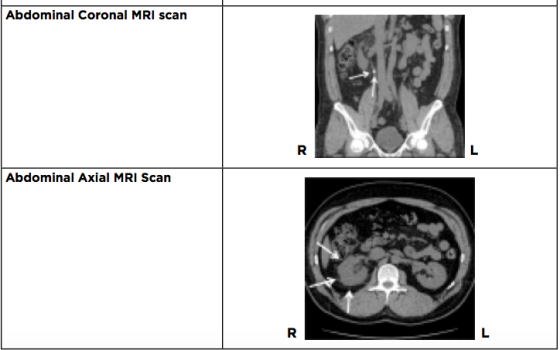
- On the axial scan of the abdomen, what is the organ pointed to by the three arrows? Is there anything wrong with this organ? If you answered yes, please explain in detail. What is a possible complication in this patient and the possible effect on the function of this organ in the long term?
- What are the possible treatment options both medical and surgical for this particular patient?
- Describe in detail the possible nursing intervention, especially with regards to diet and fluid intake.
Homework Answers
Q.What would be the clinical diagnosis in this patient? Please explain in detail the pathogenesis of this disease.
A.The diagnosis is nephrolithiasis.(stone in right ureter) Urinary tract stone is usually caused by two thingsThe first phenomenon is supersaturation of the urine by stone-forming constituents, like calcium, uric acid. Crystals or foreign bodies can act as nidus, upon which ions from the supersaturated urine form microscopic crystalline structures. The resulting calculi give rise to symptoms due to occlusion or tissue damage when they become impacted within the ureter as they pass toward the urinary bladder. Majority of renal calculi contain calcium
What are the clinical manifestations: signs, symptoms of this particular disease?
Patient will experience acute abrupt sometimes severe pain in the flank,(Renal colic)Along with that infection and haematuria also may present.The pain refers to inferiorly and anteriorly.half of the patients have nausea and vomiting.
Discuss and explain the results of the CBC, serum uric acid, and urinalysis.
CBC in case of infection the total leukocyte count may increase or leucocytosis or neutropenia indicating as surrogate marker for infection in absence of fever or hypothermia .moreover level of uric acid to know the present status after allopurinol treatment.And urine test will reveal if there is heamaturia or probable uti (pus cells and bacteria)
What do you see in the plain KUB and the coronal MRI scan of the abdomen where the 2 upper arrows are located? Identify this particular lesion, where is it located, and the specific organs involved.
The image shows calcified stone (radioopaque ). presumably calcium stone located in the middle part of right ureter.Specific organ involved is right kidney (if obstruction /infection is there) and right ureter.
Q.Review the patient’s medical history. With this in mind, what is the specific type of lesion that you should expect to see and why?
Majority uric acid stone former in nephrolithiasis are associated with metabolic disease and also frequently gout(tophi), metabolic disease and Low or acidic pH . here patient is on allopurinol , to combat high uric acid level.
So we can expect here urate stone.
Add Answer to:
Case Report:
A 56-year-old male anatomy professor at a well-known university
in North Hollywood was brought...
A 56-year-old male anatomy professor at a well-known university in North Hollywood was brought to the...
 A 56-year-old male anatomy professor at a well-known university in North Hollywood was brought to the emergency room at the UCLA Ronald Reagan Medical Center. His chief complaint was right flank pain. History of present IlIness: One day prior to admission, the patient developed a change in the color of his urine from pale yellow to red in color. There was no associated fever, painful urination, or penile discharge. He decided to consult with his primary physician the following day...
Case Report: A 56-year-old male anatomy professor at a well-known university in North Hollywood was brought...
Case Report: A 56-year-old male anatomy professor at a well-known university in North Hollywood was brought to the emergency room at the UCLA Ronald Reagan Medical Center. His chief complaint was right flank pain. History of present Illness: One day prior to admission, the patient developed a change in the color of his urine from pale yellow to red in color. There was no associated fever, painful urination, or penile discharge. He decided to consult with his primary physician the...
In patient with kidney stone with right renal calculi: Case Report: A 56-year-old male anatomy professor...
 In patient with kidney stone with right renal calculi:
Case Report:
A 56-year-old male anatomy professor at a well-known university
in North Hollywood was brought to the emergency room at the UCLA
Ronald Reagan Medical Center. His chief complaint was right flank
pain.
History of present Illness:
One day prior to admission, the patient developed a change in
the color of his urine from pale yellow to red in color. There was
no associated fever, painful urination, or penile discharge....
In patient with kidney stone with right renal calculi:
Case Report:
A 56-year-old male anatomy professor at a well-known university
in North Hollywood was brought to the emergency room at the UCLA
Ronald Reagan Medical Center. His chief complaint was right flank
pain.
History of present Illness:
One day prior to admission, the patient developed a change in
the color of his urine from pale yellow to red in color. There was
no associated fever, painful urination, or penile discharge....
Uncompensated Acid/Base Imbalance Case 1 Mrs. Benette, a 71 year old woman, is brought in by...
 Uncompensated Acid/Base Imbalance
Case 1
Mrs. Benette, a 71 year old woman, is brought in by ambulance to
the ED. She is very tired and lethargic but can communicate. She is
complaining of tinnitus (ringing in her ears) that she describes as
a freight train driving by her head and severe dyspepsia (upset
stomach). She has a medical history of rheumatoid arthritis. Upon
questioning of the patient, she tells you she is taking pain
medication for her arthritis but can’t...
Uncompensated Acid/Base Imbalance
Case 1
Mrs. Benette, a 71 year old woman, is brought in by ambulance to
the ED. She is very tired and lethargic but can communicate. She is
complaining of tinnitus (ringing in her ears) that she describes as
a freight train driving by her head and severe dyspepsia (upset
stomach). She has a medical history of rheumatoid arthritis. Upon
questioning of the patient, she tells you she is taking pain
medication for her arthritis but can’t...
Answer the questions according to given case study- Adam is a 68-year-old male admitted to the...
Answer the questions according to given case study- Adam is a 68-year-old male admitted to the hospital with a 1-month history of nausea, vomiting, and diarrhea resulting in weight loss and fatigue. He presents tachycardic with abdominal pain, fever, and chills. Adam is a retired engineer and lives at home with his wife. Anthropometric Data: Height: 165 cm (65”) Weight: 75 kg (165 lbs) BMI: 27.5 kg/m2 Weight History Usual body weight: 82 kg (180 lbs) 1 year ago Biochemical...
Mr. Williams is a 69 year old male who arrived at the emergency department, complaining of...
 Mr. Williams is a 69 year old male who arrived at the emergency department, complaining of severe vomiting & weakness for two days. Identifying Information: 69 yr old male History of Present illness: 69 yr old male presented to the ED c/o of severe vomiting & weakness for two days. He states he has taken the medications for vomiting but can't hold anything down. He feels dizzy when standing up and feels very weak. Currently being treated for tongue cancer....
Adam is a 68-year-old male admitted to the hospital with a 1-month history of nausea, vomiting,...
Adam is a 68-year-old male admitted to the hospital with a 1-month history of nausea, vomiting, and diarrhea resulting in weight loss and fatigue. He presents tachycardic with abdominal pain, fever, and chills. Adam is a retired engineer and lives at home with his wife. Anthropometric Data: Height: 165 cm (65”) Weight: 75 kg (165 lbs) BMI: 27.5 kg/m2 Weight History Usual body weight: 82 kg (180 lbs) 1 year ago Biochemical Data: Sodium 129 (135-145 mEq/L) Potassium 3.2 (3.6-5.0...
Phillip, a 25-year-old male, presented to the hospital emergency department (ED) complaining of headaches, nausea, dizziness,...
Phillip, a 25-year-old male, presented to the hospital emergency department (ED) complaining of headaches, nausea, dizziness, and episodes of repetitive vomiting. He was conscious and denied having chest pain, shortness of breath, abdominal pain, diarrhea, and hematemesis. He also stated that he did not smoke, drink, or use illicit drugs. While being interviewed further, Phillip did reveal to the clinician that he had attempted suicide in the past and had a history of depression. He was currently taking olanzapine (Zyprexa),...
Nursing help needed: Ted is a 67-year-old male with no significant past medical history, except for...
Nursing help needed: Ted is a 67-year-old male with no significant past medical history, except for occasional migraine headaches. He is married, has two grown children, and is retired from the Air Force. He does not smoke and does not use alcohol. He has no regular exercise program but does try to eat healthy. On June 15, Ted awoke with pain in his chin and jaw that radiated to his left ear. The next day, he visited his physician, as...
 A 56-year-old male anatomy professor at a well-known university in North Hollywood was brought to the emergency room at the UCLA Ronald Reagan Medical Center. His chief complaint was right flank pain. History of present IlIness: One day prior to admission, the patient developed a change in the color of his urine from pale yellow to red in color. There was no associated fever, painful urination, or penile discharge. He decided to consult with his primary physician the following day...
 In patient with kidney stone with right renal calculi:
Case Report:
A 56-year-old male anatomy professor at a well-known university
in North Hollywood was brought to the emergency room at the UCLA
Ronald Reagan Medical Center. His chief complaint was right flank
pain.
History of present Illness:
One day prior to admission, the patient developed a change in
the color of his urine from pale yellow to red in color. There was
no associated fever, painful urination, or penile discharge....
In patient with kidney stone with right renal calculi:
Case Report:
A 56-year-old male anatomy professor at a well-known university
in North Hollywood was brought to the emergency room at the UCLA
Ronald Reagan Medical Center. His chief complaint was right flank
pain.
History of present Illness:
One day prior to admission, the patient developed a change in
the color of his urine from pale yellow to red in color. There was
no associated fever, painful urination, or penile discharge....
 Uncompensated Acid/Base Imbalance
Case 1
Mrs. Benette, a 71 year old woman, is brought in by ambulance to
the ED. She is very tired and lethargic but can communicate. She is
complaining of tinnitus (ringing in her ears) that she describes as
a freight train driving by her head and severe dyspepsia (upset
stomach). She has a medical history of rheumatoid arthritis. Upon
questioning of the patient, she tells you she is taking pain
medication for her arthritis but can’t...
Uncompensated Acid/Base Imbalance
Case 1
Mrs. Benette, a 71 year old woman, is brought in by ambulance to
the ED. She is very tired and lethargic but can communicate. She is
complaining of tinnitus (ringing in her ears) that she describes as
a freight train driving by her head and severe dyspepsia (upset
stomach). She has a medical history of rheumatoid arthritis. Upon
questioning of the patient, she tells you she is taking pain
medication for her arthritis but can’t...
 Mr. Williams is a 69 year old male who arrived at the emergency department, complaining of severe vomiting & weakness for two days. Identifying Information: 69 yr old male History of Present illness: 69 yr old male presented to the ED c/o of severe vomiting & weakness for two days. He states he has taken the medications for vomiting but can't hold anything down. He feels dizzy when standing up and feels very weak. Currently being treated for tongue cancer....
Most questions answered within 3 hours.
-
Where is the error in this code sequence?
String s1 = "Hello";
String s2 = "ello";...
asked 11 months ago -
Financial data for Joel de Paris, Inc., for last year
follow:
Joel de Paris, Inc.
Balance...
asked 11 months ago -
Consider this reaction:
Al2(SO4)3 (aq)+ BaCl3
(aq) Al2Cl6 (aq)- +
3BaSO4(s) . What is the...
asked 11 months ago -
Suppose that Savneet is considering increasing her
recent random sample from 20 car rentals to 40...
asked 11 months ago -
Trucks arrive at an unloading terminal at an average rate of 120
per hour.
Trucks arrive...
asked 11 months ago -
Why are methanol and ethanol completely soluble in water while
octanol is not very little soluble....
asked 11 months ago -
A facilities manager at a university reads in a research report
that the mean amount of...
asked 11 months ago -
When the CuSO4 is rehydrated by adding water to the anhydrous
compound, is this an endothermic...
asked 11 months ago -
A ray of sunlight is passing from diamond into crown glass; the
angle of incidence is...
asked 11 months ago -
A block of mass 0.249 kg is placed on top of a light, vertical
spring of...
asked 11 months ago -
how do the kidneys compensate in the presences of acidosis
a) trigger hyperventilate
b) reserve acid...
asked 11 months ago -
Question 501 pts
The rental rate of capital to the firm increases. Which of the
following...
asked 11 months ago