
Homework Answers
zero
govenrment securities are always provide no risk,so the return from the securities will also less.when risk increases the return also increases,if an investor dont want to take risk,then they can take government securities as the risk is zero
Add Answer to:
Question 4 (0.2 points) The risk premium on long-term government bonds is equal to: 1) the...
The average risk premium on long-term government bonds for the period 1926-2014 was equal to: zero....
 The average risk premium on long-term government bonds for the period 1926-2014 was equal to: zero. 1 percent the rate of return on the bonds plus the corporate bond rate. the rate of return on the bonds minus the T-bill rate. the rate of return on the bonds minus the inflation rate.
The market has an expected rate of return of 9.8 percent. The long-term government bond is...
The market has an expected rate of return of 9.8 percent. The long-term government bond is expected to yield 4.5 percent and the U.S. Treasury bill is expected to yield 3.4 percent. The inflation rate is 3.1 percent. What is the market risk premium?
The market has an expected rate of return of 11.2 percent. The long-term government bond is...
The market has an expected rate of return of 11.2 percent. The long-term government bond is expected to yield 5.8 percent and the U.S. Treasury bill is expected to yield 3.9 percent. The inflation rate is 3.6 percent. What is the market risk premium?
Consider the following information for a period of years Long-term government bonds Long-term corporate bonds Inflation...
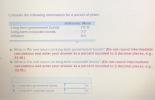 Consider the following information for a period of years Long-term government bonds Long-term corporate bonds Inflation Arithmetic Mean 7.6% 7.7 4.6 un a. What is the real return on long-term government bonds? (Do not round intermediate calculations and enter your answer as a percent rounded to 2 decimal places, e.g., 32.16.) b. What is the real return on long-term corporate bonds? (Do not round intermediate calculations and enter your answer as a percent rounded to 2 decimal places, e.g. 32.16.)...
Consider the following information for a period of years: Arithmetic Mean 7.5% Long-term government bonds Long-term...
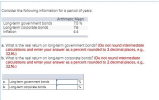 Consider the following information for a period of years: Arithmetic Mean 7.5% Long-term government bonds Long-term corporate bonds Inflation a. What is the real return on long-term government bonds? (Do not round Intermediate calculations and enter your answer as a percent rounded to 2 decimal places, e.g.. 32.16.) Ib. What is the real return on long-term corporate bonds? (Do not round Intermediate calculations and enter your answer as a percent rounded to 2 decimal places, e.g.. 32.16.) a. Long-term government...
Consider the following information for a period of years: Arithmetic Mean Long-term government bonds Long-term corp...
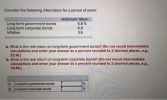 Consider the following information for a period of years: Arithmetic Mean Long-term government bonds Long-term corporate bonds Inflation 6.8% 6.9 3.6 a. What is the real return on long-term government bonds? (Do not round intermediate calculations and enter your answer as a percent rounded to 2 decimal places, e.g., 32.16.) b. What is the real return on long-term corporate bonds? (Do not round intermediate calculations and enter your answer as a percent rounded to 2 decimal places, e.g., 32.16.) %...
If 10-year T-bonds have a yield of 5.2%, 10-year corporate bonds yield 7.5%, the maturity risk premium on all 10-year bonds is 1.1%, and corporate bonds have a 0.2% liquidity premium versus a zero liquidity premium for T-bonds, what is the default risk pr
If 10-year T-bonds have a yield of 5.2%, 10-year corporate bonds yield 7.5%, the maturity risk premium on all 10-year bonds is 1.1%, and corporate bonds have a 0.2% liquidity premium versus a zero liquidity premium for T-bonds, what is the default risk premium on the corporate bond?a. 1.00%b. 1.10%c. 1.20%d. 1.30%e. 1.40%
Question 13 (0.2 points) Which one of the following is the computation of the risk premium...
 Question 13 (0.2 points) Which one of the following is the computation of the risk premium for an individual security? E(R) is the expected return on the security, Rfis the risk-free rate, B is the security's beta, and E(RM) is the expected rate of return on the market. O 1) E(RM) - RF O2) B[E(RM) - RA O 3) E(R) - E(RM) 04) E(R) - [E(RM) + RA View hint for Question 13 Question 14 (0.2 points) Which one of...
14 Over the last one hundred years a. long term government bonds have outperformed large company...
 14 Over the last one hundred years a. long term government bonds have outperformed large company stocks b long term government bonds have outperformed Treasury bills c interest income plus operating income d Inflation has been higher than long-term government bonds 15 Let's say a company's stock price falls significanlty immediatley after reports of dissapointing sales during the period are announced. This best describes a. strong form market efficiency b weak form market efficiency c neutral form efficient d volatile...
23. (a) = 4% You are given the following data for a corporate bond in a...
 23. (a) = 4% You are given the following data for a corporate bond in a particular economy: r* = real risk-free rate Inflation premium Maturity risk premium = 1% Default risk premium Liquidity premium = 7% = 3% = 2% Assume that a highly liquid market does not exist for long-term Treasury bonds in that economy, and the expected rate of inflation is constant. Given these conditions find the appropriate rates for a Treasury bill and a long-term Treasury...
 The average risk premium on long-term government bonds for the period 1926-2014 was equal to: zero. 1 percent the rate of return on the bonds plus the corporate bond rate. the rate of return on the bonds minus the T-bill rate. the rate of return on the bonds minus the inflation rate.
 Consider the following information for a period of years Long-term government bonds Long-term corporate bonds Inflation Arithmetic Mean 7.6% 7.7 4.6 un a. What is the real return on long-term government bonds? (Do not round intermediate calculations and enter your answer as a percent rounded to 2 decimal places, e.g., 32.16.) b. What is the real return on long-term corporate bonds? (Do not round intermediate calculations and enter your answer as a percent rounded to 2 decimal places, e.g. 32.16.)...
 Consider the following information for a period of years: Arithmetic Mean 7.5% Long-term government bonds Long-term corporate bonds Inflation a. What is the real return on long-term government bonds? (Do not round Intermediate calculations and enter your answer as a percent rounded to 2 decimal places, e.g.. 32.16.) Ib. What is the real return on long-term corporate bonds? (Do not round Intermediate calculations and enter your answer as a percent rounded to 2 decimal places, e.g.. 32.16.) a. Long-term government...
 Consider the following information for a period of years: Arithmetic Mean Long-term government bonds Long-term corporate bonds Inflation 6.8% 6.9 3.6 a. What is the real return on long-term government bonds? (Do not round intermediate calculations and enter your answer as a percent rounded to 2 decimal places, e.g., 32.16.) b. What is the real return on long-term corporate bonds? (Do not round intermediate calculations and enter your answer as a percent rounded to 2 decimal places, e.g., 32.16.) %...
 Question 13 (0.2 points) Which one of the following is the computation of the risk premium for an individual security? E(R) is the expected return on the security, Rfis the risk-free rate, B is the security's beta, and E(RM) is the expected rate of return on the market. O 1) E(RM) - RF O2) B[E(RM) - RA O 3) E(R) - E(RM) 04) E(R) - [E(RM) + RA View hint for Question 13 Question 14 (0.2 points) Which one of...
 14 Over the last one hundred years a. long term government bonds have outperformed large company stocks b long term government bonds have outperformed Treasury bills c interest income plus operating income d Inflation has been higher than long-term government bonds 15 Let's say a company's stock price falls significanlty immediatley after reports of dissapointing sales during the period are announced. This best describes a. strong form market efficiency b weak form market efficiency c neutral form efficient d volatile...
 23. (a) = 4% You are given the following data for a corporate bond in a particular economy: r* = real risk-free rate Inflation premium Maturity risk premium = 1% Default risk premium Liquidity premium = 7% = 3% = 2% Assume that a highly liquid market does not exist for long-term Treasury bonds in that economy, and the expected rate of inflation is constant. Given these conditions find the appropriate rates for a Treasury bill and a long-term Treasury...
Most questions answered within 3 hours.
-
Where is the error in this code sequence?
String s1 = "Hello";
String s2 = "ello";...
asked 10 months ago -
Financial data for Joel de Paris, Inc., for last year
follow:
Joel de Paris, Inc.
Balance...
asked 10 months ago -
Consider this reaction:
Al2(SO4)3 (aq)+ BaCl3
(aq) Al2Cl6 (aq)- +
3BaSO4(s) . What is the...
asked 10 months ago -
Suppose that Savneet is considering increasing her
recent random sample from 20 car rentals to 40...
asked 10 months ago -
Trucks arrive at an unloading terminal at an average rate of 120
per hour.
Trucks arrive...
asked 10 months ago -
Why are methanol and ethanol completely soluble in water while
octanol is not very little soluble....
asked 10 months ago -
A facilities manager at a university reads in a research report
that the mean amount of...
asked 10 months ago -
When the CuSO4 is rehydrated by adding water to the anhydrous
compound, is this an endothermic...
asked 10 months ago -
A ray of sunlight is passing from diamond into crown glass; the
angle of incidence is...
asked 10 months ago -
A block of mass 0.249 kg is placed on top of a light, vertical
spring of...
asked 10 months ago -
how do the kidneys compensate in the presences of acidosis
a) trigger hyperventilate
b) reserve acid...
asked 10 months ago -
Question 501 pts
The rental rate of capital to the firm increases. Which of the
following...
asked 10 months ago