
Homework Answers
Add Answer to:
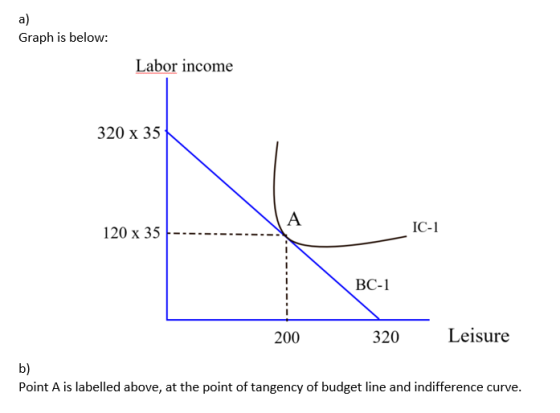
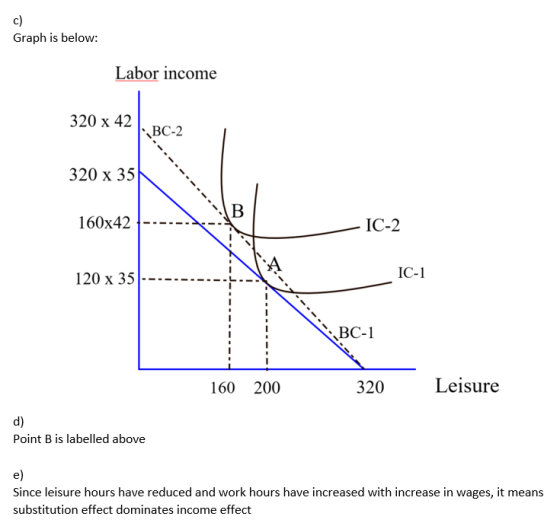
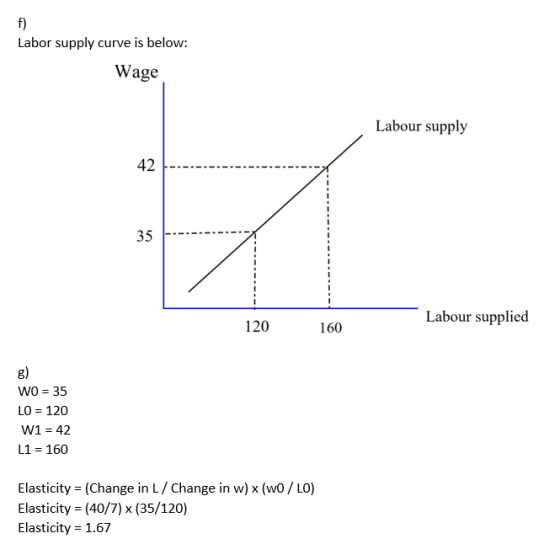
2a) Suppose Henley has 320 hours available each month to devote to either labor or leisure....
Jeff has 400 hours each month to devote to either leisure or work. For each hour...
Jeff has 400 hours each month to devote to either leisure or work. For each hour he chooses to work, he earns a wage of $40. Written in terms of leisure in hours (L) and consumption in dollars (C), Jeff's budget constraint is
Gina works at a diner. She has 100 hours each week to spend at labor/leisure, earns...
 Gina works at a diner. She has 100 hours each week to spend at labor/leisure, earns a wage of $15 per hour, and works in a fancy modern restaurant that doesn't involve tips from customers. She has no sources of non-labor income, but she does have to pay $200 per week in childcare for her precious baby Carlos (regardless of how many hours she actually utilizes the childcare). Her utility function is U 1. 0.001CL2 (3 points) Each week she...
Draw a graph with leisure on the horizontal axis and income on the vertical axis. Assume 320...
Draw a graph with leisure on the horizontal axis and income on the vertical axis. Assume 320 discretionary hours in a month, that can be used for labor or leisure, and that the wage is $10 an hour. Draw the budget constraint, and an indifference curve corresponding to choosing a full time 160 hour a month job. Label earnings. Assume the family would qualify for $600 in TANF benefits each month if hours of labor are zero. The program offers a $225 earned...
On a separate sheet of paper, draw a labor-leisure diagram with consumption ($) on the vertical...
On a separate sheet of paper, draw a labor-leisure diagram with consumption ($) on the vertical axis, and hours of leisure on the horizontal axis. Assume there are 16 discretionary hours in a day, and that wage is $20 per hour, and unearned income, V, is $100. Draw the budget constraint for a day, labeling the endpoints, and draw a utility maximizing indifference curve. Label approximate hours of leisure, labor, and earnings at the optimal point (choose numbers that appear...
On a separate sheet of paper, draw a graph representing the labor leisure decision over a...
On a separate sheet of paper, draw a graph representing the labor leisure decision over a year, with 4000 discretionary hours in a year. Label your axes with leisure on the horizontal axis, and consumption on the vertical axis. Assume the wage is $20 per hour. Draw a budget constraint and label the endpoints. Carefully draw an indifference curve for a utility maximizing worker who initially chooses 1500 hours of work per year. Label hours of leisure, hours of labor,...
INCOME (Dollars) Kate has 80 hours per week to devote to working or to leisure. She...
 INCOME (Dollars) Kate has 80 hours per week to devote to working or to leisure. She is paid an hourly wage and can work at her job as many hours a week as she likes. The following graph illustrates Kate's weekly income-lelsure tradeoff. The three lines labeled BC, BC, and BC illustrate her time allocation budget at three different wages; points A, B, and C show her optimal time allocation choices along each of these constralints BC 1200 BC 800...
Erin has the following utility over cookies and leisure. U = min(31,c) (Utility) 5 € 4...
 Erin has the following utility over cookies and leisure. U = min(31,c) (Utility) 5 € 4 3 2 1 0 0 0.33 0.67 + 5 1 2 3 4 Her indifference curves are plotted in the above graph. She can choose from the following five bundles for leisure and consumption (l,c): 1. Point 1: (3,3) 2. Point 2: (2,2) 3. Point 3: (1,1) 4. Point 4: (3,2) 5. Point 5: (3,1) a. What is her utility from each bundle? b....
Leisure-labour choice 1. Mr. Cog works in a machine factory. He can work as many hours per day as he wishes at a wa...
 Leisure-labour choice 1. Mr. Cog works in a machine factory. He can work as many hours per day as he wishes at a wage rate of w. Let C be the number of dollars he spends on consumer goods and let R be the number of hours of leisure that he chooses. (a) Mr. Cog earns $8 an hour and has 18 hours per day to devote to labor or leisure, and he has $16 of nonlabor income per day....
Problem #1: Optimal labor supply Clark gains utility from consumption c and leisure l and his...
Problem #1: Optimal labor supply Clark gains utility from consumption c and leisure l and his preferences for consumption and leisure can be expressed as U(c, l) = 2(√ c)(l). This utility function implies that Clark’s marginal utility of leisure is 2√ c and his marginal utility of consumption is l √ c . He has 16 hours per day to allocate between leisure (l) and work (h). His hourly wage is $12 after taxes. Clark also receives a daily...
1. Rachel has a labor-leisure utility function given by U(L, C) = 4L(C + 24) where...
1. Rachel has a labor-leisure utility function given by U(L, C) = 4L(C + 24) where the marginal utility of consumption is 4L and the marginal utility of leisure is 4C + 96. After taxes, she makes $12 per hour and has 16 hours a day to work or consume leisure. (a) What is her budget constraint? Graph it. Show on the graph where her optimal bundle would be (Hint: You don’t need to solve anything. Just be general). (b)...
 Gina works at a diner. She has 100 hours each week to spend at labor/leisure, earns a wage of $15 per hour, and works in a fancy modern restaurant that doesn't involve tips from customers. She has no sources of non-labor income, but she does have to pay $200 per week in childcare for her precious baby Carlos (regardless of how many hours she actually utilizes the childcare). Her utility function is U 1. 0.001CL2 (3 points) Each week she...
 INCOME (Dollars) Kate has 80 hours per week to devote to working or to leisure. She is paid an hourly wage and can work at her job as many hours a week as she likes. The following graph illustrates Kate's weekly income-lelsure tradeoff. The three lines labeled BC, BC, and BC illustrate her time allocation budget at three different wages; points A, B, and C show her optimal time allocation choices along each of these constralints BC 1200 BC 800...
 Erin has the following utility over cookies and leisure. U = min(31,c) (Utility) 5 € 4 3 2 1 0 0 0.33 0.67 + 5 1 2 3 4 Her indifference curves are plotted in the above graph. She can choose from the following five bundles for leisure and consumption (l,c): 1. Point 1: (3,3) 2. Point 2: (2,2) 3. Point 3: (1,1) 4. Point 4: (3,2) 5. Point 5: (3,1) a. What is her utility from each bundle? b....
 Leisure-labour choice 1. Mr. Cog works in a machine factory. He can work as many hours per day as he wishes at a wage rate of w. Let C be the number of dollars he spends on consumer goods and let R be the number of hours of leisure that he chooses. (a) Mr. Cog earns $8 an hour and has 18 hours per day to devote to labor or leisure, and he has $16 of nonlabor income per day....
Most questions answered within 3 hours.
-
Where is the error in this code sequence?
String s1 = "Hello";
String s2 = "ello";...
asked 10 months ago -
Financial data for Joel de Paris, Inc., for last year
follow:
Joel de Paris, Inc.
Balance...
asked 10 months ago -
Consider this reaction:
Al2(SO4)3 (aq)+ BaCl3
(aq) Al2Cl6 (aq)- +
3BaSO4(s) . What is the...
asked 10 months ago -
Suppose that Savneet is considering increasing her
recent random sample from 20 car rentals to 40...
asked 10 months ago -
Trucks arrive at an unloading terminal at an average rate of 120
per hour.
Trucks arrive...
asked 10 months ago -
Why are methanol and ethanol completely soluble in water while
octanol is not very little soluble....
asked 10 months ago -
A facilities manager at a university reads in a research report
that the mean amount of...
asked 10 months ago -
When the CuSO4 is rehydrated by adding water to the anhydrous
compound, is this an endothermic...
asked 10 months ago -
A ray of sunlight is passing from diamond into crown glass; the
angle of incidence is...
asked 10 months ago -
A block of mass 0.249 kg is placed on top of a light, vertical
spring of...
asked 10 months ago -
how do the kidneys compensate in the presences of acidosis
a) trigger hyperventilate
b) reserve acid...
asked 10 months ago -
Question 501 pts
The rental rate of capital to the firm increases. Which of the
following...
asked 10 months ago