Consider an economy in which the representative consumer preferences are described by U(C, l) = 0.9...
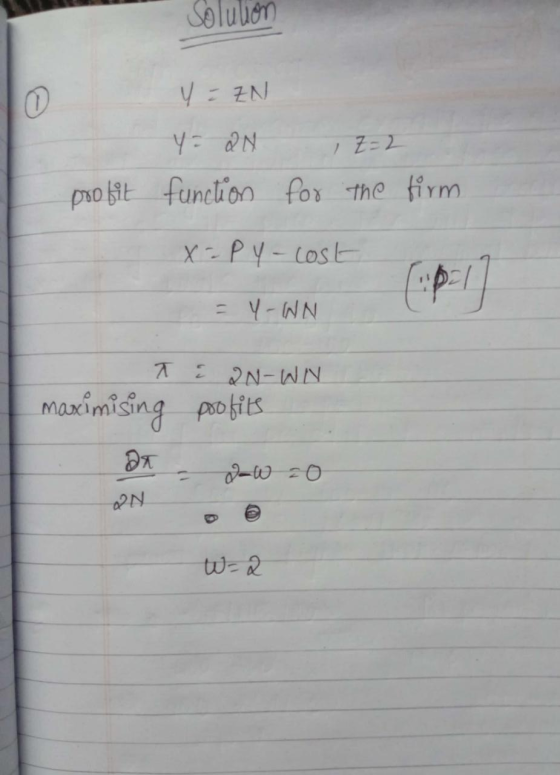
Consider an economy in which the representative consumer preferences are described by U(C, l) = 0.9 ln(C) + 0.1 ln(l). The total number of hours available to the representative consumer is h = 1, and the market real wage is w. The representative firm produces the final consumption good using the technology function Y = zN where N is the labour, and z = 2. Assume the government sets the level of its spending to G = 0.75 which has to be financed through a proportional tax t.
1. Given the linear specification of the production function, what will be the equilibrium wage w* ? .
Homework Answers
Add Answer to:
Consider an economy in which the representative consumer
preferences are described by U(C, l) = 0.9...
Consider a representative consumer who has preferences over an aggregate consumption good c and leisure l....
Consider a representative consumer who has preferences over an aggregate consumption good c and leisure l. Her preferences are described by the utility function: U(c,l) = ln(c) + ln(l) The consumer has a time endowment of h hours which can be used to work at the market or enjoyed as leisure. The real wage rate is w per hour. The worker pays a proportional wage tax of rate t, so the worker’s after-tax wage is (1−t)w. The consumer also has...
Problem 3: Inelastic labor supply A representative consumer has preferences described by the utility function: u(c)...
Problem 3: Inelastic labor supply A representative consumer has preferences described by the utility function: u(c) = ln c, where c denotes consumption. Assume that the total number of hours available to the worker are h¯ = 1. The consumer/worker receives the wage, w, for her labor services. A. Obtain the labor supply curve. B. Introduce a proportional tax on labor income, τw. Obtain the new labor supply curve. C. Introduce a proportional tax on consumption, τc. Obtain the new...
A representative consumer has preferences described by the utility function: uc, 1) = ln(c- c) +...
 A representative consumer has preferences described by the utility function: uc, 1) = ln(c- c) + Inl where c denotes consumption and I leisure. The parameter o captures the level of subsistence consumption. Assume that the total number of hours available to the worker are h = 1. The consumer/worker receives the wage, w, for her labor services. A. Obtain the labor supply curve. B. Introduce a proportional tax on labor income, T. Obtain the new labor supply curve. C....
3. Consider a representative consumer who has preferences over an aggregate consumption good e and leisure....
 3. Consider a representative consumer who has preferences over an aggregate consumption good e and leisure. Her preferences are described by the uility function: U(c,l) In(e) +In(l) The consumer has a time endowment of h hours which can be used to work at the market or enjoyed as leisure. The real wage rate is w per hour. The worker pays a proportional wage tax of rate t, so the worker's after-tax wage is (1 t). The consumer also has dividend...
Competitive Equilibrium (10 pts) Consider an economy with a representative consumer, a representative firm, and a...
Competitive Equilibrium (10 pts) Consider an economy with a representative consumer, a representative firm, and a government. • The consumer can work up to h hours at an hourly rate of w. She only gets utility from consumption and does not care about how much she works. Their preferences are represented by the utility function U(C, l) = ln(C). The consumer also owns an exogenously given K units of capital, which they can rent to the firms at a price...
Suppose the representative household has the following utility function: U (C; l) = ln C +...
Suppose the representative household has the following utility function: U (C; l) = ln C + 0:5 ln l where C is consumption and l is leisure. The householdís time constraint is l+N=1 where Ns is the representative householdís labour supply. Further assume that the production function is Cobb-Douglas zK0:5 (N)0:5 where z = 1 and K = 1: 2.1 Assuming that the government spending is G = 0; use the Social Plannerís problem to solve for Pareto optimal numerical...
Assume the representative consumer lives in two periods and his preferences can be described by U(c,...
Assume the representative consumer lives in two periods and his preferences can be described by U(c, c' ) = c ^(1/2) + β(c') ^(1/2) , where c is the current consumption, c' is next period consumption, and β = 0.95. Let’s assume that the consumer can borrow or lend at the interest rate r = 10%. The consumer receives an income y = 100 in the current period and y' = 110 in the next period. The government wants to...
Assume the representative consumer lives in two periods and his preferences can be described by the...
Assume the representative consumer lives in two periods and his preferences can be described by the utility function U(c; c') = c1/3 + B(c')1/3; where c is the current consumption, c' is next period consumption, and B = 0.95. Let's assume that the consumer can borrow or lend at the interest rate r = 10%. The consumer receives an income y = 100 in the current period and y' = 110 in the next period. The government wants to spend...
Consider the closed-economy one-period macroeconomic model. The consumer is endowed with h units of time, and...
Consider the closed-economy one-period macroeconomic model. The consumer is endowed with h units of time, and chooses consumption C and leisure ` to maximize U = log(C) + θlog(`), subject to the budget constraint C = wNs + π. Production is described by Y = zNd . Government spending G is financed with a proportional revenue tax (tax rate τ ) on the firm. Find the firm’s optimal demand for labor Nd , as a function of w and τ...
2. (20 POINTS) Consider an economy with one representative consumer and one representative firm. There is...
 2. (20 POINTS) Consider an economy with one representative consumer and one representative firm. There is no government (no taxes). The consumer's utility function is U = log(C) - N where cis consumption and N$ is labor supply. The consumer's budget constraint is c = WNS + it in real terms. The representative firm has a standard Cobb-Douglas production function F(z,K,N) = zkN1-4. Suppose z=1 and K=1 so that the production function is simplified to F(N) = N1-4. Set up...
 A representative consumer has preferences described by the utility function: uc, 1) = ln(c- c) + Inl where c denotes consumption and I leisure. The parameter o captures the level of subsistence consumption. Assume that the total number of hours available to the worker are h = 1. The consumer/worker receives the wage, w, for her labor services. A. Obtain the labor supply curve. B. Introduce a proportional tax on labor income, T. Obtain the new labor supply curve. C....
 3. Consider a representative consumer who has preferences over an aggregate consumption good e and leisure. Her preferences are described by the uility function: U(c,l) In(e) +In(l) The consumer has a time endowment of h hours which can be used to work at the market or enjoyed as leisure. The real wage rate is w per hour. The worker pays a proportional wage tax of rate t, so the worker's after-tax wage is (1 t). The consumer also has dividend...
 2. (20 POINTS) Consider an economy with one representative consumer and one representative firm. There is no government (no taxes). The consumer's utility function is U = log(C) - N where cis consumption and N$ is labor supply. The consumer's budget constraint is c = WNS + it in real terms. The representative firm has a standard Cobb-Douglas production function F(z,K,N) = zkN1-4. Suppose z=1 and K=1 so that the production function is simplified to F(N) = N1-4. Set up...
Most questions answered within 3 hours.
-
Where is the error in this code sequence?
String s1 = "Hello";
String s2 = "ello";...
asked 10 months ago -
Financial data for Joel de Paris, Inc., for last year
follow:
Joel de Paris, Inc.
Balance...
asked 10 months ago -
Consider this reaction:
Al2(SO4)3 (aq)+ BaCl3
(aq) Al2Cl6 (aq)- +
3BaSO4(s) . What is the...
asked 10 months ago -
Suppose that Savneet is considering increasing her
recent random sample from 20 car rentals to 40...
asked 10 months ago -
Trucks arrive at an unloading terminal at an average rate of 120
per hour.
Trucks arrive...
asked 10 months ago -
Why are methanol and ethanol completely soluble in water while
octanol is not very little soluble....
asked 10 months ago -
A facilities manager at a university reads in a research report
that the mean amount of...
asked 10 months ago -
When the CuSO4 is rehydrated by adding water to the anhydrous
compound, is this an endothermic...
asked 10 months ago -
A ray of sunlight is passing from diamond into crown glass; the
angle of incidence is...
asked 10 months ago -
A block of mass 0.249 kg is placed on top of a light, vertical
spring of...
asked 10 months ago -
how do the kidneys compensate in the presences of acidosis
a) trigger hyperventilate
b) reserve acid...
asked 10 months ago -
Question 501 pts
The rental rate of capital to the firm increases. Which of the
following...
asked 10 months ago