Karen needs to prepare povidone-iodine solution in the correct concentration to prepare the surgical site. The...
- Karen needs to prepare povidone-iodine solution in the correct
concentration to prepare the surgical site. The solution comes in a
7.5% concentration. Karen needs to dilute the solution to a
concentration of 1%. She needs 100ml of solution to prepare the
site.
- Identify the standard formula for preparing solutions. (1 point)
- How many milliliters of the 7.5% povidone-iodine should Karen start with? (2 points)
- How many milliliters of water does Karen need? (2 points)
Homework Answers
A) [Initial volume - V1] [Initial concentration- C1] = [Final volume- V2] [Final concentration- C2]
B) Final concentration = 1%
Final volume = 100 ml
Initial concentration = 7.5%
Initial volume = ?
V1 = (V2 C2) / C1
V1 = (100 * 1) / 7.5 = 13.33 ml
13.33 ml of 7.5% povidone-iodine solution is needed.
C) The final volume needed is 100 ml of which povidone-iodine solution is 13.33 ml and remaining is water. So
100-13.33 = 86.67 ml
• 13.33 ml of 7.5% povidone-iodine solution and 86.67 ml water make 1% 100 ml povidone-iodine solution.
Add Answer to:
Karen needs to prepare povidone-iodine solution in the correct
concentration to prepare the surgical site. The...
You are asked to prepare 2 liters of a 1:500 solution of povidone iodine. You find...
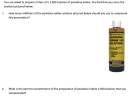 You are asked to prepare 2 liters of a 1:500 solution of povidone iodine. You find that you carry the product pictured below. 1. How many milliliters of the povidone iodine solution pictured below should you use to compound this prescription? NOC 0503-1550-56 POVIDONE IODINE 10% SOLUTION TOPICAL ANTISEPTIC BACTERICIDE FOR USE IN MINOR SKIN WOUND SCRAPES CUTS HET BOE (231 Qualitest II. What is the percent concentration of the preparation of povidone-iodine 1:500 solution that you compounded?
The veterinarian asks Karen to reconstitute a bottle of the antibiotic Ampicillin to administer intravenously. The...
The veterinarian asks Karen to reconstitute a bottle of the antibiotic Ampicillin to administer intravenously. The dosage of the drug is 3 mg/lb. Ampicillin comes in 3 g vials. Each vial needs to be mixed with a diluent for a final concentration of 300 mg/ml. Patient weighs 690kg. What dose weight of Ampicillin should Winnie receive? (2 points) What dose volume of Ampicillin should Winnie receive? (2 points) How many milliliters of diluent should be mixed with each 3 g...
Chemistry 2A Lab 13: Solution Calculations Introduction This lab involves sample calculations using various concentration units....
 Chemistry 2A Lab 13: Solution Calculations Introduction This lab involves sample calculations using various concentration units. This lab will work with the following types of concentration units: % mass, % volume, % mass/volume, and molarity. A solution is the sum total of the solute and solvent. % mass= mass solute mass solution -100 volumesolute .100 % volume- volume solution % mass/volume mass solute volumesolution -100 Molarity moles solute liters solution The dilution of a liquid requires the addition of more...
Chemistry 2A Lab 13: Solution Calculations Introduction This lab involves sample calculations using various concentration units....
 Chemistry 2A Lab 13: Solution Calculations Introduction This lab involves sample calculations using various concentration units. This lab will work with the following types of concentration units: % mass, % volume, % mass/volume, and molarity. A solution is the sum total of the solute and solvent. mass solute .100 % mass = mass solution volumesolute % volume 100 volume solution % mass/volume -.100 mass solute volumesolution Molarity moles solute liters solution The dilution of a liquid requires the addition of...
1.) You have a solution that is 18.5% (v/v) methyl alcohol. If the bottle contains 1.27...
1.) You have a solution that is 18.5% (v/v) methyl alcohol. If the bottle contains 1.27 L of solution, what is the volume (V) in milliliters of methyl alcohol? 2.) A 6.00 % (m/v) NaCl solution contains 26.8 g of NaCl. What is the total volume (V) of the solution in milliliters? 3.) 25.0 mL of a 6.0 M HNO3 stock solution is diluted using water to 100 mL. How many moles of HNO3 are present in the dilute solution?...
Chemistry 2A Lab 13: Solution Calculations Introduction This lab involves sample calculations using various concentration units....
 Chemistry 2A Lab 13: Solution Calculations Introduction This lab involves sample calculations using various concentration units. This lab will work with the following types of concentration units: % mass, % volume, % mass/volume, and molarity. A solution is the sum total of the solute and solvent. % mass= mass solute mass solution -100 volumesolute .100 % volume- volume solution % mass/volume mass solute volumesolution -100 Molarity moles solute liters solution The dilution of a liquid requires the addition of more...
Chemistry 2A Lab 13: Solution Calculations Introduction This lab involves sample calculations using various concentration units....
 Chemistry 2A Lab 13: Solution Calculations Introduction This lab involves sample calculations using various concentration units. This lab will work with the following types of concentration units: % mass, % volume, % mass/volume, and molarity. A solution is the sum total of the solute and solvent. mass solute 100 mass solution % mass- volumesolute -100 volume solution % volume mass solute 100 volumesolution % mass/ volume moles solute Molarity liters solution The dilution of a liquid requires the addition of...
6. Explain how you prepare the following dilute solution from more concentration.(Dilution) 5.00L of 6.00 M...
 6. Explain how you prepare the following dilute solution from more concentration.(Dilution) 5.00L of 6.00 M H2SO4 from a 18.0 M H2SO4 solution 7. 250 mL of 0.500 M CaCl2 from a 3.00 M CaCl2 solution.(Dilution) 8. Boiling point and Freezing point Elevation Calculate the boiling point and freezing points of water solutions that are 1.50 Min the KCl, a strong electrolyte. (the kb for water is 0.520, kf = 1.86)
A researcher needs 80 mL of an albumin solution at a concentration of 4 mg/mL. She...
A researcher needs 80 mL of an albumin solution at a concentration of 4 mg/mL. She uses a stock solution of albumin at 20 mg/mL and mixes it with water. How many mL of water and stock solution should be mixed?
To anesthetize Winnie, the veterinarian asks Karen to prepare a 1 L bag of “triple drip”...
To anesthetize Winnie, the veterinarian asks Karen to prepare a 1 L bag of “triple drip” that contains 5% Dextrose, 5% Guaifenesin, 1000 mg of Ketamine (100 mg/ml), and 500 mg of Xylazine (5000 mg/50ml). What volume of Ketamine should be added to the bag? (2 points) What volume of Xylazine should be added to the bag? (2 points) Karen continues preparing the bag of “triple dip” from Question 2 above. What volume of 50% Dextrose should be added to...
 You are asked to prepare 2 liters of a 1:500 solution of povidone iodine. You find that you carry the product pictured below. 1. How many milliliters of the povidone iodine solution pictured below should you use to compound this prescription? NOC 0503-1550-56 POVIDONE IODINE 10% SOLUTION TOPICAL ANTISEPTIC BACTERICIDE FOR USE IN MINOR SKIN WOUND SCRAPES CUTS HET BOE (231 Qualitest II. What is the percent concentration of the preparation of povidone-iodine 1:500 solution that you compounded?
 Chemistry 2A Lab 13: Solution Calculations Introduction This lab involves sample calculations using various concentration units. This lab will work with the following types of concentration units: % mass, % volume, % mass/volume, and molarity. A solution is the sum total of the solute and solvent. % mass= mass solute mass solution -100 volumesolute .100 % volume- volume solution % mass/volume mass solute volumesolution -100 Molarity moles solute liters solution The dilution of a liquid requires the addition of more...
 Chemistry 2A Lab 13: Solution Calculations Introduction This lab involves sample calculations using various concentration units. This lab will work with the following types of concentration units: % mass, % volume, % mass/volume, and molarity. A solution is the sum total of the solute and solvent. mass solute .100 % mass = mass solution volumesolute % volume 100 volume solution % mass/volume -.100 mass solute volumesolution Molarity moles solute liters solution The dilution of a liquid requires the addition of...
 Chemistry 2A Lab 13: Solution Calculations Introduction This lab involves sample calculations using various concentration units. This lab will work with the following types of concentration units: % mass, % volume, % mass/volume, and molarity. A solution is the sum total of the solute and solvent. % mass= mass solute mass solution -100 volumesolute .100 % volume- volume solution % mass/volume mass solute volumesolution -100 Molarity moles solute liters solution The dilution of a liquid requires the addition of more...
 Chemistry 2A Lab 13: Solution Calculations Introduction This lab involves sample calculations using various concentration units. This lab will work with the following types of concentration units: % mass, % volume, % mass/volume, and molarity. A solution is the sum total of the solute and solvent. mass solute 100 mass solution % mass- volumesolute -100 volume solution % volume mass solute 100 volumesolution % mass/ volume moles solute Molarity liters solution The dilution of a liquid requires the addition of...
 6. Explain how you prepare the following dilute solution from more concentration.(Dilution) 5.00L of 6.00 M H2SO4 from a 18.0 M H2SO4 solution 7. 250 mL of 0.500 M CaCl2 from a 3.00 M CaCl2 solution.(Dilution) 8. Boiling point and Freezing point Elevation Calculate the boiling point and freezing points of water solutions that are 1.50 Min the KCl, a strong electrolyte. (the kb for water is 0.520, kf = 1.86)
Most questions answered within 3 hours.
-
Where is the error in this code sequence?
String s1 = "Hello";
String s2 = "ello";...
asked 10 months ago -
Financial data for Joel de Paris, Inc., for last year
follow:
Joel de Paris, Inc.
Balance...
asked 10 months ago -
Consider this reaction:
Al2(SO4)3 (aq)+ BaCl3
(aq) Al2Cl6 (aq)- +
3BaSO4(s) . What is the...
asked 10 months ago -
Suppose that Savneet is considering increasing her
recent random sample from 20 car rentals to 40...
asked 10 months ago -
Trucks arrive at an unloading terminal at an average rate of 120
per hour.
Trucks arrive...
asked 10 months ago -
Why are methanol and ethanol completely soluble in water while
octanol is not very little soluble....
asked 10 months ago -
A facilities manager at a university reads in a research report
that the mean amount of...
asked 10 months ago -
When the CuSO4 is rehydrated by adding water to the anhydrous
compound, is this an endothermic...
asked 10 months ago -
A ray of sunlight is passing from diamond into crown glass; the
angle of incidence is...
asked 10 months ago -
A block of mass 0.249 kg is placed on top of a light, vertical
spring of...
asked 10 months ago -
how do the kidneys compensate in the presences of acidosis
a) trigger hyperventilate
b) reserve acid...
asked 10 months ago -
Question 501 pts
The rental rate of capital to the firm increases. Which of the
following...
asked 10 months ago