Refer to Figure 10.3. Inflation increases most rapidly as the economy moves from
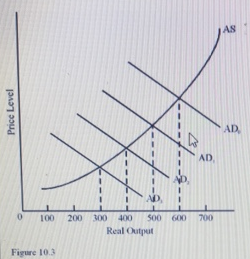
Refer to Figure 10.3. Inflation increases most rapidly as the economy moves from

Homework Answers

Add Answer to:
Refer to Figure 10.3. Inflation increases most rapidly as the economy moves from
4. Again refer to Figure 1, starting from point ", and assume the initial long-run equilibrium...
 4. Again refer to Figure 1, starting from point ", and assume the initial long-run equilibrium inflation rate is also the Fed's targeted inflation rate. (a) This cconomy sutfers a shock, and the inflation rate increases while real output falls. Most likely, this is a shock (indicate whether this isa positive (+) or a nagative (-)shock, causing thecurve toC Call the temporary equilibrium as "2" (b) The Central Bank decides to stabilize real output at the potential output level. It...
40. Inflation initiated by increases in wages or other resource prices is labeled A) demand-pull inflation....
 40. Inflation initiated by increases in wages or other resource prices is labeled A) demand-pull inflation. B) cost-pull inflation. - C) cost-push inflation. D) pull-cost inflation. 1. Cost-push inflation: A) is caused by too little total spending B) moves the nation's production possibilities curve leftward. C) moves the economy outward from its production possibilities curve. D) moves the economy production possibilities curve rightward. - Cost-push inflation may be caused by: A) a decline in per unit production costs. B) an...
Refer to figure above, An expansionary fiscal policy would be most effective in raising output with little or no inflation when the aggregate demand curve shifts from
 1. Refer to figure above, An expansionary fiscal policy would be most effective in raising output with little or no inflation when the aggregate demand curve shifts from a. AD1 to AD2.b. AD3 to AD4.c. AD5 to AD6.d. AD1 to AD6.
Refer to the figure below. Suppose the economy is in a short-run equilibrium at output Y3...
 Refer to the figure below. Suppose the economy is in a short-run
equilibrium at output Y3 and inflation rate
π2. The economy is currently experiencing ______, and
the correct monetary policy response to this situation, to return
the economy to potential GDP, is to ______.
Select one:
a. a recessionary gap; raise taxes
b. an expansionary gap; cut taxes
c. a recessionary gap; increase the money supply
d. an expansionary gap; decrease the money supply
Inflation rate ASI AS2 AD...
Refer to the figure below. Suppose the economy is in a short-run
equilibrium at output Y3 and inflation rate
π2. The economy is currently experiencing ______, and
the correct monetary policy response to this situation, to return
the economy to potential GDP, is to ______.
Select one:
a. a recessionary gap; raise taxes
b. an expansionary gap; cut taxes
c. a recessionary gap; increase the money supply
d. an expansionary gap; decrease the money supply
Inflation rate ASI AS2 AD...
Find the directions in which the function increases and decreases most rapidly at Po Then find...
 Find the directions in which the function increases and decreases most rapidly at Po Then find the derivatives of the function in these directions f(x,y,z) = (x/y) - yz, Po(-3.1.4) The direction in which the given function f(x,y,z) = (x/Y)- yz increases most rapidly at Po(-3.1.4) isu = 11+( 1+ k (Type exact answers, using radicals as needed) The direction in which the given function f(x,y,z) = (x/y) - yz decreases most rapidly at Po(-3.1.4) is -u=1:-( k (Type exact...
Refer to the figure above. If Roller Skates Unlimited moves from isoquant A to isoquant B,...
 Refer to the figure above. If Roller Skates Unlimited moves from
isoquant A to isoquant B, the number of roller skates produced
Group of answer choices
a) increases.
b) decreases.
c) remains constant, but Roller Skates Unlimited uses more
capital and labor.
d) remains constant, but input prices have risen.
Isoquants for producing roller skates Units of capital (K) A Units of labor(L) We were unable to transcribe this image
Refer to the figure above. If Roller Skates Unlimited moves from
isoquant A to isoquant B, the number of roller skates produced
Group of answer choices
a) increases.
b) decreases.
c) remains constant, but Roller Skates Unlimited uses more
capital and labor.
d) remains constant, but input prices have risen.
Isoquants for producing roller skates Units of capital (K) A Units of labor(L) We were unable to transcribe this image
For a given level of inflation expectations, if the central bank increases the money supply growth...
 For a given level of inflation expectations, if the central bank increases the money supply growth rate, then in the short run a. the Phillips curve shifts left b. the economy moves down along the short-run Phillips curve C. the economy moves up along the short-run Phillips curve. d. the Phillips curve shifts right.
Suppose an economy moves from a point inside of its production possibilities curve to a point...
Suppose an economy moves from a point inside of its production possibilities curve to a point on the curve. The most likely source of this economic growth is: Group of answer choices increases in the quality of inputs. demand and efficiency factors. technological change. supply factors.
Find the directions in which the function increases and decreases most rapidly at Po. Then find...
 Find the directions in which the function increases and decreases most rapidly at Po. Then find the derivatives of the function in those directions u f(x,y,z) = 4 In (xy) + 2 In (yz)+2 In (xz). Po(1,1,1) In which direction does the function increase most rapidly? (i+1+O (Type exact answers, using radicals as needed) In which direction does the function decrease most rapidly? = (1+) ;+ OK (Type exact answers, using radicals as needed.) What is the value of the...
Find a vector that gives the direction in which the given function increases most rapidly at...
 Find a vector that gives the direction in which the given function increases most rapidly at the indicated point. F(x, y, z) = xy2 + 6xz+y + 3yz?; (1,4,-1)
 4. Again refer to Figure 1, starting from point ", and assume the initial long-run equilibrium inflation rate is also the Fed's targeted inflation rate. (a) This cconomy sutfers a shock, and the inflation rate increases while real output falls. Most likely, this is a shock (indicate whether this isa positive (+) or a nagative (-)shock, causing thecurve toC Call the temporary equilibrium as "2" (b) The Central Bank decides to stabilize real output at the potential output level. It...
 40. Inflation initiated by increases in wages or other resource prices is labeled A) demand-pull inflation. B) cost-pull inflation. - C) cost-push inflation. D) pull-cost inflation. 1. Cost-push inflation: A) is caused by too little total spending B) moves the nation's production possibilities curve leftward. C) moves the economy outward from its production possibilities curve. D) moves the economy production possibilities curve rightward. - Cost-push inflation may be caused by: A) a decline in per unit production costs. B) an...
 Refer to the figure below. Suppose the economy is in a short-run
equilibrium at output Y3 and inflation rate
π2. The economy is currently experiencing ______, and
the correct monetary policy response to this situation, to return
the economy to potential GDP, is to ______.
Select one:
a. a recessionary gap; raise taxes
b. an expansionary gap; cut taxes
c. a recessionary gap; increase the money supply
d. an expansionary gap; decrease the money supply
Inflation rate ASI AS2 AD...
Refer to the figure below. Suppose the economy is in a short-run
equilibrium at output Y3 and inflation rate
π2. The economy is currently experiencing ______, and
the correct monetary policy response to this situation, to return
the economy to potential GDP, is to ______.
Select one:
a. a recessionary gap; raise taxes
b. an expansionary gap; cut taxes
c. a recessionary gap; increase the money supply
d. an expansionary gap; decrease the money supply
Inflation rate ASI AS2 AD...
 Find the directions in which the function increases and decreases most rapidly at Po Then find the derivatives of the function in these directions f(x,y,z) = (x/y) - yz, Po(-3.1.4) The direction in which the given function f(x,y,z) = (x/Y)- yz increases most rapidly at Po(-3.1.4) isu = 11+( 1+ k (Type exact answers, using radicals as needed) The direction in which the given function f(x,y,z) = (x/y) - yz decreases most rapidly at Po(-3.1.4) is -u=1:-( k (Type exact...
 Refer to the figure above. If Roller Skates Unlimited moves from
isoquant A to isoquant B, the number of roller skates produced
Group of answer choices
a) increases.
b) decreases.
c) remains constant, but Roller Skates Unlimited uses more
capital and labor.
d) remains constant, but input prices have risen.
Isoquants for producing roller skates Units of capital (K) A Units of labor(L) We were unable to transcribe this image
Refer to the figure above. If Roller Skates Unlimited moves from
isoquant A to isoquant B, the number of roller skates produced
Group of answer choices
a) increases.
b) decreases.
c) remains constant, but Roller Skates Unlimited uses more
capital and labor.
d) remains constant, but input prices have risen.
Isoquants for producing roller skates Units of capital (K) A Units of labor(L) We were unable to transcribe this image
 For a given level of inflation expectations, if the central bank increases the money supply growth rate, then in the short run a. the Phillips curve shifts left b. the economy moves down along the short-run Phillips curve C. the economy moves up along the short-run Phillips curve. d. the Phillips curve shifts right.
 Find the directions in which the function increases and decreases most rapidly at Po. Then find the derivatives of the function in those directions u f(x,y,z) = 4 In (xy) + 2 In (yz)+2 In (xz). Po(1,1,1) In which direction does the function increase most rapidly? (i+1+O (Type exact answers, using radicals as needed) In which direction does the function decrease most rapidly? = (1+) ;+ OK (Type exact answers, using radicals as needed.) What is the value of the...
 Find a vector that gives the direction in which the given function increases most rapidly at the indicated point. F(x, y, z) = xy2 + 6xz+y + 3yz?; (1,4,-1)
Most questions answered within 3 hours.
-
Where is the error in this code sequence?
String s1 = "Hello";
String s2 = "ello";...
asked 10 months ago -
Financial data for Joel de Paris, Inc., for last year
follow:
Joel de Paris, Inc.
Balance...
asked 10 months ago -
Consider this reaction:
Al2(SO4)3 (aq)+ BaCl3
(aq) Al2Cl6 (aq)- +
3BaSO4(s) . What is the...
asked 10 months ago -
Suppose that Savneet is considering increasing her
recent random sample from 20 car rentals to 40...
asked 10 months ago -
Trucks arrive at an unloading terminal at an average rate of 120
per hour.
Trucks arrive...
asked 10 months ago -
Why are methanol and ethanol completely soluble in water while
octanol is not very little soluble....
asked 10 months ago -
A facilities manager at a university reads in a research report
that the mean amount of...
asked 10 months ago -
When the CuSO4 is rehydrated by adding water to the anhydrous
compound, is this an endothermic...
asked 10 months ago -
A ray of sunlight is passing from diamond into crown glass; the
angle of incidence is...
asked 10 months ago -
A block of mass 0.249 kg is placed on top of a light, vertical
spring of...
asked 10 months ago -
how do the kidneys compensate in the presences of acidosis
a) trigger hyperventilate
b) reserve acid...
asked 10 months ago -
Question 501 pts
The rental rate of capital to the firm increases. Which of the
following...
asked 10 months ago