
Homework Answers
Option N
Explanation: when the economy is overheated, this means the actual output is larger than the potential output. In this situation, if aggregate demand increases further, it leads to even a higher price.
Add Answer to:
17. A large increase in aggregate demand in an overheated economy will tend to: M Increase...
(1) Other things being equal, which of the following will increase aggregate expenditures? Group of answer...
(1) Other things being equal, which of the following will increase aggregate expenditures? Group of answer choices An increase in domestic prices relative to foreign prices A decrease in the interest rate A decrease in real wealth An increase in income taxes A decrease in government purchases of goods and services (2) If the current unemployment rate is 5 percent and the natural unemployment rate is 6 percent, then the economy is Group of answer choices producing a level of...
The graph below depicts an economy where an increase in aggregate demand has caused inflation. The...
 The graph below depicts an economy where an increase in aggregate demand has caused inflation. The economy's current level of real GDP (Y2) is above its long-run equilibrium. This is illustrated by the long-run aggregate supply curve (LRAS) and a price level (P2) above the equilibrium value of Pe Fiscal Policy LRAS AS AD. 1 Real GDP Which of the following is an example of an automatic stabilizer that would help this economy move toward fll employment again? A reduction...
when all other influences on expenditure plans remain the same. Aggregate demand is the relationship between...
 when all other influences on expenditure plans remain the same. Aggregate demand is the relationship between the quantity of demanded and the OA. real GDP, price level O B. nominal GDP, interest rate O C. real GDP; exchange rate O D. nominal GDP, quantity of output supplied What is stagflation and why does cost-push inflation cause stagflation? Stagflation is a combination of a in the price level and in real GDP O A. rise; a decrease O B. fall; a...
In the graph, the initial aggregate supply curve is AS and the initial aggregate demand curve...
 In the graph, the initial aggregate supply curve is AS and the initial aggregate demand curve is ADo Some events that could have changed aggregate demand from AD, to AD are O A. a fall in the exchange rate or Price level 0 AS AS an increase in expected future inflation O B. a decrease in the money wage rate or 105 10 an increase in potential GDP ( 100 C. a decrease in expected future income or a decrease...
If the aggregate demand in the economy depicted below is AD2, ceteris paribus, what is likely...
 If the aggregate demand in the economy depicted below is AD2, ceteris paribus, what is likely to happen in this economy in the long run (without any government intervention)? Price level LRAS SRAS P3 AD3 AD1 2 AD2 2 Y Y Real GDP O The SRAS curve will shift to the right. Nominal wages will decrease. Nominal wages will increase. Both the nominal wages will decrease and the SRAS curve will shift to the right. O The SRAS curve will...
QUESTION 8 Higher rates of inflation would tend to: O a. increase velocity and decrease nominal...
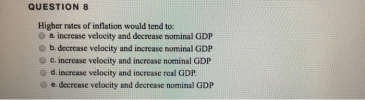 QUESTION 8 Higher rates of inflation would tend to: O a. increase velocity and decrease nominal GDP b. decrease velocity and increase nominal GDP c. increase velocity and increase nominal GDP e d. increase velocity and increase real GDP e. decrease velocity and decrease nominal GDP
Question 56 (1 point) Consider the aggregate supply-aggregate demand model. How does an increase in aggregate...
 Question 56 (1 point) Consider the aggregate supply-aggregate demand model. How does an increase in aggregate demand affect the unemployment rate and the inflation rate? LRAS: SRAS Price level (GDP deflator 2009 = 100) AD AD AD GDP, GDP, GDP AD AD AD2 GDP, GDP, GDP; Real GDP (trillions of 2009 dollars) The unemployment rate decreases and the inflation rate increases. ia The unemployment rate increases and the inflation rate decreases. Both the unemployment rate and the inflation rate increase....
An increase in aggregate demand (AD) can cause
Question 6 An increase in aggregate demand (AD) can cause an increase in cyclical unemployment. a recession in the economy. an expansion in the economy. Question 9 Which of the following would cause a negative demand shock (shift to the left) in aggregate demand? decreased availability of business capital increased government spending production costs falling Question 10For aggregate demand and aggregate supply to be an economic model, the equilibrium aggregate price level and equilibrium aggregate real GDP should only consider long run curves. be considered in individual markets. intersect.
The graph below depicts an economy where an increase in aggregate demand has caused inflation. The...
 The graph below depicts an economy where an increase in aggregate demand has caused inflation. The economy's current level of real GDP (Y) is above its long-run equilibrium. This is illustrated by the long-run aggregate supply curve (LRAS) and a price level 2) above the equilibrium value of Pe Fiscal Policy Price Level Real GDP Which of the following is an example of an automatic stabilizer that would help this economy move toward full employment again A reduced need for...
1. Most recessions originate from: a. an increase in aggregate demand c. an increase in...
1. Most recessions originate from: a. an increase in aggregate demand c. an increase in aggregate supply b. a decrease in aggregate demand d. a decrease in aggregate supply 2. In the 1930’s our main economic problem, said Keynes, was: a. too much government interference with the economy b. insufficient aggregate demand c. inflation d. huge budget deficits 3. Supply side economics stresses that: a. budget deficits will stimulate demand, output, and employment...
 The graph below depicts an economy where an increase in aggregate demand has caused inflation. The economy's current level of real GDP (Y2) is above its long-run equilibrium. This is illustrated by the long-run aggregate supply curve (LRAS) and a price level (P2) above the equilibrium value of Pe Fiscal Policy LRAS AS AD. 1 Real GDP Which of the following is an example of an automatic stabilizer that would help this economy move toward fll employment again? A reduction...
 when all other influences on expenditure plans remain the same. Aggregate demand is the relationship between the quantity of demanded and the OA. real GDP, price level O B. nominal GDP, interest rate O C. real GDP; exchange rate O D. nominal GDP, quantity of output supplied What is stagflation and why does cost-push inflation cause stagflation? Stagflation is a combination of a in the price level and in real GDP O A. rise; a decrease O B. fall; a...
 In the graph, the initial aggregate supply curve is AS and the initial aggregate demand curve is ADo Some events that could have changed aggregate demand from AD, to AD are O A. a fall in the exchange rate or Price level 0 AS AS an increase in expected future inflation O B. a decrease in the money wage rate or 105 10 an increase in potential GDP ( 100 C. a decrease in expected future income or a decrease...
 If the aggregate demand in the economy depicted below is AD2, ceteris paribus, what is likely to happen in this economy in the long run (without any government intervention)? Price level LRAS SRAS P3 AD3 AD1 2 AD2 2 Y Y Real GDP O The SRAS curve will shift to the right. Nominal wages will decrease. Nominal wages will increase. Both the nominal wages will decrease and the SRAS curve will shift to the right. O The SRAS curve will...
 QUESTION 8 Higher rates of inflation would tend to: O a. increase velocity and decrease nominal GDP b. decrease velocity and increase nominal GDP c. increase velocity and increase nominal GDP e d. increase velocity and increase real GDP e. decrease velocity and decrease nominal GDP
 Question 56 (1 point) Consider the aggregate supply-aggregate demand model. How does an increase in aggregate demand affect the unemployment rate and the inflation rate? LRAS: SRAS Price level (GDP deflator 2009 = 100) AD AD AD GDP, GDP, GDP AD AD AD2 GDP, GDP, GDP; Real GDP (trillions of 2009 dollars) The unemployment rate decreases and the inflation rate increases. ia The unemployment rate increases and the inflation rate decreases. Both the unemployment rate and the inflation rate increase....
 The graph below depicts an economy where an increase in aggregate demand has caused inflation. The economy's current level of real GDP (Y) is above its long-run equilibrium. This is illustrated by the long-run aggregate supply curve (LRAS) and a price level 2) above the equilibrium value of Pe Fiscal Policy Price Level Real GDP Which of the following is an example of an automatic stabilizer that would help this economy move toward full employment again A reduced need for...
Most questions answered within 3 hours.
-
Where is the error in this code sequence?
String s1 = "Hello";
String s2 = "ello";...
asked 10 months ago -
Financial data for Joel de Paris, Inc., for last year
follow:
Joel de Paris, Inc.
Balance...
asked 10 months ago -
Consider this reaction:
Al2(SO4)3 (aq)+ BaCl3
(aq) Al2Cl6 (aq)- +
3BaSO4(s) . What is the...
asked 10 months ago -
Suppose that Savneet is considering increasing her
recent random sample from 20 car rentals to 40...
asked 10 months ago -
Trucks arrive at an unloading terminal at an average rate of 120
per hour.
Trucks arrive...
asked 10 months ago -
Why are methanol and ethanol completely soluble in water while
octanol is not very little soluble....
asked 10 months ago -
A facilities manager at a university reads in a research report
that the mean amount of...
asked 10 months ago -
When the CuSO4 is rehydrated by adding water to the anhydrous
compound, is this an endothermic...
asked 10 months ago -
A ray of sunlight is passing from diamond into crown glass; the
angle of incidence is...
asked 10 months ago -
A block of mass 0.249 kg is placed on top of a light, vertical
spring of...
asked 10 months ago -
how do the kidneys compensate in the presences of acidosis
a) trigger hyperventilate
b) reserve acid...
asked 10 months ago -
Question 501 pts
The rental rate of capital to the firm increases. Which of the
following...
asked 10 months ago