Dave and Sharon Sampson recently established a plan to save $300 per month (or $3,600 per...
Dave and Sharon Sampson recently established a plan to save $300 per month (or $3,600 per year) for their children’s education. Their oldest child is six years old and will begin college in twelve years. They will invest the $300 in a savings account that they expect will earn interest of about 2% per year over the next twelve years. The Sampsons wonder how much additional money they would accumulate if they could earn 5% per year on the savings account instead of 2%. They also wonder how their savings would accumulate if they could save $400 per month (or $4,800 per year) instead of $300 per month.
-
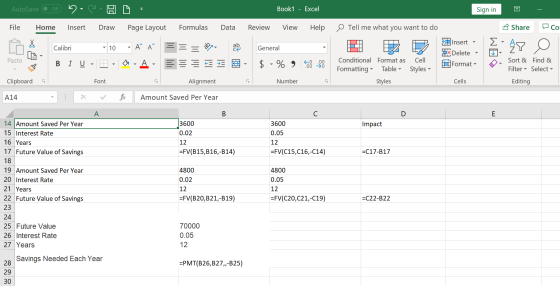
Help the Sampsons determine how much they will have for the children’s education by calculating how much $3,600 in annual savings will accumulate to if they earn interest of (a) 2% and (b) 5%. Next, determine how much $4,800 in annual savings will accumulate to if they earn interest of (a) 2% and (b) 5%.
Amount Saved Per Year $3,600 $3,600 Interest Rate 2% 5% Years 12 12 Future Value of Savings Amount Saved Per Year $4,800 $4,800 Interest Rate 2% 5% Years 12 12 Future Value of Savings -
What is the impact of the higher interest rate of 5% (instead of 2%) on the Sampsons’ accumulated savings?
-
What is the impact of the higher savings of $4,800 (instead of $3,600) on their accumulated savings?
-
If the Sampsons set a goal to save $70,000 for their children’s college education in twelve years, how would you determine the yearly savings necessary to achieve this goal? How much would they have to save by the end of each year to achieve this goal, assuming a 5% annual interest rate?
Future Value $70,000 Interest Rate 5% Years 12 Savings Needed Each Year
Homework Answers
| Amount Saved Per Year | 3600 | 3600 | Impact |
| Interest Rate | 0.02 | 0.05 | |
| Years | 12 | 12 | |
| Future Value of Savings | $48,283.52 | $57,301.66 | $9,018.13 |
| Amount Saved Per Year | 4800 | 4800 | |
| Interest Rate | 2% | 5% | |
| Years | 12 | 12 | |
| Future Value of Savings | $64,378.03 | $76,402.21 | $12,024.18 |
| Future Value | $70,000 |
| Interest Rate | 5% |
| Years | 12 |
| Savings Needed Each Year | $4,397.78 |
Workings
Add Answer to:
Dave and Sharon Sampson recently established a plan to save $300
per month (or $3,600 per...
please answer all 1. Help the Sampsons determine how much they will have for the children's...
 please answer all
1. Help the Sampsons determine how much they will have for the children's education by calculating how much $3,600 in annual savings will accumulate to if they earn interest of (a) 2 percent and (b) 5 percent. Next, determine how much $4,800 in annual savings will accumulate to if they earn interest of (a) 2 percent and (b) 5 percent. Savings Accumulated Over the Next 12 Years (Based on Plan to Save $3,600 per Year at 27...
please answer all
1. Help the Sampsons determine how much they will have for the children's education by calculating how much $3,600 in annual savings will accumulate to if they earn interest of (a) 2 percent and (b) 5 percent. Next, determine how much $4,800 in annual savings will accumulate to if they earn interest of (a) 2 percent and (b) 5 percent. Savings Accumulated Over the Next 12 Years (Based on Plan to Save $3,600 per Year at 27...
Recall that the Sampsons would like to save a total of $1,000 per month. They notice...
Recall that the Sampsons would like to save a total of $1,000 per month. They notice that their local bank offers the certificate of deposit (CD) rates listed in the following table; they now need to determine if they should invest in CDs, and if so, which CDs will best suit their savings goals. The Sampsons are saving for a down payment on a new car that they will purchase for Sharon within a year. They hope to save money...
Calculate the amount to be saved at the beginning of each year for 18 years, in...
Calculate the amount to be saved at the beginning of each year for 18 years, in order to accumulate $45,000 for each of the twins education, assuming a discount rate of 12% on their savings. They will commence their university study in the month of January. If instead, they save money at the end of the year, how much do they have to put aside to meet the same education funding goal?
You are trying to decide how much to save for retirement. Assume you plan to save...
 You are trying to decide how much to save for retirement. Assume you plan to save $5,500 per year with the first investment made one year from now. You think you can earn 11.5% per year on your investments and you plan to retire in 34 years, immediately after making your last $5.500 investment. a. How much will you have in your retirement account on the day you retire? b. If, instead of investing $5,500 per year, you wanted to...
You are trying to decide how much to save for retirement. Assume you plan to save...
 You are trying to decide how much to save for retirement. Assume you plan to save $5,000 per year with the first investment made one year from now. You think you can earn 5.0% per year on your investments and you plan to retire in 27 years, immediately after making your last S5,000 investment. a. How much will you have in your retirement account on the day you retire? b. If, instead of investing S5,000 per year, you wanted to...
You are trying to decide how much to save for retirement. Assume you plan to save...
You are trying to decide how much to save for retirement. Assume you plan to save $4,000 per year with the first investment made one year from now. You think you can earn 7.0% per year on your investments and you plan to retire in 45 years, immediately after making your last $4,000 investment. a. How much will you have in your retirement account on the day you retire? b. If, instead of investing $4,000 per year, you wanted to...
If you invest $2,500 today, $3,600 in 2 years, $4,500 in 5 years, and $1,600 in...
If you invest $2,500 today, $3,600 in 2 years, $4,500 in 5 years, and $1,600 in 7 years, how much will be in the bank 15 years from today if interest is 8.5% compounded annually? 2. Charlie hopes to accumulate $83,000 in a savings account in 10 years. If he wishes to make a single deposit today and the bank pays 3 percent compounded annually on deposits of this size, how much should Charlie deposit in the account? 3. If...
Leo plans to save $300 per month towards retirement at the begining of each month. how...
Leo plans to save $300 per month towards retirement at the begining of each month. how much would he have at the enf of 45 years, assuming an interest rate of 10.2% multiple choice: a. $3,402,878 b. $3,170,956 c. 3,166,933 d. 3,193,377
You plan to retire 30 years from now. You will save $5,000 per year for the...
 You plan to retire 30 years from now. You will save $5,000 per year for the next 15 years, and then $7,000 for the 15 years after that. You can earn 9% on your savings. How much will you have 30 years from now? Round your answer tothe nearest whole number,for example 1441. You will save $4,000 per year for the next 30 years. You will earn 10% on your savings. At the end of 30 years, you will retire,...
1. You would like to save $70 000 in 10 years. To accumulate this amount, you...
 1. You would like to save $70 000 in 10 years. To accumulate this amount, you plan to make a regular deposit with an equal amount of cash into a saving account at the end of each year. This account will earn 6% p.a interest compounded annually. Your first payment will be made at the end of this year. a. How much must you deposit annually to accumulate this amount in 10 years? b. If you decide to make a...
 please answer all
1. Help the Sampsons determine how much they will have for the children's education by calculating how much $3,600 in annual savings will accumulate to if they earn interest of (a) 2 percent and (b) 5 percent. Next, determine how much $4,800 in annual savings will accumulate to if they earn interest of (a) 2 percent and (b) 5 percent. Savings Accumulated Over the Next 12 Years (Based on Plan to Save $3,600 per Year at 27...
please answer all
1. Help the Sampsons determine how much they will have for the children's education by calculating how much $3,600 in annual savings will accumulate to if they earn interest of (a) 2 percent and (b) 5 percent. Next, determine how much $4,800 in annual savings will accumulate to if they earn interest of (a) 2 percent and (b) 5 percent. Savings Accumulated Over the Next 12 Years (Based on Plan to Save $3,600 per Year at 27...
 You are trying to decide how much to save for retirement. Assume you plan to save $5,500 per year with the first investment made one year from now. You think you can earn 11.5% per year on your investments and you plan to retire in 34 years, immediately after making your last $5.500 investment. a. How much will you have in your retirement account on the day you retire? b. If, instead of investing $5,500 per year, you wanted to...
 You are trying to decide how much to save for retirement. Assume you plan to save $5,000 per year with the first investment made one year from now. You think you can earn 5.0% per year on your investments and you plan to retire in 27 years, immediately after making your last S5,000 investment. a. How much will you have in your retirement account on the day you retire? b. If, instead of investing S5,000 per year, you wanted to...
 You plan to retire 30 years from now. You will save $5,000 per year for the next 15 years, and then $7,000 for the 15 years after that. You can earn 9% on your savings. How much will you have 30 years from now? Round your answer tothe nearest whole number,for example 1441. You will save $4,000 per year for the next 30 years. You will earn 10% on your savings. At the end of 30 years, you will retire,...
 1. You would like to save $70 000 in 10 years. To accumulate this amount, you plan to make a regular deposit with an equal amount of cash into a saving account at the end of each year. This account will earn 6% p.a interest compounded annually. Your first payment will be made at the end of this year. a. How much must you deposit annually to accumulate this amount in 10 years? b. If you decide to make a...
Most questions answered within 3 hours.
-
Where is the error in this code sequence?
String s1 = "Hello";
String s2 = "ello";...
asked 10 months ago -
Financial data for Joel de Paris, Inc., for last year
follow:
Joel de Paris, Inc.
Balance...
asked 10 months ago -
Consider this reaction:
Al2(SO4)3 (aq)+ BaCl3
(aq) Al2Cl6 (aq)- +
3BaSO4(s) . What is the...
asked 10 months ago -
Suppose that Savneet is considering increasing her
recent random sample from 20 car rentals to 40...
asked 10 months ago -
Trucks arrive at an unloading terminal at an average rate of 120
per hour.
Trucks arrive...
asked 10 months ago -
Why are methanol and ethanol completely soluble in water while
octanol is not very little soluble....
asked 10 months ago -
A facilities manager at a university reads in a research report
that the mean amount of...
asked 10 months ago -
When the CuSO4 is rehydrated by adding water to the anhydrous
compound, is this an endothermic...
asked 10 months ago -
A ray of sunlight is passing from diamond into crown glass; the
angle of incidence is...
asked 10 months ago -
A block of mass 0.249 kg is placed on top of a light, vertical
spring of...
asked 10 months ago -
how do the kidneys compensate in the presences of acidosis
a) trigger hyperventilate
b) reserve acid...
asked 10 months ago -
Question 501 pts
The rental rate of capital to the firm increases. Which of the
following...
asked 10 months ago