Suppose that the price today (t = 0) of a stock S is 50. With four...
Suppose that the price today (t = 0) of a stock S is 50. With four periods, you know that in each period the price goes up 20% or down 20%. In each period you also have access to a bank account, which pays constant interest of 5% (a dollar invested in the bank account at time t returns 1.05 at time t + 1). 1. Find the stock price tree up to date t = 4. What are the possible payoffs of a call option with strike price of 42 that matures at date t = 4? What is the price of this option at date t = 0?
Homework Answers
Suppose that the price today (t = 0) of a stock S is 50. In four periods, the price can go up 20% or down 20%.
Therefore, the price after 1st Period=
50*1.20 and 50*0.80
=60 or 40
The price after 2nd Period if is 60,, The price after 3rd Period=
60*1.20 and 60*0.80
= 72 or 48
The price after 2nd Period if is 40,, The price after 3rd Period=
40*1.20 and 40*0.80
= 48 or 32
The price after 3rd Period if is72,, The price after 4th Period=
72*1.20 and 72*0.80
= 86.40 or 57.60
The price after 3rd Period if is 48,, The price after 4th Period=
48*1.20 and 48*0.80
= 57.60 or 38.40
The price after 3rd Period if is 32,, The price after 4th Period=
32*1.20 and 32*0.80
= 38.40 or 25.60
If the a call option with strike price of 42 that matures at date t = 4, the possible pay offs at various probable prices after 4th year shall be=
At,
86.40= 86.40- 42= 44.40
57.60 = 57.60- 42= 15.60
38.40 the call option will not be exercised as the price is below the strike price of 42 payoff =0
25.60 the call option will not be exercised as the price is below the strike price of 42 payoff =0
Since the Bank interest rate is 5% the current price of call option can be calculated as
Strike Price of option after 4 years pulled down to current year
that means the present value of the Strike price of the call option by the current market interest rate.
= 42 / (1+5%)4
= 34.55 (approx)
Add Answer to:
Suppose that the price today (t = 0) of a stock S is 50. With
four...
Question 13 (1 point) Suppose SO = 100 and stock tree is below, rf=0, p=0.45 t=0...
 Question 13 (1 point) Suppose SO = 100 and stock tree is below, rf=0, p=0.45 t=0 t=1 t=2 110.25 105.0 100.0 100.0 95.3 90.7 b) Compute payoffs for a call (with $105 strike, expires t=2) if S-100 at t-2? 0 1 0-5 Question 14 (1 point) Suppose SO = 100 and stock tree is below, rf=0 (risk free rate), p=0.45 (risk-neutral probability). Call option with strike 105. t=0 t=1 t=2 110.25 105.0 100.0 95.3 90.7 100.0 c) Compute C_u (call...
1. Consider a stock with price S = $100 at t = 0. The interest rate...
 1. Consider a stock with price S = $100 at t = 0. The interest rate is 10% compounded continuously. (a) [10pts] Determine the upper and lower bounds on the price of a European call option at t = 0 with strike price $120 and expiration T = 1 year. (b) [10pts) If the price of a European call with strike price $120 and expiration T = 1 year at t = 0 is $50, use put-call parity to determine...
Part II (Binomial Tree) ai' 1. Compute the price of a call option using the stock...
 Part II (Binomial Tree) ai' 1. Compute the price of a call option using the stock price tree u1.4634 and d=0.7317. The stock price is $38. The strike price is 840 and the interest rate is 8%. The time-period is 6 month. Use a 2 stage binomial tree 2. Assume that where ?-8%, the dividend yield ?. 0, ? is the annual standard deviation and ?VE is the standard deviation over a period of length h. The initial stock price...
Use the Black-Scholes formula to price a call option for a stock whose share price today...
Use the Black-Scholes formula to price a call option for a stock whose share price today is $16 when the interest rate is 4%, the maturity date is 6 month, the strike price is $17.5 and the volatility is 20%. Find the price of the same option half way to maturity if the share price at that time is $17.
Suppose the share price of a certain stock is $8 today and that it will either...
Suppose the share price of a certain stock is $8 today and that it will either be $9 or $7 in one months time and will move, if at $9, to either $8 or $12 and, if at $7, to either $8 or $6 in the next month. Find the value of the call option with the maturity date of 2 months. Assume r=5% and the strike price is $9.
2. Arbitrage on the tree A stock that pays no dividends has price today of 100. In one year's tim...
 2. Arbitrage on the tree A stock that pays no dividends has price today of 100. In one year's time the stock is worth 110 with probability 0.75, and 85 with probability 0.25. The one-year annually compounded interest rate is 5%. a) Calculate the forward price of the stock for a forward contract with maturity one year. (b) Calculate the price of a one-year European put option with strike 100. (c) Suppose you observe that the put option in part...
Let S = {S(t), t > 0) denote the price of a continuous dividend-paying stock. The prepaid forward price for delivery...
Let S = {S(t), t > 0) denote the price of a continuous dividend-paying stock. The prepaid forward price for delivery of one share of this stock in one year equals $98.02. Assume that the Black-Scholes model is used for the evolution of the stock price. Consider a European call and European put option both with exercise date in one year. They have the same strike price and the same Black-Scholes price equal to $9.37. What is the implied volatility...
Below is a two-period price tree for a share of stock in Ameren Corp (AEE) Today...
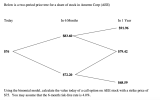 Below is a two-period price tree for a share of stock in Ameren Corp (AEE) Today In 6 Months In 1 Year $91.96 $83.60 $76 < > $79.42 $72.20 $68.59 Using the binomial model, calculate the value today of a call option on AEE stock with a strike price of $75. You may assume that the 6-month risk-free rate is 4.0%.
You bought Stock A at a purchase price of: Put option strike price: $25 $15 Option...
 You bought Stock A at a purchase price of: Put option strike price: $25 $15 Option expiration date: Price of put option: June 30, 2020 $5 Stock goes up to $50 Stock goes down to $5 Profit/Loss on stock if sell now Profit/Loss on call option if sell now
Consider a stock with a price with S = 100 and pays no dividends. The annual...
Consider a stock with a price with S = 100 and pays no dividends. The annual risk-free is 10%. A European put option on the stock with a strike price 90 and an expiration date three months from now has a price of 10. What is the price of a European call option on this stock with the same strike price and expiration date?
 Question 13 (1 point) Suppose SO = 100 and stock tree is below, rf=0, p=0.45 t=0 t=1 t=2 110.25 105.0 100.0 100.0 95.3 90.7 b) Compute payoffs for a call (with $105 strike, expires t=2) if S-100 at t-2? 0 1 0-5 Question 14 (1 point) Suppose SO = 100 and stock tree is below, rf=0 (risk free rate), p=0.45 (risk-neutral probability). Call option with strike 105. t=0 t=1 t=2 110.25 105.0 100.0 95.3 90.7 100.0 c) Compute C_u (call...
 1. Consider a stock with price S = $100 at t = 0. The interest rate is 10% compounded continuously. (a) [10pts] Determine the upper and lower bounds on the price of a European call option at t = 0 with strike price $120 and expiration T = 1 year. (b) [10pts) If the price of a European call with strike price $120 and expiration T = 1 year at t = 0 is $50, use put-call parity to determine...
 Part II (Binomial Tree) ai' 1. Compute the price of a call option using the stock price tree u1.4634 and d=0.7317. The stock price is $38. The strike price is 840 and the interest rate is 8%. The time-period is 6 month. Use a 2 stage binomial tree 2. Assume that where ?-8%, the dividend yield ?. 0, ? is the annual standard deviation and ?VE is the standard deviation over a period of length h. The initial stock price...
 2. Arbitrage on the tree A stock that pays no dividends has price today of 100. In one year's time the stock is worth 110 with probability 0.75, and 85 with probability 0.25. The one-year annually compounded interest rate is 5%. a) Calculate the forward price of the stock for a forward contract with maturity one year. (b) Calculate the price of a one-year European put option with strike 100. (c) Suppose you observe that the put option in part...
 Below is a two-period price tree for a share of stock in Ameren Corp (AEE) Today In 6 Months In 1 Year $91.96 $83.60 $76 < > $79.42 $72.20 $68.59 Using the binomial model, calculate the value today of a call option on AEE stock with a strike price of $75. You may assume that the 6-month risk-free rate is 4.0%.
 You bought Stock A at a purchase price of: Put option strike price: $25 $15 Option expiration date: Price of put option: June 30, 2020 $5 Stock goes up to $50 Stock goes down to $5 Profit/Loss on stock if sell now Profit/Loss on call option if sell now
Most questions answered within 3 hours.
-
Where is the error in this code sequence?
String s1 = "Hello";
String s2 = "ello";...
asked 11 months ago -
Financial data for Joel de Paris, Inc., for last year
follow:
Joel de Paris, Inc.
Balance...
asked 11 months ago -
Consider this reaction:
Al2(SO4)3 (aq)+ BaCl3
(aq) Al2Cl6 (aq)- +
3BaSO4(s) . What is the...
asked 11 months ago -
Suppose that Savneet is considering increasing her
recent random sample from 20 car rentals to 40...
asked 11 months ago -
Trucks arrive at an unloading terminal at an average rate of 120
per hour.
Trucks arrive...
asked 11 months ago -
Why are methanol and ethanol completely soluble in water while
octanol is not very little soluble....
asked 11 months ago -
A facilities manager at a university reads in a research report
that the mean amount of...
asked 11 months ago -
When the CuSO4 is rehydrated by adding water to the anhydrous
compound, is this an endothermic...
asked 11 months ago -
A ray of sunlight is passing from diamond into crown glass; the
angle of incidence is...
asked 11 months ago -
A block of mass 0.249 kg is placed on top of a light, vertical
spring of...
asked 11 months ago -
how do the kidneys compensate in the presences of acidosis
a) trigger hyperventilate
b) reserve acid...
asked 11 months ago -
Question 501 pts
The rental rate of capital to the firm increases. Which of the
following...
asked 11 months ago