Examine Case Study: An Elderly Hispanic Man With Major Depressive Disorder. You will be asked to...
Examine Case Study: An Elderly Hispanic Man With Major Depressive Disorder. You will be asked to make three decisions concerning the medication to prescribe to this client. Be sure to consider factors that might impact the client’s pharmacokinetic and pharmacodynamic processes. At each decision point stop to complete the following: Decision #1 Which decision did you select? Why did you select this decision? Support your response with evidence and references to the Learning Resources. What were you hoping to achieve by making this decision? Support your response with evidence and references to the Learning Resources. Explain any difference between what you expected to achieve with Decision #1 and the results of the decision. Why were they different? Decision #2 Why did you select this decision? Support your response with evidence and references to the Learning Resources. What were you hoping to achieve by making this decision? Support your response with evidence and references to the Learning Resources. Explain any difference between what you expected to achieve with Decision #2 and the results of the decision. Why were they different? Decision #3 Why did you select this decision? Support your response with evidence and references to the Learning Resources. What were you hoping to achieve by making this decision? Support your response with evidence and references to the Learning Resources. Explain any difference between what you expected to achieve with Decision #3 and the results of the decision. Why were they different? Also include how ethical considerations might impact your treatment plan and communication with clients. Note: Support your rationale with a minimum of three academic resources. While you may use the course text to support your rationale, it will not count toward the resource requirement.
Homework Answers
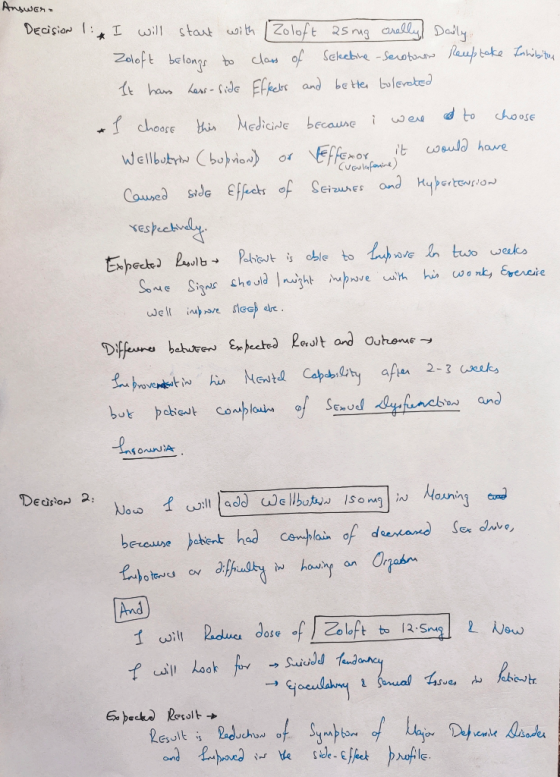
 Decision 1: Start with Zoloft
25 mg
Decision 1: Start with Zoloft
25 mg
Decision 2: Wellbutrin 150mg + Zoloft 12.5mg
Decision 3: Elavil 50mg + Wellbutrin 150mg
Add Answer to:
Examine Case Study: An Elderly Hispanic Man With Major
Depressive Disorder. You will be asked to...
Generalized Anxiety Disorder Middle-Aged White Male With Anxiety BACKGROUND INFORMATION The client is a 46-year-old white...
 Generalized Anxiety Disorder
Middle-Aged White Male With Anxiety
BACKGROUND INFORMATION
The client is a 46-year-old white male who works as a welder at
a local steel fabrication factory. He presents today after being
referred by his PCP after a trip to the emergency room in which he
felt he was having a heart attack. He stated that he felt chest
tightness, shortness of breath, and feeling of impending doom. He
does have some mild hypertension (which is treated with low...
Generalized Anxiety Disorder
Middle-Aged White Male With Anxiety
BACKGROUND INFORMATION
The client is a 46-year-old white male who works as a welder at
a local steel fabrication factory. He presents today after being
referred by his PCP after a trip to the emergency room in which he
felt he was having a heart attack. He stated that he felt chest
tightness, shortness of breath, and feeling of impending doom. He
does have some mild hypertension (which is treated with low...
Delusional Disorders Pakistani Female With Delusional Thought Processes BACKGROUND The client is a 34-year-old Pakistani female...
 Delusional Disorders
Pakistani Female With Delusional Thought Processes
BACKGROUND
The client is a 34-year-old Pakistani female who moved to the
United States in her late teens/early 20s. She is currently in an
“arranged” marriage (her husband was selected for her since she was
9 years old). She presents to your office today following a 21 day
hospitalization for what was diagnosed as “brief psychotic
disorder.” She was given this diagnosis as her symptoms have
persisted for less than 1 month....
Delusional Disorders
Pakistani Female With Delusional Thought Processes
BACKGROUND
The client is a 34-year-old Pakistani female who moved to the
United States in her late teens/early 20s. She is currently in an
“arranged” marriage (her husband was selected for her since she was
9 years old). She presents to your office today following a 21 day
hospitalization for what was diagnosed as “brief psychotic
disorder.” She was given this diagnosis as her symptoms have
persisted for less than 1 month....
BACKGROUND INFORMATION The client is a 46-year-old white male who works as a welder at a...
 BACKGROUND INFORMATION
The client is a 46-year-old white male who works as a welder at
a local steel fabrication factory. He presents today after being
referred by his PCP after a trip to the emergency room in which he
felt he was having a heart attack. He stated that he felt chest
tightness, shortness of breath, and feeling of impending doom. He
does have some mild hypertension (which is treated with low sodium
diet) and is about 15 lbs. overweight....
BACKGROUND INFORMATION
The client is a 46-year-old white male who works as a welder at
a local steel fabrication factory. He presents today after being
referred by his PCP after a trip to the emergency room in which he
felt he was having a heart attack. He stated that he felt chest
tightness, shortness of breath, and feeling of impending doom. He
does have some mild hypertension (which is treated with low sodium
diet) and is about 15 lbs. overweight....
For this Assignment, you will examine an infant case study to determine short-term developmental outcomes. Refer...
For this Assignment, you will examine an infant case study to determine short-term developmental outcomes. Refer to the following Case Study about Sam, a male infant: An infant male, Sam, was born to Jane and Roberto. Jane works in the city as a medical transcriptionist, but requested 12 weeks of family leave effective immediately upon Sam’s birth. Sam was born 6 weeks premature, by Cesarean delivery. His Apgar score at 1 minute was 5; after receiving oxygen, his Apgar score...
Diagnosis: Peptic ulcer with partial gastric outlet obstruction Case Study Discussion – Part II: Answer the following an...
Diagnosis: Peptic ulcer with partial gastric outlet obstruction Case Study Discussion – Part II: Answer the following and post your response as an additional response to your original Part I thread. Reflecting back on your previous post, how successful were you in identifying the possible diagnosis? What aspects from the case study were the most relevant in order to help confirm this diagnosis? Formulate a treatment plan and support your plan of care by incorporating evidence based rationale. What is...
A company is making a critical part for the iPhone. What type of inspection plan would...
A company is making a critical part for the iPhone. What type of inspection plan would you recommend as this part is manufactured (0% inspection, 100% inspection, or something in-between)? Support your answer by: 1. Why did you plot your response where you did? Cite your resources in APA format. 2. What are the consequences (positive and negative) of your decision? How do you know? Cite your resources in APA format.
Think back to a time in your life when you were faced with a critical decision....
Think back to a time in your life when you were faced with a critical decision. Describe what your decision was, and the approach you took to making it. Did you use a systematic approach? Was it a qualitative or quantitative approach? What was the outcome good or bad? In retrospect, would you consider it a good decision? Why? Would you approach the decision in a different way after learning about some of the tools and techniques in this course?l
For this Discussion, you examine a case study of hearing-impaired children who developed their own language...
For this Discussion, you examine a case study of hearing-impaired children who developed their own language system. To do this, you will apply one theory from the behaviorist, linguistic, or interactionist approaches as a lens through which to interpret the phenomena present in the case. To prepare: Review this week’s Learning Resources and consider the different theories and their approaches to explaining language development. Read the article “A Linguistic Big Bang” and consider the language developed by the children in...
You are expected to observe different customers in a grocery store ( or any socially distancing...
You are expected to observe different customers in a grocery store ( or any socially distancing environment that you are comfortable with) and tell us what you observed as their decision making process. What behaviors did you expect and what surprised you? Was there a difference among genders, age groups, culture/nationality, family/singles? Does your personal research substantiate what you have read and learned in this class?
The business value of improved decision making in an organizational setting is the focus of chapter...
The business value of improved decision making in an organizational setting is the focus of chapter 12 Enhancing Decision Making. Successful organizations are those that have mastered the decision making process. In order to facilitate this process, there are technologies that specialize in modeling, data mining, and analysis, all in support of better human decision making. Keep in mind that these technologies are not a substitute for human decision making but rather are designed to aid in the process. By...
 Generalized Anxiety Disorder
Middle-Aged White Male With Anxiety
BACKGROUND INFORMATION
The client is a 46-year-old white male who works as a welder at
a local steel fabrication factory. He presents today after being
referred by his PCP after a trip to the emergency room in which he
felt he was having a heart attack. He stated that he felt chest
tightness, shortness of breath, and feeling of impending doom. He
does have some mild hypertension (which is treated with low...
Generalized Anxiety Disorder
Middle-Aged White Male With Anxiety
BACKGROUND INFORMATION
The client is a 46-year-old white male who works as a welder at
a local steel fabrication factory. He presents today after being
referred by his PCP after a trip to the emergency room in which he
felt he was having a heart attack. He stated that he felt chest
tightness, shortness of breath, and feeling of impending doom. He
does have some mild hypertension (which is treated with low...
 Delusional Disorders
Pakistani Female With Delusional Thought Processes
BACKGROUND
The client is a 34-year-old Pakistani female who moved to the
United States in her late teens/early 20s. She is currently in an
“arranged” marriage (her husband was selected for her since she was
9 years old). She presents to your office today following a 21 day
hospitalization for what was diagnosed as “brief psychotic
disorder.” She was given this diagnosis as her symptoms have
persisted for less than 1 month....
Delusional Disorders
Pakistani Female With Delusional Thought Processes
BACKGROUND
The client is a 34-year-old Pakistani female who moved to the
United States in her late teens/early 20s. She is currently in an
“arranged” marriage (her husband was selected for her since she was
9 years old). She presents to your office today following a 21 day
hospitalization for what was diagnosed as “brief psychotic
disorder.” She was given this diagnosis as her symptoms have
persisted for less than 1 month....
 BACKGROUND INFORMATION
The client is a 46-year-old white male who works as a welder at
a local steel fabrication factory. He presents today after being
referred by his PCP after a trip to the emergency room in which he
felt he was having a heart attack. He stated that he felt chest
tightness, shortness of breath, and feeling of impending doom. He
does have some mild hypertension (which is treated with low sodium
diet) and is about 15 lbs. overweight....
BACKGROUND INFORMATION
The client is a 46-year-old white male who works as a welder at
a local steel fabrication factory. He presents today after being
referred by his PCP after a trip to the emergency room in which he
felt he was having a heart attack. He stated that he felt chest
tightness, shortness of breath, and feeling of impending doom. He
does have some mild hypertension (which is treated with low sodium
diet) and is about 15 lbs. overweight....
Most questions answered within 3 hours.
-
Where is the error in this code sequence?
String s1 = "Hello";
String s2 = "ello";...
asked 10 months ago -
Financial data for Joel de Paris, Inc., for last year
follow:
Joel de Paris, Inc.
Balance...
asked 10 months ago -
Consider this reaction:
Al2(SO4)3 (aq)+ BaCl3
(aq) Al2Cl6 (aq)- +
3BaSO4(s) . What is the...
asked 10 months ago -
Suppose that Savneet is considering increasing her
recent random sample from 20 car rentals to 40...
asked 10 months ago -
Trucks arrive at an unloading terminal at an average rate of 120
per hour.
Trucks arrive...
asked 10 months ago -
Why are methanol and ethanol completely soluble in water while
octanol is not very little soluble....
asked 10 months ago -
A facilities manager at a university reads in a research report
that the mean amount of...
asked 10 months ago -
When the CuSO4 is rehydrated by adding water to the anhydrous
compound, is this an endothermic...
asked 10 months ago -
A ray of sunlight is passing from diamond into crown glass; the
angle of incidence is...
asked 10 months ago -
A block of mass 0.249 kg is placed on top of a light, vertical
spring of...
asked 10 months ago -
how do the kidneys compensate in the presences of acidosis
a) trigger hyperventilate
b) reserve acid...
asked 10 months ago -
Question 501 pts
The rental rate of capital to the firm increases. Which of the
following...
asked 10 months ago