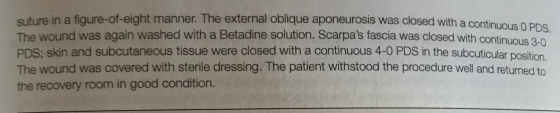
Assign the ICD-10-CM code(s) to diagnoses and conditions and
assign the CPT surgery code(s) and the appropriate HCPCS level II
and CPT modifier(s). Do not assign ICD-10-CM external cause
codes.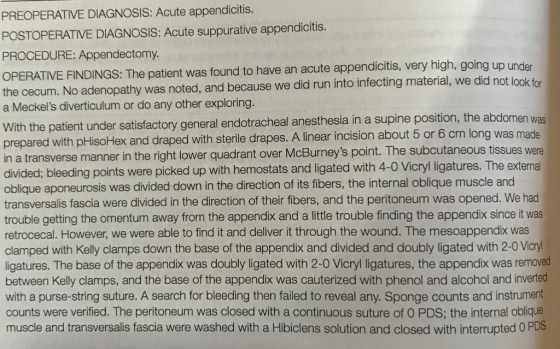
Homework Answers
Ans) K35.80
K35. 80 Acute suppurative appendicitis (disorder)
- When a surgeon performs a primary appendectomy, meaning that removal of the appendix was the sole reason for the surgery, choose one of these CPT® codes: 44950, Appendectomy. 44960, Appendectomy; for ruptured appendix with abscess or generalized peritonitis. 44970, Laparoscopy, surgical, appendectomy.
-
Add Answer to:
Assign the ICD-10-CM code(s) to diagnoses and conditions and
assign the CPT surgery code(s) and the...
code the following three operative reports assigning the appropriate CPT and ICD-10-CM codes and modifiers. PREOPERATIVE...
code the following three operative reports assigning the appropriate CPT and ICD-10-CM codes and modifiers. PREOPERATIVE DIAGNOSIS: Appendicitis. POSTOPERATIVE DIAGNOSIS: Appendicitis, nonperforated. PROCEDURE PERFORMED: Appendectomy. ANESTHESIA: General endotracheal. PROCEDURE: After informed consent was obtained, the patient was brought to the operative suite and placed supine on the operating table. General endotracheal anesthesia was induced without incident. The patient was prepped and draped in the usual sterile manner. A transverse right lower quadrant incision was made directly over the point of...
Assign the ICD-10-CM code to diagnoses and conditions and assign the CPT surgery codes and the...
Assign the ICD-10-CM code to diagnoses and conditions and assign the CPT surgery codes and the appropriate HCPCS level II and CPT modifiers. Do not assign ICD-10-CM external cause codes. PREOPERATIVE DIAGNOSIS: Arteriosclerotic heart disease. POSTOPERATIVE DIAGNOSIS: Arteriosclerotic heart disease. PROCEDURE: Coronary artery bypass graft x 5. The patient was brought into the operating suite and placed in the supine position. Anesthesia was administered, and monitoring lines were placed. The patient was prepped and draped in the usual sterile fashion....
Assign the ICD-10-CM code to diagnoses and conditions and assign the CPT surgery codes and the...
 Assign the ICD-10-CM code to
diagnoses and conditions and assign the CPT surgery codes and the
appropriate HCPCS level II and CPT modifiers. Do not assign
ICD-10-CM external cause codes.
4. PREOPERATIVE DIAGNOSIS: Arteriosclerotic heart disease. ton POSTOPERATIVE DIAGNOSIS: Arteriosclerotic heart disease. PROCEDURE: Coronary artery bypass graft x 5. The patient was brought into the operating suite and placed in the supine position. Anesthesia was administered, and monitoring lines were placed. The patient was prepped and draped in the usual...
Assign the ICD-10-CM code to
diagnoses and conditions and assign the CPT surgery codes and the
appropriate HCPCS level II and CPT modifiers. Do not assign
ICD-10-CM external cause codes.
4. PREOPERATIVE DIAGNOSIS: Arteriosclerotic heart disease. ton POSTOPERATIVE DIAGNOSIS: Arteriosclerotic heart disease. PROCEDURE: Coronary artery bypass graft x 5. The patient was brought into the operating suite and placed in the supine position. Anesthesia was administered, and monitoring lines were placed. The patient was prepped and draped in the usual...
Assign the ICD-10-CM code(s) to diagnoses and conditions and assign the CPT surgery code(s) and the...
Assign the ICD-10-CM code(s) to diagnoses and conditions and assign the CPT surgery code(s) and the appropriate HCPCS level 11 and CPT modifier(s). Do not assign ICD-10-CM external cause codes. With the patient under general anesthesia, a vertical midline scrotal incision was made, carried down through the skin and subcutaneous tissues. With use of the cautery, the hemiscrotum was entered. The left testicle was delivered into the wound. There was no active bleeding, and the testicle was sent for analysis....
Assign the ICD-10-CM code(s) to diagnoses and conditions and assign the CPT surgery code(s) and the...
Assign the ICD-10-CM code(s) to diagnoses and conditions and assign the CPT surgery code(s) and the appropriate HCPCS level II and CPT modifier(s). Do not assign ICD-10-CM external cause codes. flexure status post-multiple endoscopic polypectomies PREOPERATIVE DIAGNOSIS: Polyp of hepatic flexure, status posthurupit on POSTOPERATIVE DIAGNOSIS: Polyp of hepatic flexure, status post-multiple endoscopic polypectomies OPERATION PERFORMED: Right hemicolectomy. INDICATIONS FOR PROCEDURE: The patient is a 67-year-old white female with a history of a sessile polyp in the hepatic flexure. Despite...
Assign the ICD-10-CM code(s) to diagnoses and conditions and assign the CPT surgery code(s) and the...
Assign the ICD-10-CM code(s) to diagnoses and conditions and assign the CPT surgery code(s) and the appropriate HCPCS level II and CPT modifier(s). Do not assign ICD-10-CM external cause codes. PREOPERATIVE DIAGNOSIS: Displaced medial epicondyle fracture, left elbow. POSTOPERATIVE DIAGNOSIS: Displaced medial epicondyle fracture, left elbow. OPERATION PERFORMED: ORIF, left medial epicondyle fracture. (Initial encounter) After IV sedation was started, the patient was brought into the operating room and placed supine on the table. Once an adequate level of anesthesia...
Assign the CPT surgery code(s) and the appropriate HCPCS level II and CPT modifier(s). PREOPERATIVE DIAGNOSIS:...
Assign the CPT surgery code(s) and the appropriate HCPCS level II and CPT modifier(s). PREOPERATIVE DIAGNOSIS: Rule out lymphoma. Enlarged lymph node of axillary area on the left. POSTOPERATIVE DIAGNOSIS: Same. ANESTHESIA: Local, using 0.5% Marcaine without epinephrine The patient was brought to the operating room, and after adequate prepping and draping of the left axillary area, a large several-centimeters-in-diameter lymph node was palpated medially and superiorly. The skin overlying this node was infiltrated with 0.5% Marcaine without epinephrine, and...
Need help with CPT Service code and ICD-10-CM procedure code and a Rationale Report tolerated this...
 Need help with CPT Service code and ICD-10-CM
procedure code and a Rationale Report
tolerated this wll and was taken to recovely Slau LI ne found in the right lower quadrant, and this was aspirated cecum was grasped, and the appendix was delivered up and into thte wound The mespappendix was taken dawn between the tight-ange clamps. The base of the appendix was transected sharply and to natholoay for examination. The tip was cauterized and invertad into the cecum with...
Need help with CPT Service code and ICD-10-CM
procedure code and a Rationale Report
tolerated this wll and was taken to recovely Slau LI ne found in the right lower quadrant, and this was aspirated cecum was grasped, and the appendix was delivered up and into thte wound The mespappendix was taken dawn between the tight-ange clamps. The base of the appendix was transected sharply and to natholoay for examination. The tip was cauterized and invertad into the cecum with...
Assign the ICD-10-CM codes to diagnoses and conditions and assign the CPT surgery codes and the...
Assign the ICD-10-CM codes to diagnoses and conditions and assign the CPT surgery codes and the appropriate HCPCS level II and CPT modifiers. Do not assign ICD-10-CM external cause codes. PREOPERATIVE DIAGNOSIS: left middle trigger finger. POSTOPERATIVE DIAGNOSIS: left middle trigger finger. OPERATION PERFORMED: tenolysis Under satisfactory IV block anesthesia, the patient was prepped and draped in the usual fashion. A traverse incision was made parallel to the distal palmar crease area overlying the middle finger, and the wound was...
Need help with CPT Service code and ICD-10-CM procedure code and a Rationale Report tolerated this...
 Need help with CPT Service code and ICD-10-CM
procedure code and a Rationale Report
tolerated this wll and was taken to recovely Slau LI ne found in the right lower quadrant, and this was aspirated cecum was grasped, and the appendix was delivered up and into thte wound The mespappendix was taken dawn between the tight-ange clamps. The base of the appendix was transected sharply and to natholoay for examination. The tip was cauterized and invertad into the cecum with...
Need help with CPT Service code and ICD-10-CM
procedure code and a Rationale Report
tolerated this wll and was taken to recovely Slau LI ne found in the right lower quadrant, and this was aspirated cecum was grasped, and the appendix was delivered up and into thte wound The mespappendix was taken dawn between the tight-ange clamps. The base of the appendix was transected sharply and to natholoay for examination. The tip was cauterized and invertad into the cecum with...
 Assign the ICD-10-CM code to
diagnoses and conditions and assign the CPT surgery codes and the
appropriate HCPCS level II and CPT modifiers. Do not assign
ICD-10-CM external cause codes.
4. PREOPERATIVE DIAGNOSIS: Arteriosclerotic heart disease. ton POSTOPERATIVE DIAGNOSIS: Arteriosclerotic heart disease. PROCEDURE: Coronary artery bypass graft x 5. The patient was brought into the operating suite and placed in the supine position. Anesthesia was administered, and monitoring lines were placed. The patient was prepped and draped in the usual...
Assign the ICD-10-CM code to
diagnoses and conditions and assign the CPT surgery codes and the
appropriate HCPCS level II and CPT modifiers. Do not assign
ICD-10-CM external cause codes.
4. PREOPERATIVE DIAGNOSIS: Arteriosclerotic heart disease. ton POSTOPERATIVE DIAGNOSIS: Arteriosclerotic heart disease. PROCEDURE: Coronary artery bypass graft x 5. The patient was brought into the operating suite and placed in the supine position. Anesthesia was administered, and monitoring lines were placed. The patient was prepped and draped in the usual...
 Need help with CPT Service code and ICD-10-CM
procedure code and a Rationale Report
tolerated this wll and was taken to recovely Slau LI ne found in the right lower quadrant, and this was aspirated cecum was grasped, and the appendix was delivered up and into thte wound The mespappendix was taken dawn between the tight-ange clamps. The base of the appendix was transected sharply and to natholoay for examination. The tip was cauterized and invertad into the cecum with...
Need help with CPT Service code and ICD-10-CM
procedure code and a Rationale Report
tolerated this wll and was taken to recovely Slau LI ne found in the right lower quadrant, and this was aspirated cecum was grasped, and the appendix was delivered up and into thte wound The mespappendix was taken dawn between the tight-ange clamps. The base of the appendix was transected sharply and to natholoay for examination. The tip was cauterized and invertad into the cecum with...
 Need help with CPT Service code and ICD-10-CM
procedure code and a Rationale Report
tolerated this wll and was taken to recovely Slau LI ne found in the right lower quadrant, and this was aspirated cecum was grasped, and the appendix was delivered up and into thte wound The mespappendix was taken dawn between the tight-ange clamps. The base of the appendix was transected sharply and to natholoay for examination. The tip was cauterized and invertad into the cecum with...
Need help with CPT Service code and ICD-10-CM
procedure code and a Rationale Report
tolerated this wll and was taken to recovely Slau LI ne found in the right lower quadrant, and this was aspirated cecum was grasped, and the appendix was delivered up and into thte wound The mespappendix was taken dawn between the tight-ange clamps. The base of the appendix was transected sharply and to natholoay for examination. The tip was cauterized and invertad into the cecum with...
Most questions answered within 3 hours.
-
Where is the error in this code sequence?
String s1 = "Hello";
String s2 = "ello";...
asked 10 months ago -
Financial data for Joel de Paris, Inc., for last year
follow:
Joel de Paris, Inc.
Balance...
asked 10 months ago -
Consider this reaction:
Al2(SO4)3 (aq)+ BaCl3
(aq) Al2Cl6 (aq)- +
3BaSO4(s) . What is the...
asked 10 months ago -
Suppose that Savneet is considering increasing her
recent random sample from 20 car rentals to 40...
asked 10 months ago -
Trucks arrive at an unloading terminal at an average rate of 120
per hour.
Trucks arrive...
asked 10 months ago -
Why are methanol and ethanol completely soluble in water while
octanol is not very little soluble....
asked 10 months ago -
A facilities manager at a university reads in a research report
that the mean amount of...
asked 10 months ago -
When the CuSO4 is rehydrated by adding water to the anhydrous
compound, is this an endothermic...
asked 10 months ago -
A ray of sunlight is passing from diamond into crown glass; the
angle of incidence is...
asked 10 months ago -
A block of mass 0.249 kg is placed on top of a light, vertical
spring of...
asked 10 months ago -
how do the kidneys compensate in the presences of acidosis
a) trigger hyperventilate
b) reserve acid...
asked 10 months ago -
Question 501 pts
The rental rate of capital to the firm increases. Which of the
following...
asked 10 months ago