Argon in a closed, rigid tank. Temperature and heat transfer RTF
Homework Answers
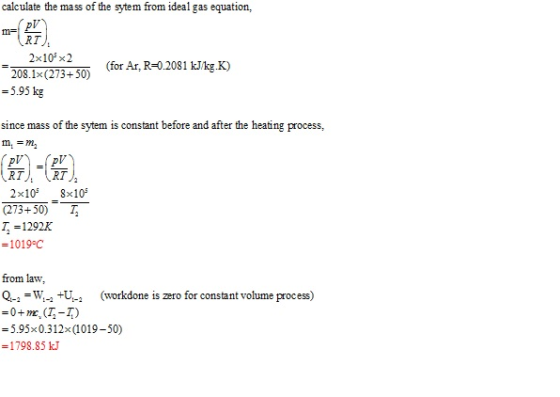
Using Energy Concepts and the Ideal Gas ModelArgon contained in a closed, rigid tank, initially at...
Using Energy Concepts and the Ideal Gas ModelArgon contained in a closed, rigid tank, initially at 50°C, 2 bar, and a volume of 2 m3, is heated to a final pressure of 8 bar. Assuming the ideal gas model with k = 1.67 for the argon, determine the final temperature, in °C, and the heat transfer, in kJ.
1. A) Argon contained in a closed, rigid tank, initially at 32.7°C, 1.5 bar, and a...
1. A) Argon contained in a closed, rigid tank, initially at 32.7°C, 1.5 bar, and a volume of 0.9 m3, is heated to a final pressure of 9.2 bar. Assuming the ideal gas model with k = 1.53 for the argon, determine the heat transfer, in kJ. B) Nitrogen (N2) contained in a piston–cylinder arrangement, initially at 8.6 bar and 422 K, undergoes an expansion to a final temperature of 300 K, during which the pressure–volume relationship is pV1.4 =...
1. A) Argon contained in a closed, rigid tank, initially at 36.3°C, 2.8 bar, and a...
1. A) Argon contained in a closed, rigid tank, initially at 36.3°C, 2.8 bar, and a volume of 1.4 m3, is heated to a final pressure of 9.9 bar. Assuming the ideal gas model with k = 1.53 for the argon, determine the heat transfer, in kJ. B) Nitrogen (N2) contained in a piston–cylinder arrangement, initially at 6 bar and 435 K, undergoes an expansion to a final temperature of 300 K, during which the pressure–volume relationship is pV1.5 =...
1.Argon contained in a closed, rigid tank, initially at 62.3°C, 3.9 bar, and a volume of...
1.Argon contained in a closed, rigid tank, initially at 62.3°C, 3.9 bar, and a volume of 4.2 m3, is heated to a final pressure of 9.4 bar. Assuming the ideal gas model with k = 1.6 for the argon, determine the heat transfer, in kJ. 2.Water vapor contained in a piston–cylinder assembly undergoes an isothermal expansion at 223°C from a pressure of 5.4 bar to a pressure of 1.9 bar. Evaluate the work, in kJ/kg. 3.A mass of 4 kilograms...
Question 1 A piston-cylinder assembly contains 3.2 kg of water at 211.9oC and 3 bar. The...
Question 1 A piston-cylinder assembly contains 3.2 kg of water at 211.9oC and 3 bar. The water is compressed to a saturated vapor state where the pressure is 51.5 bar. During compression, there is a heat transfer of energy from the water to its surroundings having a magnitude of 230 kJ. Neglecting changes in kinetic energy and potential energy, determine the work, in kJ, for the process of the water. Question 2 Water, initially saturated vapor at 10.2 bar, fills...
1.Water vapor contained in a piston–cylinder assembly undergoes an isothermal expansion at 277°C from a pressure...
1.Water vapor contained in a piston–cylinder assembly undergoes an isothermal expansion at 277°C from a pressure of 5.1 bar to a pressure of 2.7 bar. Evaluate the work, in kJ/kg. 2.Nitrogen (N2) contained in a piston–cylinder arrangement, initially at 9.3 bar and 437 K, undergoes an expansion to a final temperature of 300 K, during which the pressure–volume relationship is pV1.1 = constant. Assuming the ideal gas model for the N2, determine the heat transfer in kJ/kg. 3.Argon contained in...
2.Water, initially saturated vapor at 14.6 bar, fills a closed, rigid container. The water is heated...
2.Water, initially saturated vapor at 14.6 bar, fills a closed, rigid container. The water is heated until its temperature is 200°C. For the water, determine the heat transfer, in kJ/kg. Kinetic and potential energy effects can be ignored. 3.A piston-cylinder assembly contains 4 kg of water at 211.4oC and 3 bar. The water is compressed to a saturated vapor state where the pressure is 50.8 bar. During compression, there is a heat transfer of energy from the water to its...
Can you please help me with these 5 problems!!! please and thank you Question 1 A...
Can you please help me with these 5 problems!!! please and thank you Question 1 A mass of 5 kilograms of carbon dioxide (CO2) in a piston-cylinder assembly undergoes two processes in series from an initial state where p1 = 2.4 MPa, T1 = 260°C: Process 1–2: Constant-temperature expansion until the volume is twice the initial volume. Process 2–3: Constant-volume heating until the pressure is again 2.4 MPa. Assuming ideal gas behavior, determine the overall work, in kJ. ____________________________________________________________ Nitrogen...
Five kg of oxygen (O2), initially at 430C, fills a closed, rigid tank. Heat transfer from...
 Five kg of oxygen (O2), initially at 430C, fills a closed, rigid tank. Heat transfer from the oxygen occurs at the rate 425 w for 10 minutes. Assuming the ideal gas model with k = 1.350 for the oxygen, determine its final temperature, in °C.
1. a) A piston–cylinder assembly contains air, initially at 1.9 bar, 295 K, and a volume...
1. a) A piston–cylinder assembly contains air, initially at 1.9 bar, 295 K, and a volume of 0.6 m3. The air undergoes a process to a state where the pressure is 1 bar, during which the pressure–volume relationship is pV = constant. Assuming ideal gas behavior for the air, determine the mass in kg. b) Argon contained in a closed, rigid tank, initially at 51.1°C, 2.1 bar, and a volume of 2.9 m3, is heated to a final pressure of...
 Five kg of oxygen (O2), initially at 430C, fills a closed, rigid tank. Heat transfer from the oxygen occurs at the rate 425 w for 10 minutes. Assuming the ideal gas model with k = 1.350 for the oxygen, determine its final temperature, in °C.
Most questions answered within 3 hours.
-
Where is the error in this code sequence?
String s1 = "Hello";
String s2 = "ello";...
asked 10 months ago -
Financial data for Joel de Paris, Inc., for last year
follow:
Joel de Paris, Inc.
Balance...
asked 10 months ago -
Consider this reaction:
Al2(SO4)3 (aq)+ BaCl3
(aq) Al2Cl6 (aq)- +
3BaSO4(s) . What is the...
asked 10 months ago -
Suppose that Savneet is considering increasing her
recent random sample from 20 car rentals to 40...
asked 10 months ago -
Trucks arrive at an unloading terminal at an average rate of 120
per hour.
Trucks arrive...
asked 10 months ago -
Why are methanol and ethanol completely soluble in water while
octanol is not very little soluble....
asked 10 months ago -
A facilities manager at a university reads in a research report
that the mean amount of...
asked 10 months ago -
When the CuSO4 is rehydrated by adding water to the anhydrous
compound, is this an endothermic...
asked 10 months ago -
A ray of sunlight is passing from diamond into crown glass; the
angle of incidence is...
asked 10 months ago -
A block of mass 0.249 kg is placed on top of a light, vertical
spring of...
asked 10 months ago -
how do the kidneys compensate in the presences of acidosis
a) trigger hyperventilate
b) reserve acid...
asked 10 months ago -
Question 501 pts
The rental rate of capital to the firm increases. Which of the
following...
asked 10 months ago