

Homework Answers
A.
There is 28 small square in between RR wave, so
Cardiac Cycle - 1.12 sec/beat
Heart Rate - 54 beats/min
It is bradycardia
B.
There is 17 small square in between RR wave, so
Cardiac Cycle - 0.68 sec/beat
Heart Rate - 88 beats/min
It is Normal Sinus rhythm
C.
This image shows Ventricular fibrillation(VF)
We can not calculate HR from a VF ECG because there is no RR interval present.
D.
There is 11 small square in between RR wave, so
Cardiac Cycle - 0.44 sec/beat
Heart Rate - 136 beats/min
It is Trachycardia
Add Answer to:
AAAAA Label P. QRS, and Twaves on the ECG strip in Figure 4.5. Figure 1.5: ECG...
E IT, ECG Strip Interpretations. The paper is set at the standard 25 mm/sec. Each mm...
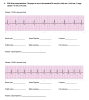 E IT, ECG Strip Interpretations. The paper is set at the standard 25 mm/sec. Each mm = 0.04 sec. 1 large square = 5 mm, or 0.2 sec. Patient 1 ECG 6-second strip الممالمیہ المسلم المعالم Heart rate Heart Rhythm P waves P:QRS ratio QRS complex. P-R interval Patient 1 Dysrhythmia Patient 2 ECG 6-second strip العالم المعالم المرام العالم المہ عالم المال Heart rate Heart Rhythm P waves P:QRS ratio QRS complex P-R interval Patient 2 Dysrhythmia
Poor ventilation causes which of the following: Respiratory acidosis Hypocarbia Hyperglycemia None of the above All...
Poor ventilation causes which of the following: Respiratory acidosis Hypocarbia Hyperglycemia None of the above All of the following are causes of obstructive shock EXCEPT: Congenital heart malformations Tension pneumothorax Cardiac tamponade Acute blood loss Which is a common cause of quiet tachypnea? High fever Hypoglycemia Upper respiratory obstruction None of the above Which statement about sinus tachycardia is NOT correct? Sinus tachycardia may occur in response to stress. Sinus tachycardia may occur in response to fever. Sinus tachycardia often...
4. To interpret an ECG, we must look at the regularity of heart beats (regular, irregular),...
 4. To interpret an ECG, we must look at the regularity of heart beats (regular, irregular), rhythm (sinus or other), heart rate, cardiac axis, duration, a description of the P wave, QRS complexes, Enlargement Figure 1-4. Standard graph paper measurements A Graph paper. conduction intervals. of one square of graph paper The ECG paper speed is 25 mm/sec. Calculate from the heart rate shown in the ECG tracing (a). Show your work. (3) a. b. Lead 1 ii) Which is...
In an adult, a heart rate of 60-100 beats/min is a normal sinus rhythm (NSR). A...
 In an adult, a heart rate of 60-100 beats/min is a normal sinus rhythm (NSR). A heart rate at or above 101 beats/min is called tachycardia, but in young children, this rate would be considered normal. Heart rates belovw 60 beats/min are normal for highly conditioned individuals, but in most adults this is bradycardia I. Calculate the heart rate for the ECGx.0 Diagnosis P-R intervals: Normal P-R intervals are between 0.12 and 0.2 seconds, averaging about 0.16 seconds. P-F intervals...
Which lead was used to collect the data for the ECG? Circle tile correct answer. Lead...
 Which lead was used to collect the data for the ECG? Circle tile correct answer. Lead 1 /Lead2/Lead3 Complete the following table for ECG and heart sounds: 2 Calculate the heart rate for your subject using the following equation: 60 (sec. per min) /avg. heat period (sec/beat) = heart rate (beats/mm) Subject heart rate _________ beats/mm What does the R-S1 interval represent in the cardiac cycle? What is/are the electrical and mechanical events that occur during this interval of the...
True or False: A respiratory rate consistently less than 10 or greater than 60 breaths per...
True or False: A respiratory rate consistently less than 10 or greater than 60 breaths per minute in a child of any age is abnormal and suggests the presence of a potentially serious problem. True False True or False: PALS management of respiratory distress/failure is adjusted based on the severity of the current condition. True False True or False: Shock may occur with a normal, increased, or decreased systemic arterial pressure. True False True or False: Respiratory failure or shock...
True or False: A nasopharyngeal airway (NPA) can be used on a semi-conscious or conscious individual,...
True or False: A nasopharyngeal airway (NPA) can be used on a semi-conscious or conscious individual, while an oropharyngeal airway (OPA) should only be used on an unconscious individual. True False True or False: An individual in PEA has an organized cardiac rhythm on ECG. True False True or False: Symptomatic bradycardia and poor perfusion may degrade into cardiac arrest. True False True or False: The definition of stable tachycardia is a fast but constant heart rate between 80 and...
I need all the questions to answer, please True or False: Synchronized cardioversion is appropriate for...
 I need all the questions to answer, please
True or False: Synchronized cardioversion is appropriate for
treating an unknown wide complex tachycardia.
True
False
True or False: A nasopharyngeal airway (NPA) can be used on a
semi-conscious or conscious individual, while an oropharyngeal
airway (OPA) should only be used on an unconscious individual.
True
False
True or False: Any bradycardia less than 60 beats per minute is
a pathologic event.
True
False
True or False: Transcutaneous pacing should be used...
I need all the questions to answer, please
True or False: Synchronized cardioversion is appropriate for
treating an unknown wide complex tachycardia.
True
False
True or False: A nasopharyngeal airway (NPA) can be used on a
semi-conscious or conscious individual, while an oropharyngeal
airway (OPA) should only be used on an unconscious individual.
True
False
True or False: Any bradycardia less than 60 beats per minute is
a pathologic event.
True
False
True or False: Transcutaneous pacing should be used...
True or False: Synchronized cardioversion is appropriate for treating an unknown wide complex tachycardia. True False...
 True or False: Synchronized cardioversion is appropriate for
treating an unknown wide complex tachycardia.
True
False
True or False: A nasopharyngeal airway (NPA) can be used on a
semi-conscious or conscious individual, while an oropharyngeal
airway (OPA) should only be used on an unconscious individual.
True
False
True or False: Any bradycardia less than 60 beats per minute is
a pathologic event.
True
False
True or False: Transcutaneous pacing should be used on an
individual with bradycardia and inadequate perfusion...
True or False: Synchronized cardioversion is appropriate for
treating an unknown wide complex tachycardia.
True
False
True or False: A nasopharyngeal airway (NPA) can be used on a
semi-conscious or conscious individual, while an oropharyngeal
airway (OPA) should only be used on an unconscious individual.
True
False
True or False: Any bradycardia less than 60 beats per minute is
a pathologic event.
True
False
True or False: Transcutaneous pacing should be used on an
individual with bradycardia and inadequate perfusion...
What is caused by an accumulation of blood in the pericardial space that results in impaired...
What is caused by an accumulation of blood in the pericardial space that results in impaired systemic venous return, impaired ventricular filling, and reduced cardiac output? Tension pneumothorax Ductal-dependent congenital heart lesions Massive pulmonary embolism Cardiac tamponade If bradycardia (heart rate less than 60 beats per minute) with a pulse is associated with cardiopulmonary compromise despite effective oxygenation and ventilation, what is the next step in management? Administer atropine. Administer epinephrine. Consider cardiac pacing. Perform CPR. The first energy dose...
 E IT, ECG Strip Interpretations. The paper is set at the standard 25 mm/sec. Each mm = 0.04 sec. 1 large square = 5 mm, or 0.2 sec. Patient 1 ECG 6-second strip الممالمیہ المسلم المعالم Heart rate Heart Rhythm P waves P:QRS ratio QRS complex. P-R interval Patient 1 Dysrhythmia Patient 2 ECG 6-second strip العالم المعالم المرام العالم المہ عالم المال Heart rate Heart Rhythm P waves P:QRS ratio QRS complex P-R interval Patient 2 Dysrhythmia
 4. To interpret an ECG, we must look at the regularity of heart beats (regular, irregular), rhythm (sinus or other), heart rate, cardiac axis, duration, a description of the P wave, QRS complexes, Enlargement Figure 1-4. Standard graph paper measurements A Graph paper. conduction intervals. of one square of graph paper The ECG paper speed is 25 mm/sec. Calculate from the heart rate shown in the ECG tracing (a). Show your work. (3) a. b. Lead 1 ii) Which is...
 In an adult, a heart rate of 60-100 beats/min is a normal sinus rhythm (NSR). A heart rate at or above 101 beats/min is called tachycardia, but in young children, this rate would be considered normal. Heart rates belovw 60 beats/min are normal for highly conditioned individuals, but in most adults this is bradycardia I. Calculate the heart rate for the ECGx.0 Diagnosis P-R intervals: Normal P-R intervals are between 0.12 and 0.2 seconds, averaging about 0.16 seconds. P-F intervals...
 Which lead was used to collect the data for the ECG? Circle tile correct answer. Lead 1 /Lead2/Lead3 Complete the following table for ECG and heart sounds: 2 Calculate the heart rate for your subject using the following equation: 60 (sec. per min) /avg. heat period (sec/beat) = heart rate (beats/mm) Subject heart rate _________ beats/mm What does the R-S1 interval represent in the cardiac cycle? What is/are the electrical and mechanical events that occur during this interval of the...
 I need all the questions to answer, please
True or False: Synchronized cardioversion is appropriate for
treating an unknown wide complex tachycardia.
True
False
True or False: A nasopharyngeal airway (NPA) can be used on a
semi-conscious or conscious individual, while an oropharyngeal
airway (OPA) should only be used on an unconscious individual.
True
False
True or False: Any bradycardia less than 60 beats per minute is
a pathologic event.
True
False
True or False: Transcutaneous pacing should be used...
I need all the questions to answer, please
True or False: Synchronized cardioversion is appropriate for
treating an unknown wide complex tachycardia.
True
False
True or False: A nasopharyngeal airway (NPA) can be used on a
semi-conscious or conscious individual, while an oropharyngeal
airway (OPA) should only be used on an unconscious individual.
True
False
True or False: Any bradycardia less than 60 beats per minute is
a pathologic event.
True
False
True or False: Transcutaneous pacing should be used...
 True or False: Synchronized cardioversion is appropriate for
treating an unknown wide complex tachycardia.
True
False
True or False: A nasopharyngeal airway (NPA) can be used on a
semi-conscious or conscious individual, while an oropharyngeal
airway (OPA) should only be used on an unconscious individual.
True
False
True or False: Any bradycardia less than 60 beats per minute is
a pathologic event.
True
False
True or False: Transcutaneous pacing should be used on an
individual with bradycardia and inadequate perfusion...
True or False: Synchronized cardioversion is appropriate for
treating an unknown wide complex tachycardia.
True
False
True or False: A nasopharyngeal airway (NPA) can be used on a
semi-conscious or conscious individual, while an oropharyngeal
airway (OPA) should only be used on an unconscious individual.
True
False
True or False: Any bradycardia less than 60 beats per minute is
a pathologic event.
True
False
True or False: Transcutaneous pacing should be used on an
individual with bradycardia and inadequate perfusion...
Most questions answered within 3 hours.
-
Where is the error in this code sequence?
String s1 = "Hello";
String s2 = "ello";...
asked 11 months ago -
Financial data for Joel de Paris, Inc., for last year
follow:
Joel de Paris, Inc.
Balance...
asked 11 months ago -
Consider this reaction:
Al2(SO4)3 (aq)+ BaCl3
(aq) Al2Cl6 (aq)- +
3BaSO4(s) . What is the...
asked 11 months ago -
Suppose that Savneet is considering increasing her
recent random sample from 20 car rentals to 40...
asked 11 months ago -
Trucks arrive at an unloading terminal at an average rate of 120
per hour.
Trucks arrive...
asked 11 months ago -
Why are methanol and ethanol completely soluble in water while
octanol is not very little soluble....
asked 11 months ago -
A facilities manager at a university reads in a research report
that the mean amount of...
asked 11 months ago -
When the CuSO4 is rehydrated by adding water to the anhydrous
compound, is this an endothermic...
asked 11 months ago -
A ray of sunlight is passing from diamond into crown glass; the
angle of incidence is...
asked 11 months ago -
A block of mass 0.249 kg is placed on top of a light, vertical
spring of...
asked 11 months ago -
how do the kidneys compensate in the presences of acidosis
a) trigger hyperventilate
b) reserve acid...
asked 11 months ago -
Question 501 pts
The rental rate of capital to the firm increases. Which of the
following...
asked 11 months ago