
Homework Answers
Answer: A caregiver at hospice is a person who is directly related to the patient as they provide care and meet the all the demands of the patient. This is the reason that family rely on caregivers. The caregivers knows that some of the others day their patient is going to die. They want to bid a proper farewell to their patient.
At the hospice there are so many caregivers based on their functions as some has duty to give bath to the patient whereas other has to provide medicine etc. The caregivers are unable to sleep properly at night as all the time they need to takecare of the patients.
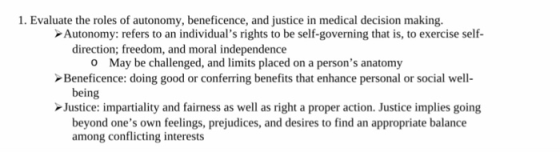
Answer: Autonomy: It is a right of a person to choose freedom and moral independence.
Beneficence: It is a kind of act whose performance have mutual benefits such as to enhance personal or social well being.
Justice: The right decision without the impartiality, that has been taken to ensure the balance and just to the right person.
Add Answer to:
Can you write both answers by your word with the same
idea
4. Discuss the reasons...
Your patient is a 44-year-old male admitted due to an exacerbation of his multiple sclerosis (MS)....
 Your patient is a 44-year-old male admitted due to an exacerbation of his multiple sclerosis (MS). During report, the nurse from the previous shift informed you he had to straight catheterize the patient due to urinary retention and bladder distention. You are in the room talking with the patient and his significant other when the primary care provider approaches them with the information that, due to a progression of the MS, the patient will need to catheterize himself for the...
Using the book, write another paragraph or two: write 170 words: Q: Compare the assumptions of...
 Using the book, write another paragraph or two: write 170
words:
Q: Compare the assumptions of physician-centered and
collaborative communication. How is the caregiver’s role different
in each model? How is the patient’s role different?
Answer: Physical-centered communication involves the specialists
taking control of the conversation. They decide on the topics of
discussion and when to end the process. The patient responds to the
issues raised by the caregiver and acts accordingly. On the other
hand, Collaborative communication involves a...
Using the book, write another paragraph or two: write 170
words:
Q: Compare the assumptions of physician-centered and
collaborative communication. How is the caregiver’s role different
in each model? How is the patient’s role different?
Answer: Physical-centered communication involves the specialists
taking control of the conversation. They decide on the topics of
discussion and when to end the process. The patient responds to the
issues raised by the caregiver and acts accordingly. On the other
hand, Collaborative communication involves a...
what discuss can you make about medicalization and chronic disease and illness? Adult Lealth Nursing Ethics...
 what discuss can you make about medicalization and chronic
disease and illness?
Adult Lealth Nursing Ethics mie B. Butts OBJECTIVES After reading this chapter, the reader should be able to do the following: 1. Explore the concept of medicalization as it relates to the societal shift away from physician predominance of the 1970s. 2. Differentiate among the following terms: compliance, noncompliance, adherence, nonadherence, and concordance. 3. Examine cultural views with regard to self-determination, decision making, and American healthcare professionals' values...
what discuss can you make about medicalization and chronic
disease and illness?
Adult Lealth Nursing Ethics mie B. Butts OBJECTIVES After reading this chapter, the reader should be able to do the following: 1. Explore the concept of medicalization as it relates to the societal shift away from physician predominance of the 1970s. 2. Differentiate among the following terms: compliance, noncompliance, adherence, nonadherence, and concordance. 3. Examine cultural views with regard to self-determination, decision making, and American healthcare professionals' values...
 Your patient is a 44-year-old male admitted due to an exacerbation of his multiple sclerosis (MS). During report, the nurse from the previous shift informed you he had to straight catheterize the patient due to urinary retention and bladder distention. You are in the room talking with the patient and his significant other when the primary care provider approaches them with the information that, due to a progression of the MS, the patient will need to catheterize himself for the...
 Using the book, write another paragraph or two: write 170
words:
Q: Compare the assumptions of physician-centered and
collaborative communication. How is the caregiver’s role different
in each model? How is the patient’s role different?
Answer: Physical-centered communication involves the specialists
taking control of the conversation. They decide on the topics of
discussion and when to end the process. The patient responds to the
issues raised by the caregiver and acts accordingly. On the other
hand, Collaborative communication involves a...
Using the book, write another paragraph or two: write 170
words:
Q: Compare the assumptions of physician-centered and
collaborative communication. How is the caregiver’s role different
in each model? How is the patient’s role different?
Answer: Physical-centered communication involves the specialists
taking control of the conversation. They decide on the topics of
discussion and when to end the process. The patient responds to the
issues raised by the caregiver and acts accordingly. On the other
hand, Collaborative communication involves a...
 what discuss can you make about medicalization and chronic
disease and illness?
Adult Lealth Nursing Ethics mie B. Butts OBJECTIVES After reading this chapter, the reader should be able to do the following: 1. Explore the concept of medicalization as it relates to the societal shift away from physician predominance of the 1970s. 2. Differentiate among the following terms: compliance, noncompliance, adherence, nonadherence, and concordance. 3. Examine cultural views with regard to self-determination, decision making, and American healthcare professionals' values...
what discuss can you make about medicalization and chronic
disease and illness?
Adult Lealth Nursing Ethics mie B. Butts OBJECTIVES After reading this chapter, the reader should be able to do the following: 1. Explore the concept of medicalization as it relates to the societal shift away from physician predominance of the 1970s. 2. Differentiate among the following terms: compliance, noncompliance, adherence, nonadherence, and concordance. 3. Examine cultural views with regard to self-determination, decision making, and American healthcare professionals' values...
Most questions answered within 3 hours.
-
Where is the error in this code sequence?
String s1 = "Hello";
String s2 = "ello";...
asked 11 months ago -
Financial data for Joel de Paris, Inc., for last year
follow:
Joel de Paris, Inc.
Balance...
asked 11 months ago -
Consider this reaction:
Al2(SO4)3 (aq)+ BaCl3
(aq) Al2Cl6 (aq)- +
3BaSO4(s) . What is the...
asked 11 months ago -
Suppose that Savneet is considering increasing her
recent random sample from 20 car rentals to 40...
asked 11 months ago -
Trucks arrive at an unloading terminal at an average rate of 120
per hour.
Trucks arrive...
asked 11 months ago -
Why are methanol and ethanol completely soluble in water while
octanol is not very little soluble....
asked 11 months ago -
A facilities manager at a university reads in a research report
that the mean amount of...
asked 11 months ago -
When the CuSO4 is rehydrated by adding water to the anhydrous
compound, is this an endothermic...
asked 11 months ago -
A ray of sunlight is passing from diamond into crown glass; the
angle of incidence is...
asked 11 months ago -
A block of mass 0.249 kg is placed on top of a light, vertical
spring of...
asked 11 months ago -
how do the kidneys compensate in the presences of acidosis
a) trigger hyperventilate
b) reserve acid...
asked 11 months ago -
Question 501 pts
The rental rate of capital to the firm increases. Which of the
following...
asked 11 months ago