
Homework Answers
One of the most important aspects of the country's shift to a capitalist economy was the decollectivisation of China's rural economy in the early 1980s. Deng Xiaoping hailed it as an "innovation," and its importance for the whole cycle of capitalist-oriented "reform" can not possibly be overestimated. The Chinese government has repeatedly referred to the supposed economic benefits of decollectivization as "growing opportunities to millions of peasants significantly."
Nevertheless, the decollectivization's political-economic implications have always been highly ambiguous, and at best doubtful. Person or small groups of peasants were often depicted as political stars for initiating the process in media accounts, but this helped to mask the strong opposition to de-collectivization in many localities. Moreover, most of the writings downplay the deeper causes and consequences of the agrarian reform, leaving the illusion that the rural reform was politically neutral at its heart.
While the Cadres failed to buy support from the workers for the reform, they were popular with the peasants. Over the transition period (1979–1984), the income of the peasants increased significantly due mainly to higher prices of procurements. Propaganda attributed decollectivisation to this achievement. Most peasants therefore had positive views on the rural reforms, at least at the beginning.
The temporary increase in rural incomes convinced most farmers to support further reforms. There was also the long-term effect of supplying an almost limitless supply of labor to private industries in urban areas, as the CCP allowed individual peasants to sell their labor power in the city after the agrarian reform. The glut of urban labor significantly eroded the influence of the old working class in publicly owned undertakings. It was under these circumstances that further urban development was made possible, including the mass unemployment.
Why did LBO activity increase in the early 1980s and after 1992? What corrections were made...
Why did LBO activity increase in the early 1980s and after 1992? What corrections were made after 1992?
Why is the consumption share of China's economy is low? What policies should the Chinese government...
Why is the consumption share of China's economy is low? What policies should the Chinese government take to promote consumption?
Write a paragraph arguing why the US or Chinese economy is stronger than the other using...
Write a paragraph arguing why the US or Chinese economy is stronger than the other using at least 5 macroeconomic statistics from the world bank data sheet. In your response, you must explain why each of the statistics you use are relevant.
Assume that a 4 percent increase in income in the economy produces an 8 percent increase in the quantity demanded of good X
6. Assume that a 4 percent increase in income in the economy produces an 8 percent increase in the quantity demanded of good X. The coefficient of income elasticity of demand is a. - 0.5 and therefore X is an inferior good. b. +2.0 and therefore X is an inferior good. c. +0.5 and therefore X is a normal good d. +2.0 and therefore X is a normal good 7. Suppose the price elasticity of demand for Reece's peanut butter cups is 1.5 and the...
The Chinese Economy What are the three benefits of FDI?
 The Chinese Economy
What are the three benefits of FDI?
The Chinese Economy
What are the three benefits of FDI?
Identify and explain the main factors that determine long-run economic growth, and why has Chinese economy grown so much since 1980?
Identify and explain the main factors that determine long-run economic growth, and why has Chinese economy grown so much since 1980?
Question 7 (8%) In the year 2000, the Chinese economy's growth was not as fast as...
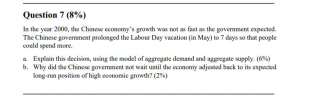 Question 7 (8%) In the year 2000, the Chinese economy's growth was not as fast as the government expected. The Chinese government prolonged the Labour Day vacation (in May) to 7 days so that people could spend more. b. Why did the Chinese government not wait until the economy adjusted back to its expected long-run position of high economic growth? (2%)
1. Why do you think that the Chinese historically pegged the value of the yuan to...
1. Why do you think that the Chinese historically pegged the value of the yuan to the U.S. dollar? 2. Why did the Chinese move to a managed-float system in 2005? 3. What are the benefits that China might gain by allowing the yuan to float freely against other major currencies such as the U.S. dollar and the euro? What are the risks? What do you think they should do? 4. Is there any evidence that the Chinese kept the...
did john maynard keynes believe that the economy was a self regulating one? why or why...
did john maynard keynes believe that the economy was a self regulating one? why or why not...
In which of the following countries did the military not take over in the 1980s? Chile...
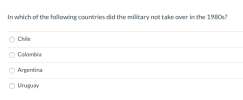 In which of the following countries did the military not take over in the 1980s? Chile Colombia Argentina Uruguay Which type of business did Pablo Escobar start in Colombia during the 1970s and 1980s? He traded arms with Europe. He sold illegal drugs, mainly to the United States. He traded coffee with the United States and Europe. O He traded cacao with the United States and Europe. How did the people of the Medellín cartel react when they were threatened...
 The Chinese Economy
What are the three benefits of FDI?
The Chinese Economy
What are the three benefits of FDI?
 Question 7 (8%) In the year 2000, the Chinese economy's growth was not as fast as the government expected. The Chinese government prolonged the Labour Day vacation (in May) to 7 days so that people could spend more. b. Why did the Chinese government not wait until the economy adjusted back to its expected long-run position of high economic growth? (2%)
 In which of the following countries did the military not take over in the 1980s? Chile Colombia Argentina Uruguay Which type of business did Pablo Escobar start in Colombia during the 1970s and 1980s? He traded arms with Europe. He sold illegal drugs, mainly to the United States. He traded coffee with the United States and Europe. O He traded cacao with the United States and Europe. How did the people of the Medellín cartel react when they were threatened...
Most questions answered within 3 hours.
-
Where is the error in this code sequence?
String s1 = "Hello";
String s2 = "ello";...
asked 11 months ago -
Financial data for Joel de Paris, Inc., for last year
follow:
Joel de Paris, Inc.
Balance...
asked 11 months ago -
Consider this reaction:
Al2(SO4)3 (aq)+ BaCl3
(aq) Al2Cl6 (aq)- +
3BaSO4(s) . What is the...
asked 11 months ago -
Suppose that Savneet is considering increasing her
recent random sample from 20 car rentals to 40...
asked 11 months ago -
Trucks arrive at an unloading terminal at an average rate of 120
per hour.
Trucks arrive...
asked 11 months ago -
Why are methanol and ethanol completely soluble in water while
octanol is not very little soluble....
asked 11 months ago -
A facilities manager at a university reads in a research report
that the mean amount of...
asked 11 months ago -
When the CuSO4 is rehydrated by adding water to the anhydrous
compound, is this an endothermic...
asked 11 months ago -
A ray of sunlight is passing from diamond into crown glass; the
angle of incidence is...
asked 11 months ago -
A block of mass 0.249 kg is placed on top of a light, vertical
spring of...
asked 11 months ago -
how do the kidneys compensate in the presences of acidosis
a) trigger hyperventilate
b) reserve acid...
asked 11 months ago -
Question 501 pts
The rental rate of capital to the firm increases. Which of the
following...
asked 11 months ago