
Homework Answers
Answer is B.
Burden will be equal on both consumer and producer because elasticity of both demand and supply are equal.
Relationship between elasticity and tax burden is such that more elastic have less burden. So relationship between elasticity and tax burden is opposite. Here both have same elasticity so burden will be born equally.
#Please rate positively...thank you
Add Answer to:
If elasticity of demand is 0.3, elasticity of supply is 0.3, and a 20% excise tax...
The graph below shows a hypothetical market for salt. Suppose that an excise or commodity tax...
 The graph below shows a hypothetical market for salt. Suppose that an excise or commodity tax is levied on consumers in an attempt to curb blood pressure problems. Show the effect of the tax by shifting the appropriate curve(s). Who has the larger tax burden? Producers (suppliers) Consumers (buyers) The tax burdens are equal Why is the tax burden as you described in in the question above? Supply is less elastic than demand. Demand is more elastic than supply. Both...
2. When the price elasticity of demand is low and the price elasticity of supply is...
2. When the price elasticity of demand is low and the price elasticity of supply is high, the burden of an excise tax falls primarily on: Consumers Producers None of the above Equally divided
16. If price elasticity of demand for good X is 2 and the price elasticity of...
16. If price elasticity of demand for good X is 2 and the price elasticity of supply for good X is 3; if an excise tax of $40 levied on good x, consumers will end up paying _______ and producers paying __________. $15; $25 $16; $24 $25; $15 $24; $16
If the demand for a good is highly elastic, then imposing an excise tax on that...
If the demand for a good is highly elastic, then imposing an excise tax on that good will A. mostly burden consumers. B. result in a large increase in quantity C. mostly burden producers D. lead to a minor decrease in price.
If the demand for a good is highly elastic, then imposing an excise tax on that...
If the demand for a good is highly elastic, then imposing an excise tax on that good will a. lead to a minor decrease in price. b. result in a large increase in quantity. c. mostly burden producers. d. mostly burden consumers.
Suppose the demand for a product is given by P = 30-20. Also, the supply is...
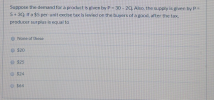 Suppose the demand for a product is given by P = 30-20. Also, the supply is given by P= 5+30. If a $5 per-unit excise tax is levied on the buyers of a good. after the tax producer surplus is equal to None of these $20 $25 $24 $64
if the demand elasticity for good X is 1.33 and the supply elasticity for X is...
if the demand elasticity for good X is 1.33 and the supply elasticity for X is .42 who will pay a greater share of a tax imposed on the market? a) producers b) consumers c) the government d) the tax will be shared equally between consumers and producers
Question 5 1 pts Assuming that a $500 excise tax is imposed in a market. The...
 Question 5 1 pts Assuming that a $500 excise tax is imposed in a market. The consumer share of the actual tax incidence turns out to be $100, while the producers' share of the tax burden turns out to be $400. O This implies that supply is relatively more elastic than demand This implies that demand is relatively more elastic than supply O Tax Burden and elasticity are unrelated concepts.
Question 23 1 pts If demand is perfectly inelastic and supply is relatively elastic, the burden...
 Question 23 1 pts If demand is perfectly inelastic and supply is relatively elastic, the burden of an excise tax: falls primarily on producers. is shared evenly by consumers and producers. falls entirely on producers. falls entirely on consumers. • Previous Next →
Panel (a) Price Panel (b) Supply Supply Demand Demand 1 2 3 4 5 6 7 8 Quantity 1 2 3 4 5 6 7 8 Quantity 6. In which...
 Panel (a) Price Panel (b) Supply Supply Demand Demand 1 2 3 4 5 6 7 8 Quantity 1 2 3 4 5 6 7 8 Quantity 6. In which of the panels in the figure do the buyers bear the greater tax incidence, and why is this? a) Panel(a), because the demand curve is relatively less elastic, meaning consumers are less willing to bear the burden of the tax. b) Panel (b), because the demand curve is relatively less...
 The graph below shows a hypothetical market for salt. Suppose that an excise or commodity tax is levied on consumers in an attempt to curb blood pressure problems. Show the effect of the tax by shifting the appropriate curve(s). Who has the larger tax burden? Producers (suppliers) Consumers (buyers) The tax burdens are equal Why is the tax burden as you described in in the question above? Supply is less elastic than demand. Demand is more elastic than supply. Both...
 Suppose the demand for a product is given by P = 30-20. Also, the supply is given by P= 5+30. If a $5 per-unit excise tax is levied on the buyers of a good. after the tax producer surplus is equal to None of these $20 $25 $24 $64
 Question 5 1 pts Assuming that a $500 excise tax is imposed in a market. The consumer share of the actual tax incidence turns out to be $100, while the producers' share of the tax burden turns out to be $400. O This implies that supply is relatively more elastic than demand This implies that demand is relatively more elastic than supply O Tax Burden and elasticity are unrelated concepts.
 Question 23 1 pts If demand is perfectly inelastic and supply is relatively elastic, the burden of an excise tax: falls primarily on producers. is shared evenly by consumers and producers. falls entirely on producers. falls entirely on consumers. • Previous Next →
 Panel (a) Price Panel (b) Supply Supply Demand Demand 1 2 3 4 5 6 7 8 Quantity 1 2 3 4 5 6 7 8 Quantity 6. In which of the panels in the figure do the buyers bear the greater tax incidence, and why is this? a) Panel(a), because the demand curve is relatively less elastic, meaning consumers are less willing to bear the burden of the tax. b) Panel (b), because the demand curve is relatively less...
Most questions answered within 3 hours.
-
Where is the error in this code sequence?
String s1 = "Hello";
String s2 = "ello";...
asked 11 months ago -
Financial data for Joel de Paris, Inc., for last year
follow:
Joel de Paris, Inc.
Balance...
asked 11 months ago -
Consider this reaction:
Al2(SO4)3 (aq)+ BaCl3
(aq) Al2Cl6 (aq)- +
3BaSO4(s) . What is the...
asked 11 months ago -
Suppose that Savneet is considering increasing her
recent random sample from 20 car rentals to 40...
asked 11 months ago -
Trucks arrive at an unloading terminal at an average rate of 120
per hour.
Trucks arrive...
asked 11 months ago -
Why are methanol and ethanol completely soluble in water while
octanol is not very little soluble....
asked 11 months ago -
A facilities manager at a university reads in a research report
that the mean amount of...
asked 11 months ago -
When the CuSO4 is rehydrated by adding water to the anhydrous
compound, is this an endothermic...
asked 11 months ago -
A ray of sunlight is passing from diamond into crown glass; the
angle of incidence is...
asked 11 months ago -
A block of mass 0.249 kg is placed on top of a light, vertical
spring of...
asked 11 months ago -
how do the kidneys compensate in the presences of acidosis
a) trigger hyperventilate
b) reserve acid...
asked 11 months ago -
Question 501 pts
The rental rate of capital to the firm increases. Which of the
following...
asked 11 months ago