
Homework Answers
Answer 1: Korotkoff sounds or K-Sounds is the name used to describe the sounds Of blood pressure heard through the stethoscope.
Answer 2: A blood pressure less than 120/80 mmHg is normal. Prehypertension is blood pressure that is slightly higher than normal. Prehypertension increases the risk that you will develop chronic, or long-lasting, high blood pressure in the future. If your blood pressure is between 120/80 mmHg and 139/89 mmHg, you have prehypertension.
Answer 3: The appropriate cuff size must be used to ensure accurate measurement. The bladder within the cuff should encircle at least 80% of the upper arm.
Answer 4: Pressure of the blood pressure cuff should be released at a rate of 2-3 mmHg per second.
Answer 5: Systolic Blood Pressure is the point at which the first of two or more Korotkoff sounds is heard (phase 1) and diastolic Blood pressure is the point before the disappearance of Korotkoff sounds (phase 5).
Answer 6: Wrap cuff firmly around upper arm at heart level; align cuff with brachial artery, approximately 1 inch/2.54 cm above the antecubital space.
Answer 7: Patent should be seated quietly for at least 5 min in a chair with back support. Feet on the floor and arms supported at "heart" level. Patient should refrain from smoking cigarettes or ingesting caffeine for at least 30 min preceding the measurement.
Answer 8: 3 common errors are as follows:
- Room noise may make it hard to hear the sounds
- cuff may not be wrapped tight enough
- cuff pressure released too fast, diastolic may not be accurately detected
Add Answer to:
Blood Pressure Lab 1. is the name used to describe the sounds of blood pressure heard...
Cardio microphone In the auscultatory measurement of blood pressure, the Korotkoff sounds will be heard as...
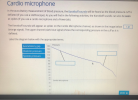 Cardio microphone In the auscultatory measurement of blood pressure, the Korotkoff sounds will be heard as the blood pressure cuff is deflated (if you use a stethoscope). As you will find in the following activities, the Korotkoff sounds can also be seen as spikes (if you use a cardio microphone and a PowerLab). 1 pc The Korotkoff sounds will appear as spikes on the Cardio Microphone channel, as shown in the image below (orange signal). The upper channel (dark blue...
physiology CASE #1 A 59-year-old man with type 2 diabetes presents with concerns about high blood...
 physiology
CASE #1 A 59-year-old man with type 2 diabetes presents with concerns about high blood pressure (BP). At a recent visit to his dentist he was told his BP was high. He was reclining in the dentist's chair when his BP was taken, but he doesn't remember the exact reading. He has no symptoms. He has never taken medications for high BP. He takes metformin for type 2 diabetes. His BP is measured once at 146/95 mm Hg in...
physiology
CASE #1 A 59-year-old man with type 2 diabetes presents with concerns about high blood pressure (BP). At a recent visit to his dentist he was told his BP was high. He was reclining in the dentist's chair when his BP was taken, but he doesn't remember the exact reading. He has no symptoms. He has never taken medications for high BP. He takes metformin for type 2 diabetes. His BP is measured once at 146/95 mm Hg in...
 Cardio microphone In the auscultatory measurement of blood pressure, the Korotkoff sounds will be heard as the blood pressure cuff is deflated (if you use a stethoscope). As you will find in the following activities, the Korotkoff sounds can also be seen as spikes (if you use a cardio microphone and a PowerLab). 1 pc The Korotkoff sounds will appear as spikes on the Cardio Microphone channel, as shown in the image below (orange signal). The upper channel (dark blue...
 physiology
CASE #1 A 59-year-old man with type 2 diabetes presents with concerns about high blood pressure (BP). At a recent visit to his dentist he was told his BP was high. He was reclining in the dentist's chair when his BP was taken, but he doesn't remember the exact reading. He has no symptoms. He has never taken medications for high BP. He takes metformin for type 2 diabetes. His BP is measured once at 146/95 mm Hg in...
physiology
CASE #1 A 59-year-old man with type 2 diabetes presents with concerns about high blood pressure (BP). At a recent visit to his dentist he was told his BP was high. He was reclining in the dentist's chair when his BP was taken, but he doesn't remember the exact reading. He has no symptoms. He has never taken medications for high BP. He takes metformin for type 2 diabetes. His BP is measured once at 146/95 mm Hg in...
Most questions answered within 3 hours.
-
Where is the error in this code sequence?
String s1 = "Hello";
String s2 = "ello";...
asked 11 months ago -
Financial data for Joel de Paris, Inc., for last year
follow:
Joel de Paris, Inc.
Balance...
asked 11 months ago -
Consider this reaction:
Al2(SO4)3 (aq)+ BaCl3
(aq) Al2Cl6 (aq)- +
3BaSO4(s) . What is the...
asked 11 months ago -
Suppose that Savneet is considering increasing her
recent random sample from 20 car rentals to 40...
asked 11 months ago -
Trucks arrive at an unloading terminal at an average rate of 120
per hour.
Trucks arrive...
asked 11 months ago -
Why are methanol and ethanol completely soluble in water while
octanol is not very little soluble....
asked 11 months ago -
A facilities manager at a university reads in a research report
that the mean amount of...
asked 11 months ago -
When the CuSO4 is rehydrated by adding water to the anhydrous
compound, is this an endothermic...
asked 11 months ago -
A ray of sunlight is passing from diamond into crown glass; the
angle of incidence is...
asked 11 months ago -
A block of mass 0.249 kg is placed on top of a light, vertical
spring of...
asked 11 months ago -
how do the kidneys compensate in the presences of acidosis
a) trigger hyperventilate
b) reserve acid...
asked 11 months ago -
Question 501 pts
The rental rate of capital to the firm increases. Which of the
following...
asked 11 months ago