
Homework Answers
Returns to scale can be found out by seeing if the output increases by the same/greater/lesser scale with an increase in the inputs in the same proportion.
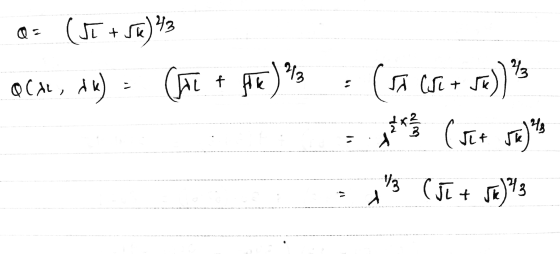
For a lambda increase in inputs, the output increases by less than lambda amd hence we have decreasing returns to scale not increasing.
Therefore this is false.
MRTS shows the rate at which for a given level of output , and for an additional increase in labour , the amount of capital that is needed to be given up.
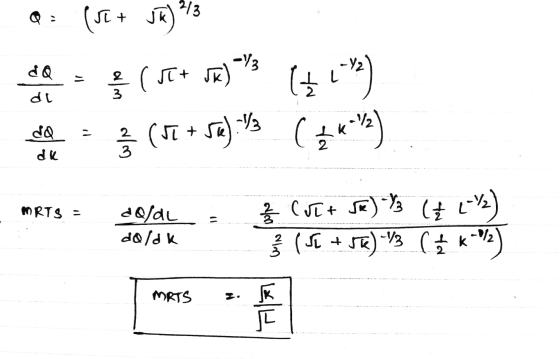
Now, dMRTS/dL is negative i.e.dMRTS/dL = -(0.5)√(KL) <0
This means for an additional increase in labour, the amount of capital that is needed to be given up is decreasing , to maintain a given level of output.
Hence this statement is true.
When L = 2 and K = 8, MRTS = 2 , hence third statement is also true.
So, 2 out of the three statements are true.
Add Answer to:
8. Consider the production function Q = (-1/2 + K1/2)2/3, where L denotes labor and K...
1. Consider the production function ?(?, ?) = (?1/2 + ?1/2)2/3 , where L denotes labor...
1. Consider the production function ?(?, ?) = (?1/2 + ?1/2)2/3 , where L denotes labor and K capital. This production function exhibits A. constant returns to scale. C. decreasing returns to scale. D. increasing returns to scale.
Consider the production function given by y = f(L,K) = L^(1/2) K^(1/3) , where y is...
Consider the production function given by y = f(L,K) = L^(1/2) K^(1/3) , where y is the output, L is the labour input, and K is the capital input. (a) Does this exhibit constant, increasing, or decreasing returns to scale? (b) Suppose that the firm employs 9 units of capital, and in the short-run, it cannot change this amount. Then what is the short-run production function? (c) Determine whether the short-run production function exhibits diminishing marginal product of labour. (d)...
a firms production function is Q=K^.2*L^.8 .The cost of labor $20 and the cost of capital...
a firms production function is Q=K^.2*L^.8 .The cost of labor $20 and the cost of capital is $80.a) what is the cost-minimizing combo of K and L if Q=100? b)does this firm have constant, increasing, decreasing returns to scale? explain. c)Prove your answer to part b using the definitions of constant, increasing or decreasing returns to scale.
2. For the following Cobb-Douglas production function, q = f(L,K) = _0.45 0.7 a. Derive expressions...
 2. For the following Cobb-Douglas production function, q = f(L,K) = _0.45 0.7 a. Derive expressions for marginal product of labor and marginal product of capital, MP, and MPK. b. Derive the expression for marginal rate of technical substitution, MRTS. C. Does this production function display constant, increasing, or decreasing returns to scale? Why? d. By how much would output increase if the firm increased each input by 50%?
A firm has the following production function, where Q is output, K is capital and L...
A firm has the following production function, where Q is output, K is capital and L is labor: Q = 400K0.5L0.3 Does this firm operate under increasing, decreasing or constant returns to scale, and why?
Consider a firm that faces the following production function: q = f(L, K) = L1/2 K1/2...
Consider a firm that faces the following production function: q = f(L, K) = L1/2 K1/2 where q is output, L is labor, and K is capital. Use this production function to answer the following questions. (a) What is the marginal product of labor (MPL)? (b) Does the MPL follow the law of diminishing returns? How do you know? (c) What is the marginal product of capital (MPK)? (d) Does the MPK follow the law of diminishing returns? How do...
SHOW ALL WORK!!! 2. For the following Cobb-Douglas production function, q=f(L,K) = _0.45 0.7 a. Derive expressions for m...
 SHOW ALL WORK!!!
2. For the following Cobb-Douglas production function, q=f(L,K) = _0.45 0.7 a. Derive expressions for marginal product of labor and marginal product of capital, MP, and MPK. b. Derive the expression for marginal rate of technical substitution, MRTS. C. Does this production function display constant, increasing, or decreasing returns to scale? Why? d. By how much would output increase if the firm increased each input by 50%?
SHOW ALL WORK!!!
2. For the following Cobb-Douglas production function, q=f(L,K) = _0.45 0.7 a. Derive expressions for marginal product of labor and marginal product of capital, MP, and MPK. b. Derive the expression for marginal rate of technical substitution, MRTS. C. Does this production function display constant, increasing, or decreasing returns to scale? Why? d. By how much would output increase if the firm increased each input by 50%?
1. A production function is given by f(K, L) = L/2+ v K. Given this form,...
 1. A production function is given by f(K, L) = L/2+ v K. Given this form, MPL = 1/2 and MPK-2 K (a) Are there constant returns to scale, decreasing returns to scale, or increasing returns to scale? (b) In the short run, capital is fixed at -4 while labor is variable. On the same graph, draw the 2. A production function is f(LK)-(L" + Ka)", where a > 0 and b > 0, For what values of a and...
Acme produces anvils using labor (L) and capital (K) according to the production function Q= f(L,K)=LK...
Acme produces anvils using labor (L) and capital (K) according to the production function Q= f(L,K)=LK with associated marginal products MPL=K, MPK =L. The price of labor is w=2 and the price of capital is r=1. Does Acme's production function for anvils exhibit increasing, constant or decreasing returns to scale? Justify your answer
A firm has a production function q = KL, where q is the quantity of output,...
A firm has a production function q = KL, where q is the quantity of output, K is the amount of capital and L is the amount of labor. a) Does this production function exhibit increasing, decreasing or constant returns to scale? b) Does the long-run cost function exhibit economies of scale or diseconomies of scale? c) Is the LR Average Cost curve increasing or decreasing with q?
 2. For the following Cobb-Douglas production function, q = f(L,K) = _0.45 0.7 a. Derive expressions for marginal product of labor and marginal product of capital, MP, and MPK. b. Derive the expression for marginal rate of technical substitution, MRTS. C. Does this production function display constant, increasing, or decreasing returns to scale? Why? d. By how much would output increase if the firm increased each input by 50%?
 SHOW ALL WORK!!!
2. For the following Cobb-Douglas production function, q=f(L,K) = _0.45 0.7 a. Derive expressions for marginal product of labor and marginal product of capital, MP, and MPK. b. Derive the expression for marginal rate of technical substitution, MRTS. C. Does this production function display constant, increasing, or decreasing returns to scale? Why? d. By how much would output increase if the firm increased each input by 50%?
SHOW ALL WORK!!!
2. For the following Cobb-Douglas production function, q=f(L,K) = _0.45 0.7 a. Derive expressions for marginal product of labor and marginal product of capital, MP, and MPK. b. Derive the expression for marginal rate of technical substitution, MRTS. C. Does this production function display constant, increasing, or decreasing returns to scale? Why? d. By how much would output increase if the firm increased each input by 50%?
 1. A production function is given by f(K, L) = L/2+ v K. Given this form, MPL = 1/2 and MPK-2 K (a) Are there constant returns to scale, decreasing returns to scale, or increasing returns to scale? (b) In the short run, capital is fixed at -4 while labor is variable. On the same graph, draw the 2. A production function is f(LK)-(L" + Ka)", where a > 0 and b > 0, For what values of a and...
Most questions answered within 3 hours.
-
Where is the error in this code sequence?
String s1 = "Hello";
String s2 = "ello";...
asked 10 months ago -
Financial data for Joel de Paris, Inc., for last year
follow:
Joel de Paris, Inc.
Balance...
asked 10 months ago -
Consider this reaction:
Al2(SO4)3 (aq)+ BaCl3
(aq) Al2Cl6 (aq)- +
3BaSO4(s) . What is the...
asked 10 months ago -
Suppose that Savneet is considering increasing her
recent random sample from 20 car rentals to 40...
asked 10 months ago -
Trucks arrive at an unloading terminal at an average rate of 120
per hour.
Trucks arrive...
asked 10 months ago -
Why are methanol and ethanol completely soluble in water while
octanol is not very little soluble....
asked 10 months ago -
A facilities manager at a university reads in a research report
that the mean amount of...
asked 10 months ago -
When the CuSO4 is rehydrated by adding water to the anhydrous
compound, is this an endothermic...
asked 10 months ago -
A ray of sunlight is passing from diamond into crown glass; the
angle of incidence is...
asked 10 months ago -
A block of mass 0.249 kg is placed on top of a light, vertical
spring of...
asked 10 months ago -
how do the kidneys compensate in the presences of acidosis
a) trigger hyperventilate
b) reserve acid...
asked 10 months ago -
Question 501 pts
The rental rate of capital to the firm increases. Which of the
following...
asked 10 months ago