Questions 1 – 4 refer to prospects X and Y below, as well as the following...
Questions 1 – 4 refer to prospects X and Y below, as well as the
following information
?? = ($0, 0.50; $40, 0.25; $100, 0.25) ?? = ($0, 0.25; $40, 0.50;
$60, 0.25)
Mark has utility of wealth given by ?(?) = ?^0.6
1. What is the expected value of prospect X (?V(?))?
2. What is the standard deviation of prospect X (SD(?))? (Round
your answer to the nearest cent,
and don’t worry, I’ll include a healthy margin of error so you
won’t get this wrong due to
rounding).
3. What is the value of the expected utility of Y for Mark
(EU(Y))?
4. How much is Mark willing to spend to acquire Y (so, what is the
value of CE(?))? (Hint, if
?(?) = ?^0.6, ?ℎ?n u^−1(?) = ?^1.67).
Homework Answers
1.
Expected value of prospect X = 0.5* $0 + 0.25 * $40 + 0.25 * $100
Expected value of prospect X = $35
2.
| X | P(x) | X* P(x) | X^2*P(x) |
| 0 | 0.5 | 0 | 0 |
| 40 | 0.25 | 10 | 400 |
| 100 | 0.25 | 25 | 2500 |
| E(x) | 35 | 2900 | |
| Var | 1675 | ||
| Std dev | 40.93 |
Note that,
Variance = X^2 * P(x) - (E(x))^2 = 2900 - 35^2
Variance = 1675
SD = sqrt ( Variance ) = sqrt( 1675) = 40.93
3.
Similar to the above method,
| Y | P(y) | U(y) = y^0.6 | U(y)* P(y) |
| 0 | 0.25 | 0.00 | 0 |
| 40 | 0.5 | 9.15 | 4.57 |
| 60 | 0.25 | 11.67 | 2.92 |
| E(U(y)) | 7.49 |
Hence,
Expected Value = 7.49
4.
| Y | P(y) | U(y) = y^0.6 | U(y)^1.67 | C(y) =(U(y)^1.67)* P(y) |
| 0 | 0.25 | 0.00 | 0 | 0.00 |
| 40 | 0.5 | 9.15 | 40.33 | 20.16 |
| 60 | 0.25 | 11.67 | 60.53 | 15.13 |
| E(C(y)) | 35.29 |
Hence,
Value of CE(y)= 35.29
Add Answer to:
Questions 1 – 4 refer to prospects X and Y below, as well as the
following...
Questions 1 – 4 refer to prospects X and Y below, as well as the following...
Questions 1 – 4 refer to prospects X and Y below, as well as the following information x = ($0,0.25;$50,0.50;$100,0.25) y = ($20,0.25;$50,0.50;$80,0.25) Mark has utility of wealth given by u(x)=x^0.4 1.) What is the expected value of prospect X (EV(X))? 2.) What is the standard deviation of prospect X (SD(X))? Round your answer to the nearest cent, and don’t worry, I’ll include a healthy margin of error so you won’t get this wrong due to rounding). 3.) What is...
I'm stuck on problem 3 and 4. Thank You. Questions 1-5 refer to prospects X and...
 I'm stuck on problem 3 and 4. Thank You.
Questions 1-5 refer to prospects X and Y below, as well as the following information X ($0,0.25; $50,0.50; $100,0.25) Y($20,0.25; $50,0.50$80,0.25) Mark has utility of wealth given by u(x) -x04 I. What is the expected value of prospect X (EVCax))? 2. What is the standard deviation of prospect X (SD(X))? (Round your answer to the nearest cent, and don't worry, Гії include a healthy margin of error so you won't get...
I'm stuck on problem 3 and 4. Thank You.
Questions 1-5 refer to prospects X and Y below, as well as the following information X ($0,0.25; $50,0.50; $100,0.25) Y($20,0.25; $50,0.50$80,0.25) Mark has utility of wealth given by u(x) -x04 I. What is the expected value of prospect X (EVCax))? 2. What is the standard deviation of prospect X (SD(X))? (Round your answer to the nearest cent, and don't worry, Гії include a healthy margin of error so you won't get...
I need help on number 2 and 5. Thank you. Questions 1 – 4 refer to...
I need help on number 2 and 5. Thank you. Questions 1 – 4 refer to prospects X and Y below, as well as the following information x = ($0,0.25;$50,0.50;$100,0.25) y = ($20,0.25;$50,0.50;$80,0.25) Mark has utility of wealth given by u(x)=x^0.4 1.) What is the expected value of prospect X (EV(X))? 2.) What is the standard deviation of prospect X (SD(X))? Round your answer to the nearest cent, and don’t worry, I’ll include a healthy margin of error so you...
Questions 5-7 ask you to consider risky prospects Y and Z, below: Y Z ($40, 0....
 Questions 5-7 ask you to consider risky prospects Y and Z, below: Y Z ($40, 0. 75; $60, 0.25) (S0, 0.40; $75,0.60) S. (10 points) Prospect Z is a mean preserving spread of prospect Y. True or False: SD(Z) > SD(Y). 6. (10 points) Jane has a concave utility of wealth function, u(x). Which of the following statements is true? (Hint: Z is a mean preserving spread of Y) a. Jane prefers Y to Z b. Jane prefers Z to...
Questions 1-4 rely on the following prompt Risky Prospect Y is defined as: Y = ($0,...
 Questions 1-4 rely on the following prompt Risky Prospect Y is defined as: Y = ($0, 0.25; $8, 0.50; $64, 0.25). Marco's utility of wealth function is given by u(x) = Vx (in case the font is too small, that says "fourth root of x”). 1. What is the value of EV(Y)? 2. What is the value of SD(Y) (the standard deviation of prospect Y (Round to the nearest hundredth). 3. What is the value of EU(Y) for Marco? 4....
Risky Prospect Y is defined as: Y (S0, 0.35; S16, 0.50: $81,0.15). Marco's utility of wealth...
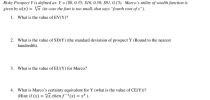 Risky Prospect Y is defined as: Y (S0, 0.35; S16, 0.50: $81,0.15). Marco's utility of wealth function is given by u(x)-Vx (in case the font is too small, that says "fourth root of x"). 1. What is the value of EV(Y)? 2. What is the value of SD(Y (the standard deviation of prospect Y (Round to the nearest hundredth) 3. What is the value of EU(Y) for Marco? 4. What is Marco's certainty equivalent for Y (what is the value...
Which of the following statements is necessarily false for some given (non-degenerate) risky prospect, X? An...
Which of the following statements is necessarily false for some given (non-degenerate) risky prospect, X? An individual with convex utility of wealth will have a greater value of CE(X) than an individual with concave utility of wealth? When utility of wealth is linear, the numeric value (ignoring units) of CE(X) – EV(X) is equivalent to the numeric value of EU(X) – U(EV(X)). A doubling of all of X’s outcomes will result in a doubling of X’s expected value. A doubling...
12. Which of the following statements is necessarily false for some given risky prospect, X (assume...
 12. Which of the following statements is necessarily false for some given risky prospect, X (assume that X has more than one possible outcome)? a. An individual with convex utility of wealth will have a greater value of CE(X) than an individual with concave utility of wealth? b. When utility of wealth is linear, the numeric value (ignoring units) of CE(X) - EV(X) is equivalent to the numeric value of EU(X) - U(EV(X)). c. A doubling of all of X's...
12. Which of the following statements is necesarily fals for some given (non-degenerate) risk,y prospect, X?...
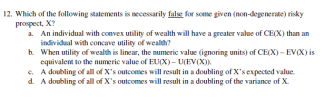 12. Which of the following statements is necesarily fals for some given (non-degenerate) risk,y prospect, X? An individual with convex utility of wealth will have a grealer value of CIİX individual with concave utility of wealth? when utility of wealth is linear, the numeric value (ignoring units) of CE(X)-EV(X) is equivalent to the numeric value of EUX) - U(EV(X). a. than an b, 1S c. A doubling of all of X's outcomes will result in a doubling of X's expected...
Table 1. Column 1 Column 2 X Column 3 Y Profits ($1,000s) Project A Probability (%)...
Table 1. Column 1 Column 2 X Column 3 Y Profits ($1,000s) Project A Probability (%) Project B Probability (%) $ 20 10 10 40 15 15 60 50 25 80 15 40 100 10 10 Use the mean – variance approach to compare prospects X and Y. Comment and explain which project dominates according to this criterion. Use the probability criteria to compare prospects X and Y. Comment and explain which project dominates according to this criterion. Assume the...
 I'm stuck on problem 3 and 4. Thank You.
Questions 1-5 refer to prospects X and Y below, as well as the following information X ($0,0.25; $50,0.50; $100,0.25) Y($20,0.25; $50,0.50$80,0.25) Mark has utility of wealth given by u(x) -x04 I. What is the expected value of prospect X (EVCax))? 2. What is the standard deviation of prospect X (SD(X))? (Round your answer to the nearest cent, and don't worry, Гії include a healthy margin of error so you won't get...
I'm stuck on problem 3 and 4. Thank You.
Questions 1-5 refer to prospects X and Y below, as well as the following information X ($0,0.25; $50,0.50; $100,0.25) Y($20,0.25; $50,0.50$80,0.25) Mark has utility of wealth given by u(x) -x04 I. What is the expected value of prospect X (EVCax))? 2. What is the standard deviation of prospect X (SD(X))? (Round your answer to the nearest cent, and don't worry, Гії include a healthy margin of error so you won't get...
 Questions 5-7 ask you to consider risky prospects Y and Z, below: Y Z ($40, 0. 75; $60, 0.25) (S0, 0.40; $75,0.60) S. (10 points) Prospect Z is a mean preserving spread of prospect Y. True or False: SD(Z) > SD(Y). 6. (10 points) Jane has a concave utility of wealth function, u(x). Which of the following statements is true? (Hint: Z is a mean preserving spread of Y) a. Jane prefers Y to Z b. Jane prefers Z to...
 Questions 1-4 rely on the following prompt Risky Prospect Y is defined as: Y = ($0, 0.25; $8, 0.50; $64, 0.25). Marco's utility of wealth function is given by u(x) = Vx (in case the font is too small, that says "fourth root of x”). 1. What is the value of EV(Y)? 2. What is the value of SD(Y) (the standard deviation of prospect Y (Round to the nearest hundredth). 3. What is the value of EU(Y) for Marco? 4....
 Risky Prospect Y is defined as: Y (S0, 0.35; S16, 0.50: $81,0.15). Marco's utility of wealth function is given by u(x)-Vx (in case the font is too small, that says "fourth root of x"). 1. What is the value of EV(Y)? 2. What is the value of SD(Y (the standard deviation of prospect Y (Round to the nearest hundredth) 3. What is the value of EU(Y) for Marco? 4. What is Marco's certainty equivalent for Y (what is the value...
 12. Which of the following statements is necessarily false for some given risky prospect, X (assume that X has more than one possible outcome)? a. An individual with convex utility of wealth will have a greater value of CE(X) than an individual with concave utility of wealth? b. When utility of wealth is linear, the numeric value (ignoring units) of CE(X) - EV(X) is equivalent to the numeric value of EU(X) - U(EV(X)). c. A doubling of all of X's...
 12. Which of the following statements is necesarily fals for some given (non-degenerate) risk,y prospect, X? An individual with convex utility of wealth will have a grealer value of CIİX individual with concave utility of wealth? when utility of wealth is linear, the numeric value (ignoring units) of CE(X)-EV(X) is equivalent to the numeric value of EUX) - U(EV(X). a. than an b, 1S c. A doubling of all of X's outcomes will result in a doubling of X's expected...
Most questions answered within 3 hours.
-
Where is the error in this code sequence?
String s1 = "Hello";
String s2 = "ello";...
asked 11 months ago -
Financial data for Joel de Paris, Inc., for last year
follow:
Joel de Paris, Inc.
Balance...
asked 11 months ago -
Consider this reaction:
Al2(SO4)3 (aq)+ BaCl3
(aq) Al2Cl6 (aq)- +
3BaSO4(s) . What is the...
asked 11 months ago -
Suppose that Savneet is considering increasing her
recent random sample from 20 car rentals to 40...
asked 11 months ago -
Trucks arrive at an unloading terminal at an average rate of 120
per hour.
Trucks arrive...
asked 11 months ago -
Why are methanol and ethanol completely soluble in water while
octanol is not very little soluble....
asked 11 months ago -
A facilities manager at a university reads in a research report
that the mean amount of...
asked 11 months ago -
When the CuSO4 is rehydrated by adding water to the anhydrous
compound, is this an endothermic...
asked 11 months ago -
A ray of sunlight is passing from diamond into crown glass; the
angle of incidence is...
asked 11 months ago -
A block of mass 0.249 kg is placed on top of a light, vertical
spring of...
asked 11 months ago -
how do the kidneys compensate in the presences of acidosis
a) trigger hyperventilate
b) reserve acid...
asked 11 months ago -
Question 501 pts
The rental rate of capital to the firm increases. Which of the
following...
asked 11 months ago