read the below case and answer all the question Mrs. Doe is a 33 year old...
read the below case and answer all the question
Mrs. Doe is a 33 year old paramedic who has discussed end-of-life decisions including the importance of Do Not Resuscitate orders with her husband. Mrs. Doe (having lost her brother years earlier) expressed to her husband that she never wanted to be kept alive by machines. She also expressed a desire to sign a DNR order but had not done so yet. Eighteen weeks (4 ½ months) into her second pregnancy, Mrs. Doe collapsed on the living room floor. Mr. Doe performed CPR and called 911. She was put on life support after suffering a suspected pulmonary embolism but never regained consciousness and was considered brain dead. Knowing his wife’s wishes, Mr. Doe makes the decision that she would NOT want to be kept alive since her quality of life would never be what it was and wants her removed from life support and be allowed to die with dignity. However, the fetus is still viable with a normal heart beat. If delivered now, the fetus would not be viable, however, if the mother was kept “alive” and the fetus had time to develop to 24-28 weeks; the fetus could survive and be delivered by cesarean. To complicate matters, Mrs. Doe lives in Texas where state law nulls a DNR order if a woman is pregnant because there is a legal duty to keep her alive while the fetus is viable.
1-Do you as the attending physician honor the patient’s wishes and remove life support knowing that the patient AND the unborn child will die or do you follow state law and keep the mother on life support for the sake of the developing fetus?
2- I WOULD or WOULD NOT remove the patient from life support?
3-Ethical considerations: What morals and values are you basing your decision on? What is the effect of this action? Will, it set precedence for others? Where is the ethical line drawn when it relates to a medical issue in letting a family member make a decision in such a short time period and under dire circumstances? Should a sense of right or wrong outweigh the rights of a person to determine her own medical care; even if that means consequences for an unborn child?
4-
Legal Considerations: Please answer the questions based on your decision.
- Do you believe you have a duty to care? What do you believe is a reasonable standard of care?
- Are you potentially breaching your duty?
- Was there potential injuries?
- Is there a direct cause to your actions and could you foresee that happening?
5-Can your actions be considered negligent
Homework Answers
Q. No. 1. Answer :
No, I can not follow the state law and to keep mother on life support, for the sake of developing fetus, because fetus is 4 1/2 month only, still it has to grow up to 36 to 38 weeks of gestational age, if we will support the mother by mechanically, there is no proper supply of nutrients and blood to the fetus to develop properly, because mother is not in consciousness.
So even though fetus grows after the delivery there may be a so many complications like any intrauterine growth retardation, premature delivery, low birth weight, and congenital malformations ect.
So we can not grow properly the fetus with out alive mother.
Q. No. 2. Answer :
Yes, if there is no chance of aliving mother we can remove the mother from life support, because we should not do harm for the client unnecessarily. This is one of the ethical principle that is nonmaleficence.
Q. No. 3. Answer :
* Nonmaleficence is one of the ethical and moral values here, it is one of the benefit to the patient.
And it is precedent to the others also. With out this if the patient attenders want to alive the baby by mechanical support to the mother, there will be a consequences to the baby growth.
Like intrauterine growth retardation, intrauterine death, low birth weight baby ect.
Q. No. 5. Answer :
No, our actions should not be considered as negligent, because we are following Nonmaleficence here, we are not harming the patient and we are going to reducing the complications to the baby also.
So it's not negligent.
Add Answer to:
read the below case and answer all the
question
Mrs. Doe is a 33 year old...
read this and answe the queastion below. Mrs. Doe is a 33 year old paramedic who...
 read this and answe the queastion below.
Mrs. Doe is a 33 year old paramedic who has discussed end-of-life decisions including the importance of Do Not Resuscitate orders with her husband. Mirs. Doe (having lost her brother years earlier) expressed to her husband that she never wanted to be kept alive by machines. She also expressed a desire to sign a DNR order but had not done so yet. Eighteen weeks (4 /h months) into her second pregnancy, Mrs. Doe...
read this and answe the queastion below.
Mrs. Doe is a 33 year old paramedic who has discussed end-of-life decisions including the importance of Do Not Resuscitate orders with her husband. Mirs. Doe (having lost her brother years earlier) expressed to her husband that she never wanted to be kept alive by machines. She also expressed a desire to sign a DNR order but had not done so yet. Eighteen weeks (4 /h months) into her second pregnancy, Mrs. Doe...
please read the case in the top part and answer the question below Mrs. Doe is...
 please read the case in the top part and answer the question
below
Mrs. Doe is a 33 year old paramedic who has discussed end-of-lite decisions including the importance of Do Not Resuscitate orders with her husband. Mrs. Doe (having lost her brother years earlier) expressed to her husband that she never wanted to be kept alive by machines. She also expressed a desire to sign a DNR order but had not done so yet. Eighteen weeks (4 % months)...
please read the case in the top part and answer the question
below
Mrs. Doe is a 33 year old paramedic who has discussed end-of-lite decisions including the importance of Do Not Resuscitate orders with her husband. Mrs. Doe (having lost her brother years earlier) expressed to her husband that she never wanted to be kept alive by machines. She also expressed a desire to sign a DNR order but had not done so yet. Eighteen weeks (4 % months)...
Read the case and answer the below question. Note All the question are related to the...
Read the case and answer the below question. Note All the question are related to the case i cannot separate them Mrs. Doe is a 33 year old paramedic who has discussed end-of-life decisions including the importance of Do Not Resuscitate orders with her husband. Mrs. Doe (having lost her brother years earlier) expressed to her husband that she never wanted to be kept alive by machines. She also expressed a desire to sign a DNR order but had not...
Marlise Muñoz was found unconscious on the floor by her husband at their family home on...
Marlise Muñoz was found unconscious on the floor by her husband at their family home on November 26, 2013. She had suffered a massive pulmonary embolism. When paramedics arrived, she was alive but not breathing. She was rushed to John Peter Smith Hospital in Fort Worth, Texas, where she was pronounced brain dead 2 days later. She and her husband, 33 years old, both veteran paramedics, had discussed end-of-life issues, and Muñoz made it clear that she did not want...
First read the Harjo Case Study: Mrs. Harjo and Tony: Mrs. Harjo is 65 year old...
First read the Harjo Case Study: Mrs. Harjo and Tony: Mrs. Harjo is 65 year old female who identifies as Latina. She lives in Globe, Arizona, and subsists on Supplemental Security Income, SNAP (Supplemental Nutrition Assistance Program, commonly known as food stamps), and her garden. Mrs. Harjo has been living alone since the death of her husband five years ago. She is the daughter of Mexican immigrants, and visits her hometown in Mexico for Semana Santa every other year. Mrs....
Discuss the issue of Mrs Randles dignity involved in this case? ( read then respond) Mrs....
 Discuss the issue of Mrs Randles dignity involved in this
case? ( read then respond)
Mrs. Randle, a frail, 85-year-old woman who lives alone, is admitted to a geropsychiatric unit because of irritability, confusion, and in- creasing incontinence. Mrs. Randle's family states she was continually refusing assistance from her home health aides and became angry when her family and home care nurses tried to reason with her about these refusals. During her hospital admission, Mrs. Randle is treated for a...
Discuss the issue of Mrs Randles dignity involved in this
case? ( read then respond)
Mrs. Randle, a frail, 85-year-old woman who lives alone, is admitted to a geropsychiatric unit because of irritability, confusion, and in- creasing incontinence. Mrs. Randle's family states she was continually refusing assistance from her home health aides and became angry when her family and home care nurses tried to reason with her about these refusals. During her hospital admission, Mrs. Randle is treated for a...
Note: Assume that all cases take place in Illinois Case 1 Mrs. R is a 72-year-old...
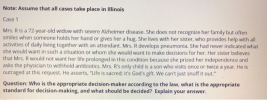 Note: Assume that all cases take place in Illinois Case 1 Mrs. R is a 72-year-old widow with severe Alzheimer disease. She does not recognize her family but often smiles when someone holds her hand or gives her a hug. She lives with her sister, who provides help with all activities of daily living together with an attendant. Mrs. R develops pneumonia. She had never indicated what she would want in such a situation or whom she would want to...
Please answer the case questions. Do not hand write CASE: SPOUSAL RIGHTS IN DECISION MAKING Mr....
 Please answer the case questions. Do not hand write
CASE: SPOUSAL RIGHTS IN DECISION MAKING Mr. Martin sustained debilitating injuries as the result of an automobile accident. He suffered severe subcortical brain damage, significantly impairing his physical and cognitive function- ing.45 His injuries left him totally paralyzed on the left side. He could not speak or eat and had no bladder or bowel control. Martin remained conscious and had some awareness of his surroundings. He could communicate to a very...
Please answer the case questions. Do not hand write
CASE: SPOUSAL RIGHTS IN DECISION MAKING Mr. Martin sustained debilitating injuries as the result of an automobile accident. He suffered severe subcortical brain damage, significantly impairing his physical and cognitive function- ing.45 His injuries left him totally paralyzed on the left side. He could not speak or eat and had no bladder or bowel control. Martin remained conscious and had some awareness of his surroundings. He could communicate to a very...
read the story and please answer the question the information is there just gotta answer the question with the st...
 read the story and please answer the question
the
information is there just gotta answer the question with the
story
Bioethics Case Study Alma be taken off of life support. Alma is 89-year-old woman and suffered from high blood pressure. She was active for her age. One night she suffered a stroke, resulting in a brain hemorrhage. Her family immediately shifted her to the hospital, and the doctor gave them the bad news that Alma had gone into a coma....
read the story and please answer the question
the
information is there just gotta answer the question with the
story
Bioethics Case Study Alma be taken off of life support. Alma is 89-year-old woman and suffered from high blood pressure. She was active for her age. One night she suffered a stroke, resulting in a brain hemorrhage. Her family immediately shifted her to the hospital, and the doctor gave them the bad news that Alma had gone into a coma....
Case Study: The Case of Mrs. Flynn Mrs. Flynn, a 68-year-old widow living alone in her...
Case Study: The Case of Mrs. Flynn Mrs. Flynn, a 68-year-old widow living alone in her home, was admitted to Community Medical Center after she became dizzy and fell while shopping for groceries. She broke her ankle in the fall. When interviewed by the hospital social worker, Mrs. Flynn admitted that she had not been taking her blood pressure medication on a regular basis and that her chronic obstructive pulmonary disease gave her difficulties when she would try to walk...
 read this and answe the queastion below.
Mrs. Doe is a 33 year old paramedic who has discussed end-of-life decisions including the importance of Do Not Resuscitate orders with her husband. Mirs. Doe (having lost her brother years earlier) expressed to her husband that she never wanted to be kept alive by machines. She also expressed a desire to sign a DNR order but had not done so yet. Eighteen weeks (4 /h months) into her second pregnancy, Mrs. Doe...
read this and answe the queastion below.
Mrs. Doe is a 33 year old paramedic who has discussed end-of-life decisions including the importance of Do Not Resuscitate orders with her husband. Mirs. Doe (having lost her brother years earlier) expressed to her husband that she never wanted to be kept alive by machines. She also expressed a desire to sign a DNR order but had not done so yet. Eighteen weeks (4 /h months) into her second pregnancy, Mrs. Doe...
 please read the case in the top part and answer the question
below
Mrs. Doe is a 33 year old paramedic who has discussed end-of-lite decisions including the importance of Do Not Resuscitate orders with her husband. Mrs. Doe (having lost her brother years earlier) expressed to her husband that she never wanted to be kept alive by machines. She also expressed a desire to sign a DNR order but had not done so yet. Eighteen weeks (4 % months)...
please read the case in the top part and answer the question
below
Mrs. Doe is a 33 year old paramedic who has discussed end-of-lite decisions including the importance of Do Not Resuscitate orders with her husband. Mrs. Doe (having lost her brother years earlier) expressed to her husband that she never wanted to be kept alive by machines. She also expressed a desire to sign a DNR order but had not done so yet. Eighteen weeks (4 % months)...
 Discuss the issue of Mrs Randles dignity involved in this
case? ( read then respond)
Mrs. Randle, a frail, 85-year-old woman who lives alone, is admitted to a geropsychiatric unit because of irritability, confusion, and in- creasing incontinence. Mrs. Randle's family states she was continually refusing assistance from her home health aides and became angry when her family and home care nurses tried to reason with her about these refusals. During her hospital admission, Mrs. Randle is treated for a...
Discuss the issue of Mrs Randles dignity involved in this
case? ( read then respond)
Mrs. Randle, a frail, 85-year-old woman who lives alone, is admitted to a geropsychiatric unit because of irritability, confusion, and in- creasing incontinence. Mrs. Randle's family states she was continually refusing assistance from her home health aides and became angry when her family and home care nurses tried to reason with her about these refusals. During her hospital admission, Mrs. Randle is treated for a...
 Note: Assume that all cases take place in Illinois Case 1 Mrs. R is a 72-year-old widow with severe Alzheimer disease. She does not recognize her family but often smiles when someone holds her hand or gives her a hug. She lives with her sister, who provides help with all activities of daily living together with an attendant. Mrs. R develops pneumonia. She had never indicated what she would want in such a situation or whom she would want to...
 Please answer the case questions. Do not hand write
CASE: SPOUSAL RIGHTS IN DECISION MAKING Mr. Martin sustained debilitating injuries as the result of an automobile accident. He suffered severe subcortical brain damage, significantly impairing his physical and cognitive function- ing.45 His injuries left him totally paralyzed on the left side. He could not speak or eat and had no bladder or bowel control. Martin remained conscious and had some awareness of his surroundings. He could communicate to a very...
Please answer the case questions. Do not hand write
CASE: SPOUSAL RIGHTS IN DECISION MAKING Mr. Martin sustained debilitating injuries as the result of an automobile accident. He suffered severe subcortical brain damage, significantly impairing his physical and cognitive function- ing.45 His injuries left him totally paralyzed on the left side. He could not speak or eat and had no bladder or bowel control. Martin remained conscious and had some awareness of his surroundings. He could communicate to a very...
 read the story and please answer the question
the
information is there just gotta answer the question with the
story
Bioethics Case Study Alma be taken off of life support. Alma is 89-year-old woman and suffered from high blood pressure. She was active for her age. One night she suffered a stroke, resulting in a brain hemorrhage. Her family immediately shifted her to the hospital, and the doctor gave them the bad news that Alma had gone into a coma....
read the story and please answer the question
the
information is there just gotta answer the question with the
story
Bioethics Case Study Alma be taken off of life support. Alma is 89-year-old woman and suffered from high blood pressure. She was active for her age. One night she suffered a stroke, resulting in a brain hemorrhage. Her family immediately shifted her to the hospital, and the doctor gave them the bad news that Alma had gone into a coma....
Most questions answered within 3 hours.
-
Where is the error in this code sequence?
String s1 = "Hello";
String s2 = "ello";...
asked 10 months ago -
Financial data for Joel de Paris, Inc., for last year
follow:
Joel de Paris, Inc.
Balance...
asked 10 months ago -
Consider this reaction:
Al2(SO4)3 (aq)+ BaCl3
(aq) Al2Cl6 (aq)- +
3BaSO4(s) . What is the...
asked 10 months ago -
Suppose that Savneet is considering increasing her
recent random sample from 20 car rentals to 40...
asked 10 months ago -
Trucks arrive at an unloading terminal at an average rate of 120
per hour.
Trucks arrive...
asked 10 months ago -
Why are methanol and ethanol completely soluble in water while
octanol is not very little soluble....
asked 10 months ago -
A facilities manager at a university reads in a research report
that the mean amount of...
asked 10 months ago -
When the CuSO4 is rehydrated by adding water to the anhydrous
compound, is this an endothermic...
asked 10 months ago -
A ray of sunlight is passing from diamond into crown glass; the
angle of incidence is...
asked 10 months ago -
A block of mass 0.249 kg is placed on top of a light, vertical
spring of...
asked 10 months ago -
how do the kidneys compensate in the presences of acidosis
a) trigger hyperventilate
b) reserve acid...
asked 10 months ago -
Question 501 pts
The rental rate of capital to the firm increases. Which of the
following...
asked 10 months ago