You purchase an annuity investment that pays you a lump sum amount of $289,284 at the...
You purchase an annuity investment that pays you a lump sum amount of $289,284 at the end of the term. You must make $20,000 quarterly payments until the end of the term. If you earn an interest rate of 2%, how many of these quarterly payments must you make? (Round to the nearest whole number)
Homework Answers
SOLUTION:-![0.5% [2% / 4; Annual rate is converted into quarterly rate] $20,000 Quarterly Interest Rate, RATE Quarterly payments, PMT Ini](http://img.homeworklib.com/questions/b9c053e0-7a4a-11ea-8e70-c98ad53db897.png?x-oss-process=image/resize,w_560)
Add Answer to:
You purchase an annuity investment that pays you a lump sum
amount of $289,284 at the...
D | Question 2 6.25 pts You purchase an annuity investment that pays you a lump...
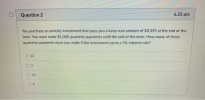 D | Question 2 6.25 pts You purchase an annuity investment that pays you a lump sum amount of $8,359 at the end of the term. You must make $1,000 quarterly payments until the end of the term. How many of these quarterly payments must you make if the investment earns a 5% interest rate? O 12 O 2 O 10
You have two choices of investments: Investment A is a 15-year annuity that requires end-of-quarter $1,400...
 You have two choices of investments: Investment A is a 15-year annuity that requires end-of-quarter $1,400 payments that earn an interest rate of 9% compounded quarterly. - Investment B is a 15-year lump sum investment that earns an interest rate of 11% compounded annually. How much money would you need to invest in Investment B today for it to be worth as much as Investment A 15 years from now? 1) $34,415 2) $40,415 3) $36,415 4) $42,415 5) $38,415
If an annuity can make an unending number of equal payments at the end of the...
 If an annuity can make an unending number of equal payments at
the end of the interest periods, it is called a
perpetuity. If a lump sum investment of
An is needed to result in n periodic
payments of R when the interest rate per period is
i, then
(a) Evaluate lim n→∞
An to find a
formula for the lump sum payment for a perpetuity.
(b) Find the lump sum investment needed to make payments of $90 per
month...
If an annuity can make an unending number of equal payments at
the end of the interest periods, it is called a
perpetuity. If a lump sum investment of
An is needed to result in n periodic
payments of R when the interest rate per period is
i, then
(a) Evaluate lim n→∞
An to find a
formula for the lump sum payment for a perpetuity.
(b) Find the lump sum investment needed to make payments of $90 per
month...
Find the lump sum deposited today that will yield the same total amount as payments of...
 Find the lump sum deposited today that will yield the same total amount as payments of $9,000 at the end of each year for 5 years, at an interest rate of 5% compounded annually. The lump sum is su (Round to the nearest cent.)
You plan to make a lump-sum deposit of $6000 now into an investment account that pays...
You plan to make a lump-sum deposit of $6000 now into an investment account that pays 8% per year, and you plan to withdraw an equal end-of-year amount of $1000 for 6 years, starting next year. At the end of the sixth year, you plan to close your account by withdrawing the remaining money. Define the engineering economy symbols involved.
You have your choice of two investment accounts. Investment A is a 10-year annuity that features...
 You have your choice of two investment accounts. Investment A is a 10-year annuity that features end-of-month $1,525 payments and has an interest rate of 7 percent compounded monthly. Investment B is an annually compounded lump-sum investment with an interest rate of 9 percent, also good for 10 years. How much money would you need to invest in B today for it to be worth as much as Investment A 10 years from now? (Do not round intermediate calculations and...
Powerball Winner: Take Lump Sum or Take the Annuity So let’s suppose, reader, that you have...
Powerball Winner: Take Lump Sum or Take the Annuity So let’s suppose, reader, that you have won Wednesday’s (2016) $1.5 billion Powerball jackpot. Congratulations! You have some important decisions to make, such as what ailing magazine to acquire and what congressional seat your spouse should run for. But first, you must choose whether to take the prize as an annuity paid over 30 years, or a lump-sum payment right now. If I’m reading you right, you should probably take the...
Powerball Winner: Take Lump Sum or Take the Annuity So let’s suppose, reader, that you have...
Powerball Winner: Take Lump Sum or Take the Annuity So let’s suppose, reader, that you have won Wednesday’s (2016) $1.5 billion Powerball jackpot. Congratulations! You have some important decisions to make, such as what ailing magazine to acquire and what congressional seat your spouse should run for. But first, you must choose whether to take the prize as an annuity paid over 30 years, or a lump-sum payment right now. If I’m reading you right, you should probably take the...
You have your choice of two investment accounts. Investment A is a 6-year annuity that features...
You have your choice of two investment accounts. Investment A is a 6-year annuity that features end-of-month $2,380 payments and has an interest rate of 10 percent compounded monthly. Investment B is an annually compounded lump-sum investment with an interest rate of 12 percent, also good for 6 years. How much money would you need to invest in B today for it to be worth as much as Investment A 6 years from now? (Do not round intermediate calculations and...
3. Many retired people buy annuities. With an annuity, a saver pays an insurance company a...
 3. Many retired people buy annuities. With an annuity, a saver pays an insurance company a lump- sum amount in return for the company's promise to pay a certain amount per year until the buyer dies. With an ordinary annuity, when the buyer dies, there is no final payment to his or her heirs. Suppose that at age 65, David Alexander pays $180,000 for an annuity that promises to pay him $20,000 per year for the remaining years of his...
 D | Question 2 6.25 pts You purchase an annuity investment that pays you a lump sum amount of $8,359 at the end of the term. You must make $1,000 quarterly payments until the end of the term. How many of these quarterly payments must you make if the investment earns a 5% interest rate? O 12 O 2 O 10
 You have two choices of investments: Investment A is a 15-year annuity that requires end-of-quarter $1,400 payments that earn an interest rate of 9% compounded quarterly. - Investment B is a 15-year lump sum investment that earns an interest rate of 11% compounded annually. How much money would you need to invest in Investment B today for it to be worth as much as Investment A 15 years from now? 1) $34,415 2) $40,415 3) $36,415 4) $42,415 5) $38,415
 If an annuity can make an unending number of equal payments at
the end of the interest periods, it is called a
perpetuity. If a lump sum investment of
An is needed to result in n periodic
payments of R when the interest rate per period is
i, then
(a) Evaluate lim n→∞
An to find a
formula for the lump sum payment for a perpetuity.
(b) Find the lump sum investment needed to make payments of $90 per
month...
If an annuity can make an unending number of equal payments at
the end of the interest periods, it is called a
perpetuity. If a lump sum investment of
An is needed to result in n periodic
payments of R when the interest rate per period is
i, then
(a) Evaluate lim n→∞
An to find a
formula for the lump sum payment for a perpetuity.
(b) Find the lump sum investment needed to make payments of $90 per
month...
 Find the lump sum deposited today that will yield the same total amount as payments of $9,000 at the end of each year for 5 years, at an interest rate of 5% compounded annually. The lump sum is su (Round to the nearest cent.)
 You have your choice of two investment accounts. Investment A is a 10-year annuity that features end-of-month $1,525 payments and has an interest rate of 7 percent compounded monthly. Investment B is an annually compounded lump-sum investment with an interest rate of 9 percent, also good for 10 years. How much money would you need to invest in B today for it to be worth as much as Investment A 10 years from now? (Do not round intermediate calculations and...
 3. Many retired people buy annuities. With an annuity, a saver pays an insurance company a lump- sum amount in return for the company's promise to pay a certain amount per year until the buyer dies. With an ordinary annuity, when the buyer dies, there is no final payment to his or her heirs. Suppose that at age 65, David Alexander pays $180,000 for an annuity that promises to pay him $20,000 per year for the remaining years of his...
Most questions answered within 3 hours.
-
Where is the error in this code sequence?
String s1 = "Hello";
String s2 = "ello";...
asked 11 months ago -
Financial data for Joel de Paris, Inc., for last year
follow:
Joel de Paris, Inc.
Balance...
asked 11 months ago -
Consider this reaction:
Al2(SO4)3 (aq)+ BaCl3
(aq) Al2Cl6 (aq)- +
3BaSO4(s) . What is the...
asked 11 months ago -
Suppose that Savneet is considering increasing her
recent random sample from 20 car rentals to 40...
asked 11 months ago -
Trucks arrive at an unloading terminal at an average rate of 120
per hour.
Trucks arrive...
asked 11 months ago -
Why are methanol and ethanol completely soluble in water while
octanol is not very little soluble....
asked 11 months ago -
A facilities manager at a university reads in a research report
that the mean amount of...
asked 11 months ago -
When the CuSO4 is rehydrated by adding water to the anhydrous
compound, is this an endothermic...
asked 11 months ago -
A ray of sunlight is passing from diamond into crown glass; the
angle of incidence is...
asked 11 months ago -
A block of mass 0.249 kg is placed on top of a light, vertical
spring of...
asked 11 months ago -
how do the kidneys compensate in the presences of acidosis
a) trigger hyperventilate
b) reserve acid...
asked 11 months ago -
Question 501 pts
The rental rate of capital to the firm increases. Which of the
following...
asked 11 months ago