
Homework Answers
Add Answer to:
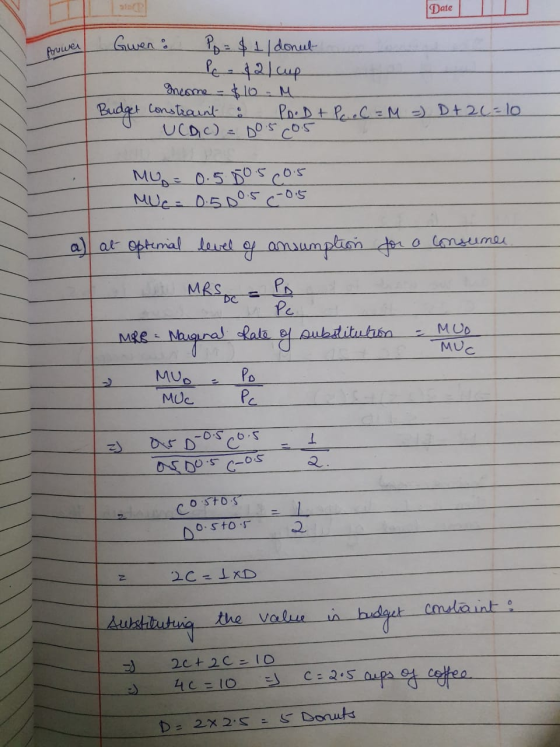
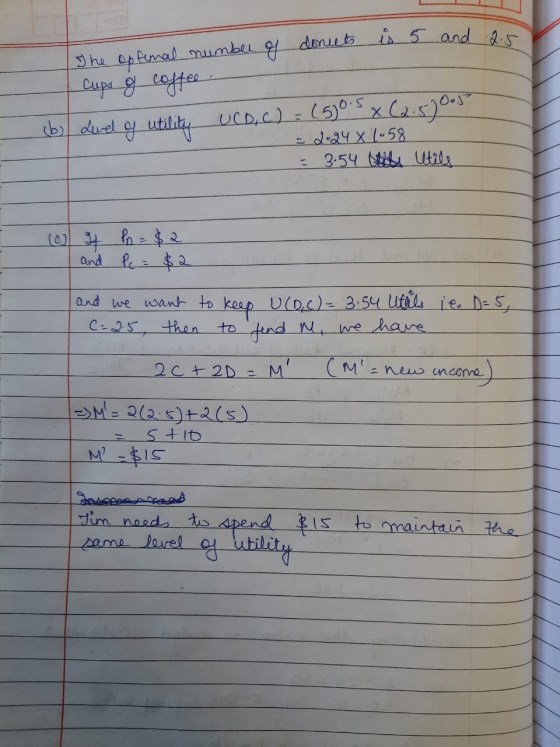
Question 9 of 10 > Consumer Behavior - End of Chapter Problem Tim spends his income...
3) (4pts. Consider a consumer who spends all his income on two goods, say 804 that...
 3) (4pts. Consider a consumer who spends all his income on two goods, say 804 that good 1 is an inferior good at the current prices and income). If the price and also the income of the consumer doubles, how does his demand for good at all. Explain. all his income on two goods, say good 1 and good 2. Assume ces and income). If the price of both goods double w does his demand for good 1 change, if...
Assume that Clark spends his entire income on the purchase of two goods, X and Y....
Assume that Clark spends his entire income on the purchase of two goods, X and Y. If his income and the prices of good X and Y all double, Clark will double the purchase of goods X and Y buy more of good X and less of good Y buy less of good X and more of good Y buy less of both goods X and Y buy the same amounts of goods X and Y According to the law...
A consumer earns I a week and spends his entire weekly income on new dress shirts...
A consumer earns I a week and spends his entire weekly income on new dress shirts and ties, because these are the only two items that provide utility to him. Further- more, he insists that for every shirt he buys, he must also buy a tie (without the ties, the new shirts are worthless and vice versa). Let Ps and Pt denotes the price of a shirt and the price of a tie, respectively. (a) Derive the consumer's demand function...
Thor Odinson has really let himself go. He spends all of his income only consuming whole...
 Thor Odinson has really let himself go. He spends all of his income only consuming whole pies of pizza (2) and cases of beer (b), priced at p: = 5 and p = 15, respectively. Suppose Thor's utility function is given by u(2,5) = 36 and his income is I = 300. (8 points total) (a) Solve for Thor's optimal bundle of pizza pies (2) and cases of beer (b). (2 points) (b) Draw Thor's budget constraint, optimal bundle, and...
Brian works in a factory and spends his monthly income on Beer and Pizza. The utility...
 Brian works in a factory and spends his monthly income on Beer and Pizza. The utility function U(X,Y) = X0.5y0.5 represents Brian's preference. Here, X is the quantity of beer, and Y is the quantity of pizza. Assume the numbers of beer and pizza do not need to be integers. Brian's monthly income is $100, the price of pizza is $4, and the price of beer is $2. a) Find the optimal consumption bundle for Brian. (Bundle A) b) The...
A consumer uses his income I for the consumption of two goods ?1 and ?2. He maximises utility at given product prices ?1...
A consumer uses his income I for the consumption of two goods ?1 and ?2. He maximises utility at given product prices ?1, ?2. His preferences with respect to both products can be described by an ordinal utility function ?(?1,?2), which exhibits a decreasing marginal rate of substitution (normal preferences). Please indicate whether the following statements are right or wrong in this context. If a statement is wrong, then describe briefly what is wrong (one sentence). a) A double value...
Consider a consumer whose income is 100 and his preference is given by U-10x04yo6. If PX-Py-1,...
 Consider a consumer whose income is 100 and his preference is given by U-10x04yo6. If PX-Py-1, what is the optimal consumption bundle by the consumer? (Please write out the constraint utility maximization problem completely, including the budget function.) Derive the demand of Good X and Y by this consumer. (The result should be a function giving you the amount of X he will buy at every given price level Px, and a function for good Y as well.) a. b....
Question 2 (20 points) A consumer purchases two goods x ano y. The consumer's income is...
 Question 2 (20 points) A consumer purchases two goods x ano y. The consumer's income is 1. Hi S income is 1. His utility is given by is * and y. Px is the price of x. Py is the price of a) Calculate consumer's optim U(x,y) = xy s optimal choice of x and y under his budget.hu uncompensated demand) b) Derive the indirect utility function. c) Are these two goods normal goods? Why d) Derive the expenditure function....
Consider a consumer in a two good economy domy whose preferences are rep- resented by the...
 Consider a consumer in a two good economy domy whose preferences are rep- resented by the following utility function U(z,y) = x + y a) Find her Marshallian demand functions for good X and good Y , 1.e., x* (Pæ, Py, I) and y* (Pz, Py, 1)? b) Find her Hicksian demand functions for good X and good Y, i.e., x" (Pc, Py, U) and yº(Px; Py, U)? c) Find her indirect utility function, V(Pa, Py, I). d) Find her...
2. Consider the following four consumers (C1,C2,C3,C4) with the following utility functions: Consumer Utility Function C1...
2. Consider the following four consumers (C1,C2,C3,C4) with the following utility functions: Consumer Utility Function C1 u(x,y) = 2x+2y C2 u(x,y) = x^3/4y^1/4 C3 u(x,y) = min(x,y) C4 u(x,y) = min(4x,3y) On the appropriate graph, draw each consumer’s indifference curves through the following points: (2,2), (4,4), (6,6) and (8,8), AND label the utility level of each curve. Hint: Each grid should have 4 curves on it representing the same preferences but with different utility levels. 3. In the following parts,...
 3) (4pts. Consider a consumer who spends all his income on two goods, say 804 that good 1 is an inferior good at the current prices and income). If the price and also the income of the consumer doubles, how does his demand for good at all. Explain. all his income on two goods, say good 1 and good 2. Assume ces and income). If the price of both goods double w does his demand for good 1 change, if...
 Thor Odinson has really let himself go. He spends all of his income only consuming whole pies of pizza (2) and cases of beer (b), priced at p: = 5 and p = 15, respectively. Suppose Thor's utility function is given by u(2,5) = 36 and his income is I = 300. (8 points total) (a) Solve for Thor's optimal bundle of pizza pies (2) and cases of beer (b). (2 points) (b) Draw Thor's budget constraint, optimal bundle, and...
 Brian works in a factory and spends his monthly income on Beer and Pizza. The utility function U(X,Y) = X0.5y0.5 represents Brian's preference. Here, X is the quantity of beer, and Y is the quantity of pizza. Assume the numbers of beer and pizza do not need to be integers. Brian's monthly income is $100, the price of pizza is $4, and the price of beer is $2. a) Find the optimal consumption bundle for Brian. (Bundle A) b) The...
 Consider a consumer whose income is 100 and his preference is given by U-10x04yo6. If PX-Py-1, what is the optimal consumption bundle by the consumer? (Please write out the constraint utility maximization problem completely, including the budget function.) Derive the demand of Good X and Y by this consumer. (The result should be a function giving you the amount of X he will buy at every given price level Px, and a function for good Y as well.) a. b....
 Question 2 (20 points) A consumer purchases two goods x ano y. The consumer's income is 1. Hi S income is 1. His utility is given by is * and y. Px is the price of x. Py is the price of a) Calculate consumer's optim U(x,y) = xy s optimal choice of x and y under his budget.hu uncompensated demand) b) Derive the indirect utility function. c) Are these two goods normal goods? Why d) Derive the expenditure function....
 Consider a consumer in a two good economy domy whose preferences are rep- resented by the following utility function U(z,y) = x + y a) Find her Marshallian demand functions for good X and good Y , 1.e., x* (Pæ, Py, I) and y* (Pz, Py, 1)? b) Find her Hicksian demand functions for good X and good Y, i.e., x" (Pc, Py, U) and yº(Px; Py, U)? c) Find her indirect utility function, V(Pa, Py, I). d) Find her...
Most questions answered within 3 hours.
-
Where is the error in this code sequence?
String s1 = "Hello";
String s2 = "ello";...
asked 11 months ago -
Financial data for Joel de Paris, Inc., for last year
follow:
Joel de Paris, Inc.
Balance...
asked 11 months ago -
Consider this reaction:
Al2(SO4)3 (aq)+ BaCl3
(aq) Al2Cl6 (aq)- +
3BaSO4(s) . What is the...
asked 11 months ago -
Suppose that Savneet is considering increasing her
recent random sample from 20 car rentals to 40...
asked 11 months ago -
Trucks arrive at an unloading terminal at an average rate of 120
per hour.
Trucks arrive...
asked 11 months ago -
Why are methanol and ethanol completely soluble in water while
octanol is not very little soluble....
asked 11 months ago -
A facilities manager at a university reads in a research report
that the mean amount of...
asked 11 months ago -
When the CuSO4 is rehydrated by adding water to the anhydrous
compound, is this an endothermic...
asked 11 months ago -
A ray of sunlight is passing from diamond into crown glass; the
angle of incidence is...
asked 11 months ago -
A block of mass 0.249 kg is placed on top of a light, vertical
spring of...
asked 11 months ago -
how do the kidneys compensate in the presences of acidosis
a) trigger hyperventilate
b) reserve acid...
asked 11 months ago -
Question 501 pts
The rental rate of capital to the firm increases. Which of the
following...
asked 11 months ago