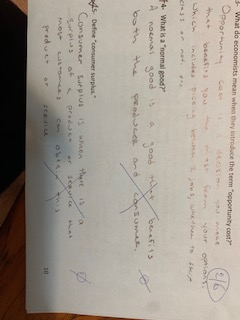
please explain question 4 and 5. Thank you.
Homework Answers
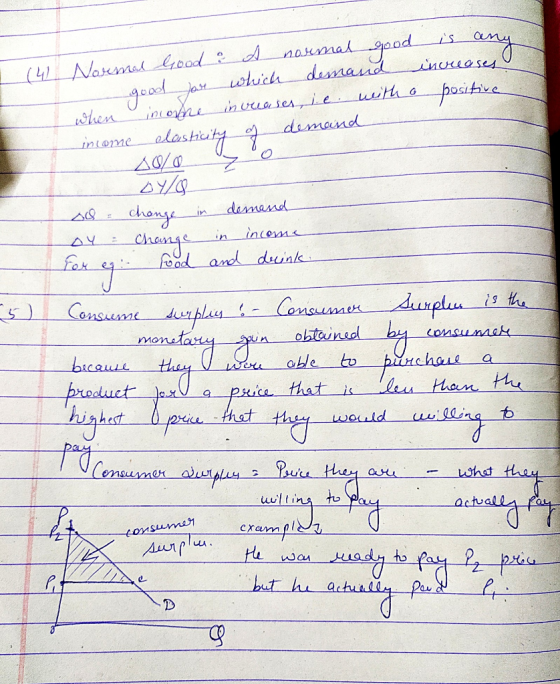
Add Answer to:
please explain question 4 and 5. Thank you.
5. What do economists mean when they introduce...
Define in your own words what economists mean by: 1. Opportunity cost 2. Normal good 3. Consumer surplus 4. Ceteris Par...
 Define in your own words what economists mean by: 1. Opportunity cost 2. Normal good 3. Consumer surplus 4. Ceteris Paribus 5. Incidence of a tax
Explain question 4 and 5. ort answers: Explain briefly. Draw a graph if helpful Why do...
 Explain question 4 and 5.
ort answers: Explain briefly. Draw a graph if helpful Why do economists represent the Production Possibility Frontier (PPF) as a concave I bowed out') curve? comer cice for roducono c e che resour way he re best suited for. Explain what economists mean when they state that the labor Market and the Capital Market demands are derived demand. The des - What do economists mean when they introduce the term opportunity cost Opportunity cost decision...
Explain question 4 and 5.
ort answers: Explain briefly. Draw a graph if helpful Why do economists represent the Production Possibility Frontier (PPF) as a concave I bowed out') curve? comer cice for roducono c e che resour way he re best suited for. Explain what economists mean when they state that the labor Market and the Capital Market demands are derived demand. The des - What do economists mean when they introduce the term opportunity cost Opportunity cost decision...
QUESTION 1 Economists use the word marginal to mean 1. A decision that is only secondary...
QUESTION 1 Economists use the word marginal to mean 1. A decision that is only secondary in importance. 2. The extra benefit or cost of a decision. 3. When firms concentrate on their profit margin. 4. When an economy is producing efficiently. 5 points QUESTION 2 Economists use the word rationality to mean.... 1. When people correctly analyze a situation and come to the best decision possible. 2. Only a hypothetical scenario, people are never really rational. 3. When...
please answer these. Thank you. 29. When a tax is placed on the buyers of coffee,...
 please answer these. Thank you.
29. When a tax is placed on the buyers of coffee, the buyers bear the entire burden of the tax b. sellers bear the entire burden of the tax burden of the tax will be always be equally divided between the buyers and the sellers d. burden of the tax will be shared by the buyers and the sellers, but the division of the burden is not always equal 30. the government wants to reduce...
please answer these. Thank you.
29. When a tax is placed on the buyers of coffee, the buyers bear the entire burden of the tax b. sellers bear the entire burden of the tax burden of the tax will be always be equally divided between the buyers and the sellers d. burden of the tax will be shared by the buyers and the sellers, but the division of the burden is not always equal 30. the government wants to reduce...
Please explain steps and Ill leave good feedback. Thank you 5. We are given a normal...
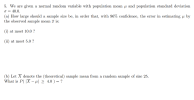 Please explain steps and Ill leave good feedback. Thank you
5. We are given a normal random variable with population mean μ and population standard deviation σ 40.0. (a) How large should a sample size be, in order that, with 96% confidence, the error in estimating μ by the observed sample mean is: (i) at most 10.0? (ii) at most 5.0? (b) Let X denote the (theoretical) sample mean from a random sample of size 25. What is P( X-씨...
Please explain steps and Ill leave good feedback. Thank you
5. We are given a normal random variable with population mean μ and population standard deviation σ 40.0. (a) How large should a sample size be, in order that, with 96% confidence, the error in estimating μ by the observed sample mean is: (i) at most 10.0? (ii) at most 5.0? (b) Let X denote the (theoretical) sample mean from a random sample of size 25. What is P( X-씨...
Could you please make sure part 1 and part 2 are right; in addition, explain part...
 Could you please make sure part 1 and part 2 are right; in
addition, explain part three. Thank you!
S = MC $100 Consumer surplus 244 producer surplus Shoptage 350 - 480 = 27.6 80 200 350 5000 Part 1: Assume that the market is in equilibrium. Calculate the producer surplus, consumer surplus, and total surplus (-5 points) consumer Surplus - (200) (40) ñ 4000 producer Surplus: (200)(50) – 5990 totar surplus = 9000 Part 2: Now suppose that a...
Could you please make sure part 1 and part 2 are right; in
addition, explain part three. Thank you!
S = MC $100 Consumer surplus 244 producer surplus Shoptage 350 - 480 = 27.6 80 200 350 5000 Part 1: Assume that the market is in equilibrium. Calculate the producer surplus, consumer surplus, and total surplus (-5 points) consumer Surplus - (200) (40) ñ 4000 producer Surplus: (200)(50) – 5990 totar surplus = 9000 Part 2: Now suppose that a...
can you please explain this deeply? thank you Question 7 Consider a consumer with preferences over...
 can you please explain this deeply? thank you
Question 7 Consider a consumer with preferences over two goods 1 and 2. Assume that the horizontal axis pertains to the amount of good 1 and the vertical axis pertains to the amount of good 2. Suppose that, given the consumption bundle r = 10 and y = 10, a consumer's MRS (marginal rate of substitution) is equal (in absolute value) to 4. The price of good 1 is $1, the price...
can you please explain this deeply? thank you
Question 7 Consider a consumer with preferences over two goods 1 and 2. Assume that the horizontal axis pertains to the amount of good 1 and the vertical axis pertains to the amount of good 2. Suppose that, given the consumption bundle r = 10 and y = 10, a consumer's MRS (marginal rate of substitution) is equal (in absolute value) to 4. The price of good 1 is $1, the price...
Please show work and explain work for both questions for a full rating. Thank you. Question...
 Please show work and explain work for both questions for a full
rating. Thank you.
Question 1 When the price of a good increases, George reduces his quantity demanded by 6 units due to substitution effect and increases his quantity demanded by 2 units due to income effect. For George, therefore, this must be: A. A normal good B. An inferior good C. A Giffen good D. Either a normal good or an inferior good E. None of the above...
Please show work and explain work for both questions for a full
rating. Thank you.
Question 1 When the price of a good increases, George reduces his quantity demanded by 6 units due to substitution effect and increases his quantity demanded by 2 units due to income effect. For George, therefore, this must be: A. A normal good B. An inferior good C. A Giffen good D. Either a normal good or an inferior good E. None of the above...
Please so work so I can use as study reference. Thank you :) 5) Suppose the...
 Please so work so I can use as study reference. Thank you
:)
5) Suppose the malket demand curve is Q- 10200-100p. The monopolist's cost finction is C(q) = 1000 + qi/2 a) Find the monopolist's marginal revenue and marginal cost functions MR b) Calculate the equilibrium monopolist price and quantity s) Sketch the monopoly's demand, marginal revenue, and marginal cost curves. Label the axes, the curves, the equilibrium, and the vertical intercepts of all curves. d) Calculate consumer surplus,...
Please so work so I can use as study reference. Thank you
:)
5) Suppose the malket demand curve is Q- 10200-100p. The monopolist's cost finction is C(q) = 1000 + qi/2 a) Find the monopolist's marginal revenue and marginal cost functions MR b) Calculate the equilibrium monopolist price and quantity s) Sketch the monopoly's demand, marginal revenue, and marginal cost curves. Label the axes, the curves, the equilibrium, and the vertical intercepts of all curves. d) Calculate consumer surplus,...
number 3 please thank you Activity 3: Chem 333D, 11/4 or 6/19 (Please do not explain...
 number 3 please thank you
Activity 3: Chem 333D, 11/4 or 6/19 (Please do not explain any of the answers in more than 3 sentences) Name: 1.) What makes an atom a good nucleophile? (3 points) 2.) What makes an atom a good electrophile? (3 points) 3.) What factors influence if a reaction is going to be a substitution or elimination reaction? (4 points)
number 3 please thank you
Activity 3: Chem 333D, 11/4 or 6/19 (Please do not explain any of the answers in more than 3 sentences) Name: 1.) What makes an atom a good nucleophile? (3 points) 2.) What makes an atom a good electrophile? (3 points) 3.) What factors influence if a reaction is going to be a substitution or elimination reaction? (4 points)
 Define in your own words what economists mean by: 1. Opportunity cost 2. Normal good 3. Consumer surplus 4. Ceteris Paribus 5. Incidence of a tax
 Explain question 4 and 5.
ort answers: Explain briefly. Draw a graph if helpful Why do economists represent the Production Possibility Frontier (PPF) as a concave I bowed out') curve? comer cice for roducono c e che resour way he re best suited for. Explain what economists mean when they state that the labor Market and the Capital Market demands are derived demand. The des - What do economists mean when they introduce the term opportunity cost Opportunity cost decision...
Explain question 4 and 5.
ort answers: Explain briefly. Draw a graph if helpful Why do economists represent the Production Possibility Frontier (PPF) as a concave I bowed out') curve? comer cice for roducono c e che resour way he re best suited for. Explain what economists mean when they state that the labor Market and the Capital Market demands are derived demand. The des - What do economists mean when they introduce the term opportunity cost Opportunity cost decision...
 please answer these. Thank you.
29. When a tax is placed on the buyers of coffee, the buyers bear the entire burden of the tax b. sellers bear the entire burden of the tax burden of the tax will be always be equally divided between the buyers and the sellers d. burden of the tax will be shared by the buyers and the sellers, but the division of the burden is not always equal 30. the government wants to reduce...
please answer these. Thank you.
29. When a tax is placed on the buyers of coffee, the buyers bear the entire burden of the tax b. sellers bear the entire burden of the tax burden of the tax will be always be equally divided between the buyers and the sellers d. burden of the tax will be shared by the buyers and the sellers, but the division of the burden is not always equal 30. the government wants to reduce...
 Please explain steps and Ill leave good feedback. Thank you
5. We are given a normal random variable with population mean μ and population standard deviation σ 40.0. (a) How large should a sample size be, in order that, with 96% confidence, the error in estimating μ by the observed sample mean is: (i) at most 10.0? (ii) at most 5.0? (b) Let X denote the (theoretical) sample mean from a random sample of size 25. What is P( X-씨...
Please explain steps and Ill leave good feedback. Thank you
5. We are given a normal random variable with population mean μ and population standard deviation σ 40.0. (a) How large should a sample size be, in order that, with 96% confidence, the error in estimating μ by the observed sample mean is: (i) at most 10.0? (ii) at most 5.0? (b) Let X denote the (theoretical) sample mean from a random sample of size 25. What is P( X-씨...
 Could you please make sure part 1 and part 2 are right; in
addition, explain part three. Thank you!
S = MC $100 Consumer surplus 244 producer surplus Shoptage 350 - 480 = 27.6 80 200 350 5000 Part 1: Assume that the market is in equilibrium. Calculate the producer surplus, consumer surplus, and total surplus (-5 points) consumer Surplus - (200) (40) ñ 4000 producer Surplus: (200)(50) – 5990 totar surplus = 9000 Part 2: Now suppose that a...
Could you please make sure part 1 and part 2 are right; in
addition, explain part three. Thank you!
S = MC $100 Consumer surplus 244 producer surplus Shoptage 350 - 480 = 27.6 80 200 350 5000 Part 1: Assume that the market is in equilibrium. Calculate the producer surplus, consumer surplus, and total surplus (-5 points) consumer Surplus - (200) (40) ñ 4000 producer Surplus: (200)(50) – 5990 totar surplus = 9000 Part 2: Now suppose that a...
 can you please explain this deeply? thank you
Question 7 Consider a consumer with preferences over two goods 1 and 2. Assume that the horizontal axis pertains to the amount of good 1 and the vertical axis pertains to the amount of good 2. Suppose that, given the consumption bundle r = 10 and y = 10, a consumer's MRS (marginal rate of substitution) is equal (in absolute value) to 4. The price of good 1 is $1, the price...
can you please explain this deeply? thank you
Question 7 Consider a consumer with preferences over two goods 1 and 2. Assume that the horizontal axis pertains to the amount of good 1 and the vertical axis pertains to the amount of good 2. Suppose that, given the consumption bundle r = 10 and y = 10, a consumer's MRS (marginal rate of substitution) is equal (in absolute value) to 4. The price of good 1 is $1, the price...
 Please show work and explain work for both questions for a full
rating. Thank you.
Question 1 When the price of a good increases, George reduces his quantity demanded by 6 units due to substitution effect and increases his quantity demanded by 2 units due to income effect. For George, therefore, this must be: A. A normal good B. An inferior good C. A Giffen good D. Either a normal good or an inferior good E. None of the above...
Please show work and explain work for both questions for a full
rating. Thank you.
Question 1 When the price of a good increases, George reduces his quantity demanded by 6 units due to substitution effect and increases his quantity demanded by 2 units due to income effect. For George, therefore, this must be: A. A normal good B. An inferior good C. A Giffen good D. Either a normal good or an inferior good E. None of the above...
 Please so work so I can use as study reference. Thank you
:)
5) Suppose the malket demand curve is Q- 10200-100p. The monopolist's cost finction is C(q) = 1000 + qi/2 a) Find the monopolist's marginal revenue and marginal cost functions MR b) Calculate the equilibrium monopolist price and quantity s) Sketch the monopoly's demand, marginal revenue, and marginal cost curves. Label the axes, the curves, the equilibrium, and the vertical intercepts of all curves. d) Calculate consumer surplus,...
Please so work so I can use as study reference. Thank you
:)
5) Suppose the malket demand curve is Q- 10200-100p. The monopolist's cost finction is C(q) = 1000 + qi/2 a) Find the monopolist's marginal revenue and marginal cost functions MR b) Calculate the equilibrium monopolist price and quantity s) Sketch the monopoly's demand, marginal revenue, and marginal cost curves. Label the axes, the curves, the equilibrium, and the vertical intercepts of all curves. d) Calculate consumer surplus,...
 number 3 please thank you
Activity 3: Chem 333D, 11/4 or 6/19 (Please do not explain any of the answers in more than 3 sentences) Name: 1.) What makes an atom a good nucleophile? (3 points) 2.) What makes an atom a good electrophile? (3 points) 3.) What factors influence if a reaction is going to be a substitution or elimination reaction? (4 points)
number 3 please thank you
Activity 3: Chem 333D, 11/4 or 6/19 (Please do not explain any of the answers in more than 3 sentences) Name: 1.) What makes an atom a good nucleophile? (3 points) 2.) What makes an atom a good electrophile? (3 points) 3.) What factors influence if a reaction is going to be a substitution or elimination reaction? (4 points)
Most questions answered within 3 hours.
-
Where is the error in this code sequence?
String s1 = "Hello";
String s2 = "ello";...
asked 10 months ago -
Financial data for Joel de Paris, Inc., for last year
follow:
Joel de Paris, Inc.
Balance...
asked 10 months ago -
Consider this reaction:
Al2(SO4)3 (aq)+ BaCl3
(aq) Al2Cl6 (aq)- +
3BaSO4(s) . What is the...
asked 10 months ago -
Suppose that Savneet is considering increasing her
recent random sample from 20 car rentals to 40...
asked 10 months ago -
Trucks arrive at an unloading terminal at an average rate of 120
per hour.
Trucks arrive...
asked 10 months ago -
Why are methanol and ethanol completely soluble in water while
octanol is not very little soluble....
asked 10 months ago -
A facilities manager at a university reads in a research report
that the mean amount of...
asked 10 months ago -
When the CuSO4 is rehydrated by adding water to the anhydrous
compound, is this an endothermic...
asked 10 months ago -
A ray of sunlight is passing from diamond into crown glass; the
angle of incidence is...
asked 10 months ago -
A block of mass 0.249 kg is placed on top of a light, vertical
spring of...
asked 10 months ago -
how do the kidneys compensate in the presences of acidosis
a) trigger hyperventilate
b) reserve acid...
asked 10 months ago -
Question 501 pts
The rental rate of capital to the firm increases. Which of the
following...
asked 10 months ago