
Suppose that market demand for a good is given by QD(P) = 10−P. The total cost of production is TC(Q) = 2Q2. Determine quantity QM and price PM that a monopolist will choose in this market. Calculate consumer surplus (CS), producer surplus (PS), and the deadweight loss (DWL) resulting from the monopoly. Graphical Solution would suffice!
Homework Answers
 Answer
For a monopolist, equilibrium condition is given by-
MARGINAL REVENUE = MARGINAL COST
STEP-1 Calculate Marginal revenue
MR= dTR/dQ = 10-2q
STEP-2 Calculate Marginal Cost
MC = dTC/dQ = 4Q
STEP-3 FINDING EQUILIBRIUM PRICE AND QUANTITY
Q* = 5/3
P* = 25/3
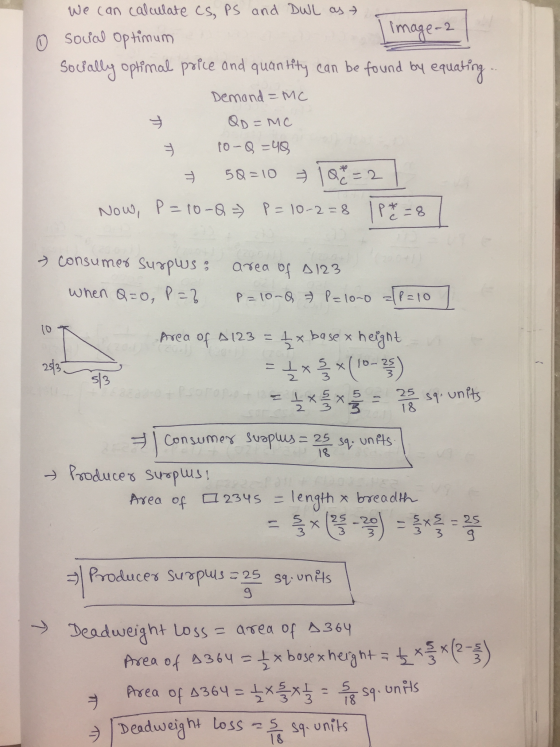
STEP-4 CALCULATING CONSUMER SURPLUS, PRODUCER SURPLUS AND DEADWEIGHT LOSS
Consumer surplus can be defined as the difference between the total amount that a consumer is willing to pay for a good and the amount he actually pays for it.
As we know, monopoly charges a higher price than what would prevail in a perfectly competitive economy, such practice leads to a loss of both consumer surplus and producer surplus. Such a loss is a welfare cost to the society and known as deadweight loss.
Add Answer to:
Suppose that market demand for a good is given by
QD(P) = 10−P. The total cost...
A monopolist faces inverse demand P = on TC(Q) = cQ. (a) Find the optimal price,...
 A monopolist faces inverse demand P = on TC(Q) = cQ. (a) Find the optimal price, P, and quantity, QM (b) Solve for the monopolist's optimal profits, TM (c) Graph the equilibrium and show consumer surplus, producer surplus and deadweight loss. Be 150 -3Q and total cost functi careful with the marginal cost curve. (d) Compute CS and PS. These will be functions of the cost parameter c. (e) Compute DWL. Similarly, it will be functions of the cost parameter...
Practice Question 4. The inverse demand curve a monopoly faces is p = 30 – Q....
 Practice Question 4. The inverse demand curve a monopoly faces is p = 30 – Q. The firm's total cost function is C(Q) = 0.5Q² and thus marginal cost function is MC(Q) = Q. (a) Determine the monopoly quantity, price and profit, and calculate the CS, PS and social welfare under the monopoly. (b) Determine the socially optimal outcome and calculate the CS, PS and social welfare under the social optimum. (c) Calculate the deadweight loss due to the monopolist...
wanna check final answer I already did it Taxation Suppose now the government decides to intervene the market with...
 wanna check final answer I already did it
Taxation Suppose now the government decides to intervene the market with a tax on producers of $4, determine the price for the consumer, the g. price for the producer, and the quantity produced with the tax Draw a graph (Diagram 4) representing the market for Hallowcen costurmes with a tax on producers of $4. Accurately label and show the h. area for consumers (CS), producer surplus (PS), deadweight loss (DWL), and government...
wanna check final answer I already did it
Taxation Suppose now the government decides to intervene the market with a tax on producers of $4, determine the price for the consumer, the g. price for the producer, and the quantity produced with the tax Draw a graph (Diagram 4) representing the market for Hallowcen costurmes with a tax on producers of $4. Accurately label and show the h. area for consumers (CS), producer surplus (PS), deadweight loss (DWL), and government...
Suppose that a Monopolist's market demand is given by P a - Q, a>2, and that...
 Suppose that a Monopolist's market demand is given by P a - Q, a>2, and that the a) Calculate the profit maximising monopoly price and quantity. b) Calculate the price and quantity that arise under perfect competition. [8 marks ] c) Calculate and compare Consumer and Producer Surplus both under monopoly [6 marks ] and perfect competition: what is the Deadweight loss due to Monopoly? Provide a graphical description of the two cases. [16 marks]
Suppose the market demand and market supply curves are given by the equations: Qd= 100-P Qs=...
Suppose the market demand and market supply curves are given by the equations: Qd= 100-P Qs= 3P a. What are the equilibrium price and equilibrium quantity in the market for this product? b. Find out consumer surplus, producer surplus, and total surplus. c. Suppose the government sets a price floor at $26 for this product. With this price floor, how much is consumer surplus? d. With this price floor of $26, how much is producer surplus? e. Find out total...
3. Consider a uniform-price monopolist that faces demand curve P() 14 2Q and faces a total...
 3. Consider a uniform-price monopolist that faces demand curve P() 14 2Q and faces a total cost TC() 20 (a) Calculate the profit maximizing price and quantity erw erwyat er Patt Q= (b) Determine the consumer surplus, producer surplus, and deadweight loss erwyat erwy erwyatt CS = el DWL =
4) Suppose a monopolist controls the market for diamonds. The inverse demand for diamonds is given...
4) Suppose a monopolist controls the market for diamonds. The inverse demand for diamonds is given by p = 1800 – Q, where Q is millions of carats of diamonds per year and p is dollars per carat. Cost function of the firm is given by C = (1/2) Q2 (SHOW EVERY WORKS) a) What price and quantity does the monopolist choose? b) Suppose the government regulates the monopolist to price at $900 per carat. What is the equilibrium quantity?...
2. Suppose the market demand curve is P = 40 − 3Q and all firms in...
2. Suppose the market demand curve is P = 40 − 3Q and all firms in the industry face M C = 4 and have no fixed costs. For each of the following situations, calculate the five items: Market Price , Quantity per firm ,Profits per firm ,Consumer Surplus ,Deadweight Loss (a) Uniform pricing monopolist P = Q = π = CS = DWL = (b) Cournot Duopoly P= Q1 = Q2 = π 1 = π2...
ECON 332 -Spring 2018 Name: Given the following information, answer the questions below: Op(P) = 100-2P...
 ECON 332 -Spring 2018 Name: Given the following information, answer the questions below: Op(P) = 100-2P C(Q) = 100 a) Find the perfectly competitive outcome, P*, Q* b) Using profit maximization, determine the monopoly quantity QM and price PM. Be sure to check second order conditions to determine whether you have identified a local maximum. c) Graph supply, demand, and marginal revenue curves. Identify P*, Q*, QM, and PM on the graph. d) Calculate consumer surplus and producer surplus (separately)...
PROBLEM II. In a market of a certain product, there is a monopolist with a cost...
 PROBLEM II. In a market of a certain product, there is a monopolist with a cost function C(Q) = 2, while the inverse demand function is given by P)600 2Q. Compute the monopoly equilibrium quantity Qm and price Pm, Q3. The monopoly equilibrium quantity Q"is (a) Q 240 (b) Q60. (c) Q90. (dQ 180 (e) Qm 120 Q4. The monopoly equilibrium price Pm is (a) Pm 240 (b) Pm 220 (c) Pm 360 (d) Pm 420 (e) Pm 380 Q5....
 A monopolist faces inverse demand P = on TC(Q) = cQ. (a) Find the optimal price, P, and quantity, QM (b) Solve for the monopolist's optimal profits, TM (c) Graph the equilibrium and show consumer surplus, producer surplus and deadweight loss. Be 150 -3Q and total cost functi careful with the marginal cost curve. (d) Compute CS and PS. These will be functions of the cost parameter c. (e) Compute DWL. Similarly, it will be functions of the cost parameter...
 Practice Question 4. The inverse demand curve a monopoly faces is p = 30 – Q. The firm's total cost function is C(Q) = 0.5Q² and thus marginal cost function is MC(Q) = Q. (a) Determine the monopoly quantity, price and profit, and calculate the CS, PS and social welfare under the monopoly. (b) Determine the socially optimal outcome and calculate the CS, PS and social welfare under the social optimum. (c) Calculate the deadweight loss due to the monopolist...
 wanna check final answer I already did it
Taxation Suppose now the government decides to intervene the market with a tax on producers of $4, determine the price for the consumer, the g. price for the producer, and the quantity produced with the tax Draw a graph (Diagram 4) representing the market for Hallowcen costurmes with a tax on producers of $4. Accurately label and show the h. area for consumers (CS), producer surplus (PS), deadweight loss (DWL), and government...
wanna check final answer I already did it
Taxation Suppose now the government decides to intervene the market with a tax on producers of $4, determine the price for the consumer, the g. price for the producer, and the quantity produced with the tax Draw a graph (Diagram 4) representing the market for Hallowcen costurmes with a tax on producers of $4. Accurately label and show the h. area for consumers (CS), producer surplus (PS), deadweight loss (DWL), and government...
 Suppose that a Monopolist's market demand is given by P a - Q, a>2, and that the a) Calculate the profit maximising monopoly price and quantity. b) Calculate the price and quantity that arise under perfect competition. [8 marks ] c) Calculate and compare Consumer and Producer Surplus both under monopoly [6 marks ] and perfect competition: what is the Deadweight loss due to Monopoly? Provide a graphical description of the two cases. [16 marks]
 3. Consider a uniform-price monopolist that faces demand curve P() 14 2Q and faces a total cost TC() 20 (a) Calculate the profit maximizing price and quantity erw erwyat er Patt Q= (b) Determine the consumer surplus, producer surplus, and deadweight loss erwyat erwy erwyatt CS = el DWL =
 ECON 332 -Spring 2018 Name: Given the following information, answer the questions below: Op(P) = 100-2P C(Q) = 100 a) Find the perfectly competitive outcome, P*, Q* b) Using profit maximization, determine the monopoly quantity QM and price PM. Be sure to check second order conditions to determine whether you have identified a local maximum. c) Graph supply, demand, and marginal revenue curves. Identify P*, Q*, QM, and PM on the graph. d) Calculate consumer surplus and producer surplus (separately)...
 PROBLEM II. In a market of a certain product, there is a monopolist with a cost function C(Q) = 2, while the inverse demand function is given by P)600 2Q. Compute the monopoly equilibrium quantity Qm and price Pm, Q3. The monopoly equilibrium quantity Q"is (a) Q 240 (b) Q60. (c) Q90. (dQ 180 (e) Qm 120 Q4. The monopoly equilibrium price Pm is (a) Pm 240 (b) Pm 220 (c) Pm 360 (d) Pm 420 (e) Pm 380 Q5....
Most questions answered within 3 hours.
-
Where is the error in this code sequence?
String s1 = "Hello";
String s2 = "ello";...
asked 10 months ago -
Financial data for Joel de Paris, Inc., for last year
follow:
Joel de Paris, Inc.
Balance...
asked 10 months ago -
Consider this reaction:
Al2(SO4)3 (aq)+ BaCl3
(aq) Al2Cl6 (aq)- +
3BaSO4(s) . What is the...
asked 10 months ago -
Suppose that Savneet is considering increasing her
recent random sample from 20 car rentals to 40...
asked 10 months ago -
Trucks arrive at an unloading terminal at an average rate of 120
per hour.
Trucks arrive...
asked 10 months ago -
Why are methanol and ethanol completely soluble in water while
octanol is not very little soluble....
asked 10 months ago -
A facilities manager at a university reads in a research report
that the mean amount of...
asked 10 months ago -
When the CuSO4 is rehydrated by adding water to the anhydrous
compound, is this an endothermic...
asked 10 months ago -
A ray of sunlight is passing from diamond into crown glass; the
angle of incidence is...
asked 10 months ago -
A block of mass 0.249 kg is placed on top of a light, vertical
spring of...
asked 10 months ago -
how do the kidneys compensate in the presences of acidosis
a) trigger hyperventilate
b) reserve acid...
asked 10 months ago -
Question 501 pts
The rental rate of capital to the firm increases. Which of the
following...
asked 10 months ago