what specific foods contain the highest percentage of calories from carbohydrates
what specific foods contain the highest percentage of calories from carbohydrates
Homework Answers
ANSWER :
Carbohydrates are useful to get energy for the daily living activities. The foods which are rich in carbohydrates and highest percentage of calories are rice, bread, pasta, potato, yogurt, milk products, milk sugars. nuts, zucchini, cauliflower, etc these all food items contains calories which are obtained from carbohydrates.
Add Answer to:
what specific foods contain the highest percentage of calories
from carbohydrates
Macronutrient Intake 4. Looking at Table 1, compare your average percentage (%) of calories for carbohydrates,...
Macronutrient Intake 4. Looking at Table 1, compare your average percentage (%) of calories for carbohydrates, total fat, and protein with the Acceptable Macronutrient Distribution Ranges (AMDRs) that you listed in the Target column? Include both your intake and the recommendations as part of your answer Table 1. Energy and Macronutrients (10 pts) Average Eaten Target Energy 1562.1 kcal 2193 kcal 71% Carbohydrates (% of calories) 87 % 91 % Total Fat (% of calories) 71 % 70 % Protein...
Making sure you meet the AMDR for carbohydrates is not enough. When choosing the foods that...
 Making sure you meet the AMDR for carbohydrates is not enough. When choosing the foods that will compose your diet, you must also examine the types of carbohydrates you consume while considering their nutrient content. Fill in the blanks for the paragraph below. Use these terms, although, not all terms will be used. Possible terms: AMDR; Added Sugars, Carbohydrates, Cholesterol, Colon, Energy, Fiber, Insoluble, Refined, Unrefined, Soluble, Weight-Loss. The ADMR for carbohydrates set by the Food and Nutrition Board of...
Most carbohydrates should come from whole foods. meats. refined grains. nutrient deficient foods. Added sugars reduce...
 Most carbohydrates should come from whole foods. meats. refined grains. nutrient deficient foods. Added sugars reduce the nutrient density of foods. C False True Sufficient carbohydrates in the diet ensure that protein is utilized to make glucose. False True Which of the following statements is TRUE about food made from whole grains? Whole grain foods have been processed to remove bran. Whole grain foods contain only the endosperm, which has most of the protein. Whole grain foods contain bran, germ,...
1. The body generally breaks down foods that contain various digestible carbohydrates at different rates. True...
 1. The body generally breaks down foods that contain various digestible carbohydrates at different rates. True or false? 2. The glycemic load of a food is related to the glycemic index of the food. True or false?
Carbohydrates = 4.1 Calories/gram (includes sugars and starches; insoluble fiber cannot be digested by humans, and...
Carbohydrates = 4.1 Calories/gram (includes sugars and starches; insoluble fiber cannot be digested by humans, and does not provide calories for humans)Protein = 4.1 Calories/gramLipids = 9.5 Calories/gram A). A one ounce serving of potato chips has 10 g of fat and 13 g of carbohydrates, mostly in the form of starches, but one g of carbohydrates is insoluble fiber. How many calories are in this serving? b). How many calories are in a 5 ounce potato chip serving(as described...
Carbohydrates = 4.1 Calories/gram (includes sugars and starches; insoluble fiber cannot be digested by humans, and...
Carbohydrates = 4.1 Calories/gram (includes sugars and starches; insoluble fiber cannot be digested by humans, and does not provide calories for humans)Protein = 4.1 Calories/gramLipids = 9.5 Calories/gram A). A 4 ounce (113 g) serving of baked salmon has 7 g of fat and 22 g of protein. How many total calories are in this serving? B). If a moderately active, 110 pound, 20 year-old woman eats one serving of salmon described in #A, what is the percentage of her...
Nutrient-dense foods provide the highest amount of nutrients for the fewest number of Calories. Choosing nutrient-dense...
Nutrient-dense foods provide the highest amount of nutrients for the fewest number of Calories. Choosing nutrient-dense foods is a helpful strategy for achieving a healthful diet. Which of the following represent recommendations within the USDA Food Patterns to help Americans consume more healthful foods and nutrients? Select all that apply. Select all that apply. Instead of 4 oz fast-food fried chicken, choose baked, boneless chicken breasts. Instead of a cheeseburger with French fries, choose a cheeseburger with fried onion rings....
ACCORDING TO THE REPORT BELOW CALCULATE THE FOLLOWING CARBOHYDRATE: Calculate the calories consumed from carbohydrate (show...
ACCORDING TO THE REPORT BELOW CALCULATE THE FOLLOWING CARBOHYDRATE: Calculate the calories consumed from carbohydrate (show work) Calculate the percentage of calories which came from carbohydrate (show work) How does the percentage of carbohydrate calories compare to the AMDR for carbohydrates? Use your food record to identify CHO foods consumed into to the following categories Whole Grains: Refined Grains: Did you consume the recommended grams of Fiber? If not, how can you increase your fiber intake? What specific changes would...
Use the cereal label below to determine (a) the number of calories derived from carbohydrates; (b)...
Use the cereal label below to determine (a) the number of calories derived from carbohydrates; (b) the percentage of calories derived from sugar. Which of the cereal's nutrient contributions are increased by adding milk? Explain why cereal with milk has a higher carbohydrate value than cereal alone. Is this cereal predominantly starch or sucrose? Do starches and complex carbohydrates increase with the addition of milk? Calculate the caloric requirement of a 4-year old child who weighs 42 pounds. Determine the...
B. Reflective Exercises What percent of your total calories came from a) fat, b) protein, and...
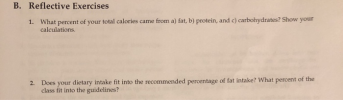 B. Reflective Exercises What percent of your total calories came from a) fat, b) protein, and c) carbohydrates? Show your calculations. 1. Does your dietary intake fit into the recommended percentage of fat intake? What percent of the class fit into the guidelines? 2.
 Making sure you meet the AMDR for carbohydrates is not enough. When choosing the foods that will compose your diet, you must also examine the types of carbohydrates you consume while considering their nutrient content. Fill in the blanks for the paragraph below. Use these terms, although, not all terms will be used. Possible terms: AMDR; Added Sugars, Carbohydrates, Cholesterol, Colon, Energy, Fiber, Insoluble, Refined, Unrefined, Soluble, Weight-Loss. The ADMR for carbohydrates set by the Food and Nutrition Board of...
 Most carbohydrates should come from whole foods. meats. refined grains. nutrient deficient foods. Added sugars reduce the nutrient density of foods. C False True Sufficient carbohydrates in the diet ensure that protein is utilized to make glucose. False True Which of the following statements is TRUE about food made from whole grains? Whole grain foods have been processed to remove bran. Whole grain foods contain only the endosperm, which has most of the protein. Whole grain foods contain bran, germ,...
 1. The body generally breaks down foods that contain various digestible carbohydrates at different rates. True or false? 2. The glycemic load of a food is related to the glycemic index of the food. True or false?
 B. Reflective Exercises What percent of your total calories came from a) fat, b) protein, and c) carbohydrates? Show your calculations. 1. Does your dietary intake fit into the recommended percentage of fat intake? What percent of the class fit into the guidelines? 2.
Most questions answered within 3 hours.
-
Where is the error in this code sequence?
String s1 = "Hello";
String s2 = "ello";...
asked 10 months ago -
Financial data for Joel de Paris, Inc., for last year
follow:
Joel de Paris, Inc.
Balance...
asked 10 months ago -
Consider this reaction:
Al2(SO4)3 (aq)+ BaCl3
(aq) Al2Cl6 (aq)- +
3BaSO4(s) . What is the...
asked 10 months ago -
Suppose that Savneet is considering increasing her
recent random sample from 20 car rentals to 40...
asked 10 months ago -
Trucks arrive at an unloading terminal at an average rate of 120
per hour.
Trucks arrive...
asked 10 months ago -
Why are methanol and ethanol completely soluble in water while
octanol is not very little soluble....
asked 10 months ago -
A facilities manager at a university reads in a research report
that the mean amount of...
asked 10 months ago -
When the CuSO4 is rehydrated by adding water to the anhydrous
compound, is this an endothermic...
asked 10 months ago -
A ray of sunlight is passing from diamond into crown glass; the
angle of incidence is...
asked 10 months ago -
A block of mass 0.249 kg is placed on top of a light, vertical
spring of...
asked 10 months ago -
how do the kidneys compensate in the presences of acidosis
a) trigger hyperventilate
b) reserve acid...
asked 10 months ago -
Question 501 pts
The rental rate of capital to the firm increases. Which of the
following...
asked 10 months ago