
Homework Answers
Ans. 21. d) Price controls lead to shortages or surpluses.
Price control is the situation where the government sets the price either above the equilibrium price or below the equilibrium price.
If the price set above the equilibrium which is in the form of the minimum price in the market and will be benefited from the producer's point of view because they will receive more than the equilibrium price but it will lead to the surplus of the good in the market.
Similarly, If the price set above the equilibrium which is in the form of the maximum price in the market and will be benefited from the Consumer's point of view because they have to pay less than the equilibrium price but it will lead to the shortage of the good in the market.
Add Answer to:
Question 21 (1 point) What are the outcomes of price controls? Price controls produce an equitable...
1 pts Question 4 Economists in general agree that rent controls are: an efficient and equitable...
 1 pts Question 4 Economists in general agree that rent controls are: an efficient and equitable way to help low- income families. an inefficient and ineffective way to help low- income families. an efficient method of dealing with the shortages created during price ceilings. the only way to solve the problem of poverty.
Question 22 (1 point) In a Bertrand model with identical firms and a homogenous product, price...
 Question 22 (1 point) In a Bertrand model with identical firms and a homogenous product, price will increase in response to a decrease in the number of firms. a firm's best-response function is identical to its rival. with a homogenous product, market power is a function of the number of firms with identical firms and a homogenous product, price will increase in response to an increase in marginal cost O equilibrium price is equal to the competitive price. Question 21...
19. Price floors lead to market surpluses. 20. Shortages normally accompany an effective price floor. 21....
 19. Price floors lead to market surpluses. 20. Shortages normally accompany an effective price floor. 21. Change in the price of a good causes the demand schedule for that good to shift. 22. Changes in consumer preference toward small, imported automobiles have shifted their demand curves downward and to the left. 23. An increase in consumer income will shift both the supply and demand curves. 24. "Equilibrium" is a situation in which there are no inherent forces to produce change....
Question 10 (1 point) In a long-run competitive market equilibrium, existing firms produce at the efficient...
 Question 10 (1 point) In a long-run competitive market equilibrium, existing firms produce at the efficient scale of production and make zero profit. True False Question 11 (1 point) Suppose that all existing firms in a long-run competitive market equilibrium are identical and have the following cost function C(Q) = A +Q2 with fixed cost A=$125.0 and MCIQ)=2Q. What is the market equilibrium price? No units. If necessary, round to 2 decimal places. Your Answer: Your Answer
Question Completion Status: QUESTION 21 When do new firms tend to enter a competitive industry When...
 Question Completion Status: QUESTION 21 When do new firms tend to enter a competitive industry When the large firms in the industry are earning zero profit when the smaller firms are leaving the industry when the new entrants can earn positive profits when there is an absence of fixed costs in the long run QUESTION 22 Marginal cost can be expressed as the ratio of the price of labor and the marginal product of labor only when labor is held...
Question 34 (1 point) Assume the market for wheat is perfectly competitive. At the current price...
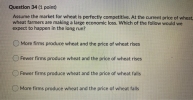 Question 34 (1 point) Assume the market for wheat is perfectly competitive. At the current price of wheat wheat farmers are making a large economic loss. Which of the follow would we expect to happen in the long run? More firms produce wheat and the price of wheat rises Fewer firms produce wheat and the price of wheat rises Fewer firms produce wheat and the price of wheat falls More firms produce wheat and the price of wheat falls
Having problems with this question Firms must typically purchase inputs from suppliers to produce output What...
 Having problems with this question
Firms must typically purchase inputs from suppliers to produce output What effect might suppliers have on an industry? O A. If suppliers are price takers, then a firm will likely be a price taker with no ability to raise price. OB. If only a few firms can supply an input, then markets will likely experience shortages because firms are unable to produce sufficient output O C. Suppliers cannot affect output markets, although an output market...
Having problems with this question
Firms must typically purchase inputs from suppliers to produce output What effect might suppliers have on an industry? O A. If suppliers are price takers, then a firm will likely be a price taker with no ability to raise price. OB. If only a few firms can supply an input, then markets will likely experience shortages because firms are unable to produce sufficient output O C. Suppliers cannot affect output markets, although an output market...
QUESTION 21 Compared with the efficient outcome, the market price of a good that generates external...
 QUESTION 21 Compared with the efficient outcome, the market price of a good that generates external benefits is too high too low O optimal O equal to the efficient price QUESTION 22 Products that create external benefits are over-consumed because the private benefits exceed the private costs under-consumed because consumers only consider the private benefits of consumption O optimally consumed as long as private benefits equal private costs O underconsumed because the social costs exceed the social benefits
Help Please QUESTION 1 Adam Smith's invisible hand economy takes individual decisions based on self-interest and...
 Help Please
QUESTION 1 Adam Smith's invisible hand economy takes individual decisions based on self-interest and guides them to outcomes that are efficient but don't necessarily benefit the social good efficient and benefit the social good second best without additional coordination can be efficient or inefficient, depending on the situation QUESTION 2 A market free from imperfections will allocate resources to the most efficient firms because consumers have full information about the range of products many firms compete with each...
Help Please
QUESTION 1 Adam Smith's invisible hand economy takes individual decisions based on self-interest and guides them to outcomes that are efficient but don't necessarily benefit the social good efficient and benefit the social good second best without additional coordination can be efficient or inefficient, depending on the situation QUESTION 2 A market free from imperfections will allocate resources to the most efficient firms because consumers have full information about the range of products many firms compete with each...
Could someone please help me with these questions! Thank in advance! Question 8 (1 point) Which...
 Could someone please help me with these questions!
Thank in advance!
Question 8 (1 point) Which of the following statements is true for a perfectly competitive market in the short run? I. It is possible that existing firms make positive profit. II. It is possible that existing firms make negative profit. Both are false. Only II. is true. Only I. is true. Both are true. Question 9 (1 point) Suppose that a firm in a perfectly competitive market has sunk...
Could someone please help me with these questions!
Thank in advance!
Question 8 (1 point) Which of the following statements is true for a perfectly competitive market in the short run? I. It is possible that existing firms make positive profit. II. It is possible that existing firms make negative profit. Both are false. Only II. is true. Only I. is true. Both are true. Question 9 (1 point) Suppose that a firm in a perfectly competitive market has sunk...
 1 pts Question 4 Economists in general agree that rent controls are: an efficient and equitable way to help low- income families. an inefficient and ineffective way to help low- income families. an efficient method of dealing with the shortages created during price ceilings. the only way to solve the problem of poverty.
 Question 22 (1 point) In a Bertrand model with identical firms and a homogenous product, price will increase in response to a decrease in the number of firms. a firm's best-response function is identical to its rival. with a homogenous product, market power is a function of the number of firms with identical firms and a homogenous product, price will increase in response to an increase in marginal cost O equilibrium price is equal to the competitive price. Question 21...
 19. Price floors lead to market surpluses. 20. Shortages normally accompany an effective price floor. 21. Change in the price of a good causes the demand schedule for that good to shift. 22. Changes in consumer preference toward small, imported automobiles have shifted their demand curves downward and to the left. 23. An increase in consumer income will shift both the supply and demand curves. 24. "Equilibrium" is a situation in which there are no inherent forces to produce change....
 Question 10 (1 point) In a long-run competitive market equilibrium, existing firms produce at the efficient scale of production and make zero profit. True False Question 11 (1 point) Suppose that all existing firms in a long-run competitive market equilibrium are identical and have the following cost function C(Q) = A +Q2 with fixed cost A=$125.0 and MCIQ)=2Q. What is the market equilibrium price? No units. If necessary, round to 2 decimal places. Your Answer: Your Answer
 Question Completion Status: QUESTION 21 When do new firms tend to enter a competitive industry When the large firms in the industry are earning zero profit when the smaller firms are leaving the industry when the new entrants can earn positive profits when there is an absence of fixed costs in the long run QUESTION 22 Marginal cost can be expressed as the ratio of the price of labor and the marginal product of labor only when labor is held...
 Question 34 (1 point) Assume the market for wheat is perfectly competitive. At the current price of wheat wheat farmers are making a large economic loss. Which of the follow would we expect to happen in the long run? More firms produce wheat and the price of wheat rises Fewer firms produce wheat and the price of wheat rises Fewer firms produce wheat and the price of wheat falls More firms produce wheat and the price of wheat falls
 Having problems with this question
Firms must typically purchase inputs from suppliers to produce output What effect might suppliers have on an industry? O A. If suppliers are price takers, then a firm will likely be a price taker with no ability to raise price. OB. If only a few firms can supply an input, then markets will likely experience shortages because firms are unable to produce sufficient output O C. Suppliers cannot affect output markets, although an output market...
Having problems with this question
Firms must typically purchase inputs from suppliers to produce output What effect might suppliers have on an industry? O A. If suppliers are price takers, then a firm will likely be a price taker with no ability to raise price. OB. If only a few firms can supply an input, then markets will likely experience shortages because firms are unable to produce sufficient output O C. Suppliers cannot affect output markets, although an output market...
 QUESTION 21 Compared with the efficient outcome, the market price of a good that generates external benefits is too high too low O optimal O equal to the efficient price QUESTION 22 Products that create external benefits are over-consumed because the private benefits exceed the private costs under-consumed because consumers only consider the private benefits of consumption O optimally consumed as long as private benefits equal private costs O underconsumed because the social costs exceed the social benefits
 Help Please
QUESTION 1 Adam Smith's invisible hand economy takes individual decisions based on self-interest and guides them to outcomes that are efficient but don't necessarily benefit the social good efficient and benefit the social good second best without additional coordination can be efficient or inefficient, depending on the situation QUESTION 2 A market free from imperfections will allocate resources to the most efficient firms because consumers have full information about the range of products many firms compete with each...
Help Please
QUESTION 1 Adam Smith's invisible hand economy takes individual decisions based on self-interest and guides them to outcomes that are efficient but don't necessarily benefit the social good efficient and benefit the social good second best without additional coordination can be efficient or inefficient, depending on the situation QUESTION 2 A market free from imperfections will allocate resources to the most efficient firms because consumers have full information about the range of products many firms compete with each...
 Could someone please help me with these questions!
Thank in advance!
Question 8 (1 point) Which of the following statements is true for a perfectly competitive market in the short run? I. It is possible that existing firms make positive profit. II. It is possible that existing firms make negative profit. Both are false. Only II. is true. Only I. is true. Both are true. Question 9 (1 point) Suppose that a firm in a perfectly competitive market has sunk...
Could someone please help me with these questions!
Thank in advance!
Question 8 (1 point) Which of the following statements is true for a perfectly competitive market in the short run? I. It is possible that existing firms make positive profit. II. It is possible that existing firms make negative profit. Both are false. Only II. is true. Only I. is true. Both are true. Question 9 (1 point) Suppose that a firm in a perfectly competitive market has sunk...
Most questions answered within 3 hours.
-
Where is the error in this code sequence?
String s1 = "Hello";
String s2 = "ello";...
asked 11 months ago -
Financial data for Joel de Paris, Inc., for last year
follow:
Joel de Paris, Inc.
Balance...
asked 11 months ago -
Consider this reaction:
Al2(SO4)3 (aq)+ BaCl3
(aq) Al2Cl6 (aq)- +
3BaSO4(s) . What is the...
asked 11 months ago -
Suppose that Savneet is considering increasing her
recent random sample from 20 car rentals to 40...
asked 11 months ago -
Trucks arrive at an unloading terminal at an average rate of 120
per hour.
Trucks arrive...
asked 11 months ago -
Why are methanol and ethanol completely soluble in water while
octanol is not very little soluble....
asked 11 months ago -
A facilities manager at a university reads in a research report
that the mean amount of...
asked 11 months ago -
When the CuSO4 is rehydrated by adding water to the anhydrous
compound, is this an endothermic...
asked 11 months ago -
A ray of sunlight is passing from diamond into crown glass; the
angle of incidence is...
asked 11 months ago -
A block of mass 0.249 kg is placed on top of a light, vertical
spring of...
asked 11 months ago -
how do the kidneys compensate in the presences of acidosis
a) trigger hyperventilate
b) reserve acid...
asked 11 months ago -
Question 501 pts
The rental rate of capital to the firm increases. Which of the
following...
asked 11 months ago