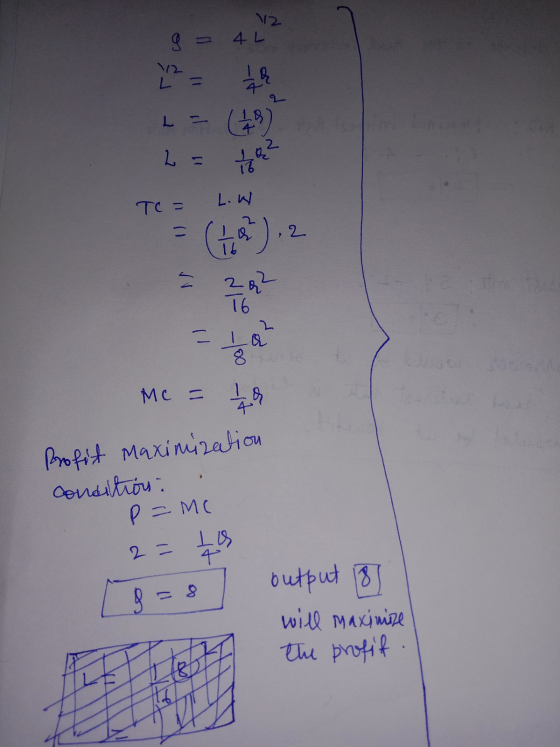
Your firm's production function is f ( L ) = 4 L 1 / 2, where...
Your firm's production function is
f ( L ) = 4 L 1 / 2, where L is units of labor. The marginal
product of labor is
M P L = 2 L 1 / 2. What amount of output will maximize your firm's
profit, if the price of a unit of output is 2 and the price of a
unit of labor is also 2?
Homework Answers
1. [30 POINTS] Consider the production function y=f(L,K) = 4/1/2K1/4 where L is labor and K...
 1. [30 POINTS] Consider the production function y=f(L,K) = 4/1/2K1/4 where L is labor and K is capital. Price per unit of the labor is w, price per unit of the capital is r, and the price per unit of the output is p. (a) (10 POINTS] In long-run, if the firm's objective is to maximize its profit, what are the factor demand functions of labor and capital? (b) (10 Points) What is the optimal output level y and the...
5) A firm's short-run production function is given by Q=50 L-.02 L^{2}
 5) A firm's short-run production function is given by Q=50 L-.02 L^{2}Where L denotes the number of workers.1. Find the size of the workforce that maximizes output.2. Find marginal product of labor (M PL)3. Find the average product of labor (APL)4. Find the size of the workforce which maximizes the average product of labor. Calculate M PL and A PL at this value. What do you observe.6) Find and classify the critical (stationary) points of the following function and state...
Is my answer correct? Suppose that a firm's short-run production function is F(K,L) = L+VKL, where...
 Is my answer correct?
Suppose that a firm's short-run production function is F(K,L) = L+VKL, where capital is fixed at K = 4. The rental rate of capital is $24 and the wage rate is $2. The variable cost of production of 48 units of output is (Hint: The amount of labor required to produce 48 units of output is an integer.) 0 $24 0 0 0
Is my answer correct?
Suppose that a firm's short-run production function is F(K,L) = L+VKL, where capital is fixed at K = 4. The rental rate of capital is $24 and the wage rate is $2. The variable cost of production of 48 units of output is (Hint: The amount of labor required to produce 48 units of output is an integer.) 0 $24 0 0 0
1. Suppose the production function in an economy is Y- of capital and L is the...
 1. Suppose the production function in an economy is Y- of capital and L is the amount of labor. The economy begins with 8I units of capital and 16 units of labor. a. Suppose also, that one more unit of labor is added to the production process every year for the next four years. What is the marginal product of labor for each year? b. Now, suppose the wage paid per hour is $1.13, the rental price of capital is...
A firm can manufacture a product according to the production function: Q = F(K, L) =...
A firm can manufacture a product according to the production function: Q = F(K, L) = K3/4L1/4. Instruction: Enter your responses rounded to three decimal places. a. Calculate the average product of labor, APL, when the level of capital is fixed at 81 units and the firm uses 16 units of labor. ____ What is the average product of labor when the firm uses 256 units of labor? ____ Instruction: The second response is the exponent on L in the...
The manager of a national retailing outlet recently hired an economist to estimate the firm's production function. Base...
The manager of a national retailing outlet recently hired an economist to estimate the firm's production function. Based on the economist's report, the manager now knows that the firm's production function is given by Q=K^(1/2) L^(1/2) and that capital is fixed at 1 unit. a. Calculate the average product of labor when 9 units of labor are utilized. b. Calculate the marginal product of labor when 9 units of labor are utilized. c. Suppose the firm can hire labor at...
A firm's production function is given by Q=2L"2 +31/2 where Q, L and K denote the...
 A firm's production function is given by Q=2L"2 +31/2 where Q, L and K denote the number of units of outputs, labor and capital. Labor cost is $2 per unit, capital cost is $1 per unit and output sells at $8 per unit. Show that the profit function is 1=16L"2 + 24K12 - 2L-K and hence find the maximum profit and the values of Land K at which it is achieved. HINT: do not forget to check the second sufficient...
A perfectly competitive firm's production function is Q=17LK where Q is the amount produced, L is...
A perfectly competitive firm's production function is Q=17LK where Q is the amount produced, L is the amount of labour hired and K is the amount of capital used. P is the price that the firm gets for its product. What is the marginal revenue product of labour?
9. Suppose the firm's production function is given by f(K,L) min (K",L" (a) For what values...
 9. Suppose the firm's production function is given by f(K,L) min (K",L" (a) For what values of a will the firm exhibit decreasing returns to scale? Constant returns to scale? Increasing returns to scale? (b) Derive the long-run cost function and the optimal input choices. (c) Suppose the capital is fixed at R = 10,000 and a =. Assuming that the firm wants to produce less than 100 units, derive 10. Consider the production function: f(K, L) = KLi. Let...
9. Suppose the firm's production function is given by f(K,L) = min (Kº,L"} (a) For what values of a will the firm e...
 9. Suppose the firm's production function is given by f(K,L) = min (Kº,L"} (a) For what values of a will the firm exhibit decreasing returns to scale? Constant returns to scale? Increasing returns to scale? (b) Derive the long-run cost function and the optimal input choices. (c) Suppose the capital is fixed at K = 10,000 and a = 1. Assuming that the firm wants to produce less than 100 units, derive 10. Consider the production function: f(K,L)=KLI. Let w...
 1. [30 POINTS] Consider the production function y=f(L,K) = 4/1/2K1/4 where L is labor and K is capital. Price per unit of the labor is w, price per unit of the capital is r, and the price per unit of the output is p. (a) (10 POINTS] In long-run, if the firm's objective is to maximize its profit, what are the factor demand functions of labor and capital? (b) (10 Points) What is the optimal output level y and the...
 5) A firm's short-run production function is given by Q=50 L-.02 L^{2}Where L denotes the number of workers.1. Find the size of the workforce that maximizes output.2. Find marginal product of labor (M PL)3. Find the average product of labor (APL)4. Find the size of the workforce which maximizes the average product of labor. Calculate M PL and A PL at this value. What do you observe.6) Find and classify the critical (stationary) points of the following function and state...
 Is my answer correct?
Suppose that a firm's short-run production function is F(K,L) = L+VKL, where capital is fixed at K = 4. The rental rate of capital is $24 and the wage rate is $2. The variable cost of production of 48 units of output is (Hint: The amount of labor required to produce 48 units of output is an integer.) 0 $24 0 0 0
Is my answer correct?
Suppose that a firm's short-run production function is F(K,L) = L+VKL, where capital is fixed at K = 4. The rental rate of capital is $24 and the wage rate is $2. The variable cost of production of 48 units of output is (Hint: The amount of labor required to produce 48 units of output is an integer.) 0 $24 0 0 0
 1. Suppose the production function in an economy is Y- of capital and L is the amount of labor. The economy begins with 8I units of capital and 16 units of labor. a. Suppose also, that one more unit of labor is added to the production process every year for the next four years. What is the marginal product of labor for each year? b. Now, suppose the wage paid per hour is $1.13, the rental price of capital is...
 A firm's production function is given by Q=2L"2 +31/2 where Q, L and K denote the number of units of outputs, labor and capital. Labor cost is $2 per unit, capital cost is $1 per unit and output sells at $8 per unit. Show that the profit function is 1=16L"2 + 24K12 - 2L-K and hence find the maximum profit and the values of Land K at which it is achieved. HINT: do not forget to check the second sufficient...
 9. Suppose the firm's production function is given by f(K,L) min (K",L" (a) For what values of a will the firm exhibit decreasing returns to scale? Constant returns to scale? Increasing returns to scale? (b) Derive the long-run cost function and the optimal input choices. (c) Suppose the capital is fixed at R = 10,000 and a =. Assuming that the firm wants to produce less than 100 units, derive 10. Consider the production function: f(K, L) = KLi. Let...
 9. Suppose the firm's production function is given by f(K,L) = min (Kº,L"} (a) For what values of a will the firm exhibit decreasing returns to scale? Constant returns to scale? Increasing returns to scale? (b) Derive the long-run cost function and the optimal input choices. (c) Suppose the capital is fixed at K = 10,000 and a = 1. Assuming that the firm wants to produce less than 100 units, derive 10. Consider the production function: f(K,L)=KLI. Let w...
Most questions answered within 3 hours.
-
Where is the error in this code sequence?
String s1 = "Hello";
String s2 = "ello";...
asked 11 months ago -
Financial data for Joel de Paris, Inc., for last year
follow:
Joel de Paris, Inc.
Balance...
asked 11 months ago -
Consider this reaction:
Al2(SO4)3 (aq)+ BaCl3
(aq) Al2Cl6 (aq)- +
3BaSO4(s) . What is the...
asked 11 months ago -
Suppose that Savneet is considering increasing her
recent random sample from 20 car rentals to 40...
asked 11 months ago -
Trucks arrive at an unloading terminal at an average rate of 120
per hour.
Trucks arrive...
asked 11 months ago -
Why are methanol and ethanol completely soluble in water while
octanol is not very little soluble....
asked 11 months ago -
A facilities manager at a university reads in a research report
that the mean amount of...
asked 11 months ago -
When the CuSO4 is rehydrated by adding water to the anhydrous
compound, is this an endothermic...
asked 11 months ago -
A ray of sunlight is passing from diamond into crown glass; the
angle of incidence is...
asked 11 months ago -
A block of mass 0.249 kg is placed on top of a light, vertical
spring of...
asked 11 months ago -
how do the kidneys compensate in the presences of acidosis
a) trigger hyperventilate
b) reserve acid...
asked 11 months ago -
Question 501 pts
The rental rate of capital to the firm increases. Which of the
following...
asked 11 months ago