Suppose when disposable income (D) is $1000/month, consumption (C) is $400/month. When disposable income is $2500/month,...
Suppose when disposable income (D) is $1000/month, consumption (C) is $400/month. When disposable income is $2500/month, consumption increases to $700/month. Which of the following equation represents the relationship between consumption and disposable income in this example?
Homework Answers
Marginal Propensity to consume is a measurement indicator which calculates that an increase in personal consumption expenditure is accompanied by an increase in income.
Marginal Propensity to consume is represented as :
MPC = 
MPC = Change in Consumption / Change in Income
MPC = 700 - 400 / 2500 - 1000
= 300 / 1500
= 1/5
or 0.2
So Marginal Propensity to Consume = 0.2
Add Answer to:
Suppose when disposable income (D) is $1000/month, consumption
(C) is $400/month. When disposable income is $2500/month,...
Suppose when real disposable income is $5,000, planned real consumption is $4000. When real disposable income...
Suppose when real disposable income is $5,000, planned real consumption is $4000. When real disposable income increases to $6000, planned real saving increases by $500. The new planned real consumption expenditures is A. $5,000. B. $4,500. C. $6,000. D. $3,500.
Suppose the following table describes the relation of consumption spending to the disposable income Disposable Income...
 Suppose the following table describes the relation of consumption spending to the disposable income Disposable Income (Yp)|400 500 600 700 800 Consumption ( 390 470 550 630 710 (a) Derive the consumption function. Explain the two components of (e) What is the level of saving when the level of income equals to $900, to $350, to $300? Redraw the graphs from points (a) and (d) and show the areas of saving and dissaving. (f) Suppose income grows from $850 to...
$140 Table: Income and Consumption Disposable Personal Income Consumption $100 220 300 300 400 380 300...
 $140 Table: Income and Consumption Disposable Personal Income Consumption $100 220 300 300 400 380 300 460 200 108. (Ref 28-4 Table: Income and Consumption) Use Table: Income and Consumption. When disposable personal income is $200, the marginal propensity to consume is: a. 0.00 b. 0.20 c. 0.80 d. 1.40 mant or foreign sector), disposable income increases from $2,0
Answer the following problems. Write your complete solutions. 1. If consumption equals 1000 when disposable income...
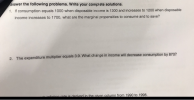 Answer the following problems. Write your complete solutions. 1. If consumption equals 1000 when disposable income is 1300 and increases to 1200 when disposable income increases to 1700, what are the marginal propensities to consume and to save? 2. The expenditure multiplier equals 3.9. What change in income will decrease consumption by 870? infletien rate is derived in the given column from 1990 to 1998.
In an economy, when disposable income increases from $400 to $500, consumption expenditure increases from $420...
 In an economy, when disposable income increases from $400 to $500, consumption expenditure increases from $420 billion to $500. Calculate the marginal propensity to consume, the change in saving, and the marginal propensity to save. The marginal propensity to consume is 0.80. >>> Answer to 2 decimal places. When disposable income increases from $400 billion to $500 billion, saving increases by $ 20 billion. The marginal propensity to save is 0.20 >>> Answer to 2 decimal places.
Table C_6 Disposable Income and Consumption Saving (S) O Disposable income (Y) Consumption (C) 1000 2,000...
 Table C_6 Disposable Income and Consumption Saving (S) O Disposable income (Y) Consumption (C) 1000 2,000 TI T LLLLL 5,000 _ 12,000 13.000 T L Refer to Table C_6. Assuming MPC=0.6, the break-even level of disposable income=_.(Do not enter a $ sign. Include a negative sign, if a negative number)
QUESTION 13 and autonomous If the consumption function is: C = 0.68(Disposable Income) + 400, the MPC- consumption...
 QUESTION 13 and autonomous If the consumption function is: C = 0.68(Disposable Income) + 400, the MPC- consumption -
1. Suppose consumption rises from $900 to $1000 and disposable income rises from $1400 to $1600....
 1. Suppose consumption rises from $900 to $1000 and disposable income rises from $1400 to $1600. What is the MPC? Show work 2. Using the MPC that you got for question 1, what is consumption if autonomous consumption is $800 and disposable income is $1500. Show work
*URGENT ECON* Disposable income Consumption 200 220 300 280 350 310 1. The table above gives...
*URGENT ECON* Disposable income Consumption 200 220 300 280 350 310 1. The table above gives consumption at dierent levels of disposable income. (a) Plot the consumption function. (b) Find the slope of the consumption function. (c) Find an equation for the consumption function. (d) What is consumption when disposable income is 400? (e) Find an equation for the savings function.
 Suppose the following table describes the relation of consumption spending to the disposable income Disposable Income (Yp)|400 500 600 700 800 Consumption ( 390 470 550 630 710 (a) Derive the consumption function. Explain the two components of (e) What is the level of saving when the level of income equals to $900, to $350, to $300? Redraw the graphs from points (a) and (d) and show the areas of saving and dissaving. (f) Suppose income grows from $850 to...
 $140 Table: Income and Consumption Disposable Personal Income Consumption $100 220 300 300 400 380 300 460 200 108. (Ref 28-4 Table: Income and Consumption) Use Table: Income and Consumption. When disposable personal income is $200, the marginal propensity to consume is: a. 0.00 b. 0.20 c. 0.80 d. 1.40 mant or foreign sector), disposable income increases from $2,0
 Answer the following problems. Write your complete solutions. 1. If consumption equals 1000 when disposable income is 1300 and increases to 1200 when disposable income increases to 1700, what are the marginal propensities to consume and to save? 2. The expenditure multiplier equals 3.9. What change in income will decrease consumption by 870? infletien rate is derived in the given column from 1990 to 1998.
 In an economy, when disposable income increases from $400 to $500, consumption expenditure increases from $420 billion to $500. Calculate the marginal propensity to consume, the change in saving, and the marginal propensity to save. The marginal propensity to consume is 0.80. >>> Answer to 2 decimal places. When disposable income increases from $400 billion to $500 billion, saving increases by $ 20 billion. The marginal propensity to save is 0.20 >>> Answer to 2 decimal places.
 Table C_6 Disposable Income and Consumption Saving (S) O Disposable income (Y) Consumption (C) 1000 2,000 TI T LLLLL 5,000 _ 12,000 13.000 T L Refer to Table C_6. Assuming MPC=0.6, the break-even level of disposable income=_.(Do not enter a $ sign. Include a negative sign, if a negative number)
 QUESTION 13 and autonomous If the consumption function is: C = 0.68(Disposable Income) + 400, the MPC- consumption -
 1. Suppose consumption rises from $900 to $1000 and disposable income rises from $1400 to $1600. What is the MPC? Show work 2. Using the MPC that you got for question 1, what is consumption if autonomous consumption is $800 and disposable income is $1500. Show work
Most questions answered within 3 hours.
-
Where is the error in this code sequence?
String s1 = "Hello";
String s2 = "ello";...
asked 10 months ago -
Financial data for Joel de Paris, Inc., for last year
follow:
Joel de Paris, Inc.
Balance...
asked 10 months ago -
Consider this reaction:
Al2(SO4)3 (aq)+ BaCl3
(aq) Al2Cl6 (aq)- +
3BaSO4(s) . What is the...
asked 10 months ago -
Suppose that Savneet is considering increasing her
recent random sample from 20 car rentals to 40...
asked 10 months ago -
Trucks arrive at an unloading terminal at an average rate of 120
per hour.
Trucks arrive...
asked 10 months ago -
Why are methanol and ethanol completely soluble in water while
octanol is not very little soluble....
asked 10 months ago -
A facilities manager at a university reads in a research report
that the mean amount of...
asked 10 months ago -
When the CuSO4 is rehydrated by adding water to the anhydrous
compound, is this an endothermic...
asked 10 months ago -
A ray of sunlight is passing from diamond into crown glass; the
angle of incidence is...
asked 10 months ago -
A block of mass 0.249 kg is placed on top of a light, vertical
spring of...
asked 10 months ago -
how do the kidneys compensate in the presences of acidosis
a) trigger hyperventilate
b) reserve acid...
asked 10 months ago -
Question 501 pts
The rental rate of capital to the firm increases. Which of the
following...
asked 10 months ago