


Homework Answers
Q. No. 1. Answer :
* during anxiety it can trigger our flight or fight response, these response can releases some of chemicals and hormones like adrenaline .
* due to that our pulse rate and breathing rate should be increases.
* the oxygen demand may increases to the brain,
* if there is no sufficient it may leads to giddiness and fatigue and client may become panic.
* these are the physiological changes may occurs during anxiety.
Q. No. 2. Answer :
Case study 21.1 :
" Hypoglossal cranial nerve " to be tested for stick out of her tongue "
Because it is Xll cranial nerve , it controls the intrinsic musculature of the tongue.
It is evaluated by having the patient " stick out their tongue " and move it side to side.
So the answer is " Hypoglossal nerve ".
Q. No. 3. Answer :
Case study 21.2 :
Cranial nerve involved in the sense of hearing is " vestibulo cochlear nerve " this is also known as auditory vestibular nerve " or eight cranial nerve.
It transmit the sound and equilibrium information from ear to the brain.
So the answer is " vestibulocochlear nerve ".
Add Answer to:
What physiological changes would you expect to observe in someone who is about to take their...
Case study 21.5 (p.494) When Tomasina was later discharged from the hospital, her form may have...
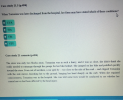 Case study 21.5 (p.494) When Tomasina was later discharged from the hospital, her form may have stated which of these conditions? CVA TIA TBI VZV Case study 21 scenario (p.494) was only two blocks away. Tomasina was in such a hurry, and it was so close, she didn't think she really needed to rummage through the garage for her bike helmet. She jumped on her bike and peddled quickly toward the store. From out of nowhere, a car sped by-...
 Case study 21.5 (p.494) When Tomasina was later discharged from the hospital, her form may have stated which of these conditions? CVA TIA TBI VZV Case study 21 scenario (p.494) was only two blocks away. Tomasina was in such a hurry, and it was so close, she didn't think she really needed to rummage through the garage for her bike helmet. She jumped on her bike and peddled quickly toward the store. From out of nowhere, a car sped by-...
Most questions answered within 3 hours.
-
Where is the error in this code sequence?
String s1 = "Hello";
String s2 = "ello";...
asked 10 months ago -
Financial data for Joel de Paris, Inc., for last year
follow:
Joel de Paris, Inc.
Balance...
asked 10 months ago -
Consider this reaction:
Al2(SO4)3 (aq)+ BaCl3
(aq) Al2Cl6 (aq)- +
3BaSO4(s) . What is the...
asked 10 months ago -
Suppose that Savneet is considering increasing her
recent random sample from 20 car rentals to 40...
asked 10 months ago -
Trucks arrive at an unloading terminal at an average rate of 120
per hour.
Trucks arrive...
asked 10 months ago -
Why are methanol and ethanol completely soluble in water while
octanol is not very little soluble....
asked 10 months ago -
A facilities manager at a university reads in a research report
that the mean amount of...
asked 10 months ago -
When the CuSO4 is rehydrated by adding water to the anhydrous
compound, is this an endothermic...
asked 10 months ago -
A ray of sunlight is passing from diamond into crown glass; the
angle of incidence is...
asked 10 months ago -
A block of mass 0.249 kg is placed on top of a light, vertical
spring of...
asked 10 months ago -
how do the kidneys compensate in the presences of acidosis
a) trigger hyperventilate
b) reserve acid...
asked 10 months ago -
Question 501 pts
The rental rate of capital to the firm increases. Which of the
following...
asked 10 months ago