
Homework Answers
46) A monopolist earns normal profit when Total
average cost equals price / average revenue. We can see that
monopolist produce at a output level where MR = MC while at that
level of output AR = AC. Therefore, monopolist earns normal profit.
Option B is correct. 47)
A non-discriminating monopolist demand curve would be above its
marginal revenue curve. Here the monopolist (the above one) is the
non discriminating one who earns a profit level of ABCD while the
figure below shows the monopolist who is price discriminating whose
demand curve is same as marginal revenue curve and earns a profit
level of ABC. Option E is correct.
47)
A non-discriminating monopolist demand curve would be above its
marginal revenue curve. Here the monopolist (the above one) is the
non discriminating one who earns a profit level of ABCD while the
figure below shows the monopolist who is price discriminating whose
demand curve is same as marginal revenue curve and earns a profit
level of ABC. Option E is correct.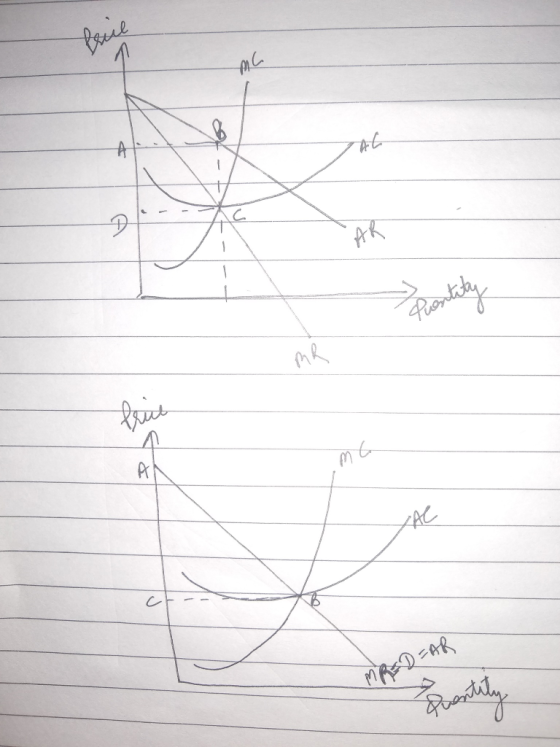
Puontiti
til MRS DEAR
Add Answer to:
Question 46 2p Which of the following is true of the profit, earned by a monopolist?...
Question 41 (1 point) 15 15- 10 10- 5 5. D 1 VIRD 1 Q 5...
 Question 41 (1 point) 15 15- 10 10- 5 5. D 1 VIRD 1 Q 5 10 15 MR 5 10 Residential Business The above figure shows the demand curves of two segment of customers-residential and business for electricity. For an electricity utility company, it will be possible to price discriminate because elasticities differ across markets. electricity cannot be resold easily. It is easy to identify which consumers belong to which segment. All of the above. Question 42 (1 point)...
marginal revenue A monopolist maximizes profit by choosing the quantity at which marginal revenue equals at...
 marginal revenue A monopolist maximizes profit by choosing the quantity at which marginal revenue equals at that quantity because the demand curve is above the marginal-revenue curve. Profit equals mulitplied by the profit-maximizing quantity Price is and marginal cost average variable cost average cost marginal revenue. A monopolist maximizes profit by choosing the quantity at which marginal revenue equals Price is at that quantity because the demand curve is above the marginal-revenue curve. Profit equals the difference between the price...
A monopolist faces the following average revenue (demand) curve:
Problem 1. (7 points) A monopolist faces the following average revenue (demand) curve: P = 300-0.3Q and the monopolist's cost function is given by C(Q) = 8000+0.3Q2 (a) Derive the monopolist's marginal revenue equation. (2 pts) (b) Derive the monopolist's marginal cost equation. (1 pt) (c) What level of output will the monopolist choose in order to maximize its profits? (2 pts) (d) What price will the monopolist receive at the profit-maximizing level of output? (1 pt) (e) Calculate the monopolist's profit when they produce at the profit-maximizing level....
As long as the demand curve lies above the marginal revenue curve for a monopolist, at...
 As long as the demand curve lies above the marginal revenue
curve for a monopolist, at its profit-maximizing output level, it
will charge a price for its product that is
Question7 2 pts As long as the demand curve lies above the marginal revenue curve for a monopolist, at its profit-maximizing output level, it will charge a price for its product that is O above total cost. below marginal cost. O above marginal cost. O above average total cost.
As long as the demand curve lies above the marginal revenue
curve for a monopolist, at its profit-maximizing output level, it
will charge a price for its product that is
Question7 2 pts As long as the demand curve lies above the marginal revenue curve for a monopolist, at its profit-maximizing output level, it will charge a price for its product that is O above total cost. below marginal cost. O above marginal cost. O above average total cost.
For the perfectly price discriminating monopolist, its curve is the same as its curve Question 10...
 For the perfectly price discriminating monopolist, its curve is the same as its curve Question 10 Not yet answered Points out of 1.00 P Flag question Select one: o a. demand, marginal cost b. marginal cost; average fixed cost c. average variable cost; average total cost d. demand; marginal revenue o e marginal revenue; marginal product of labor Previous page Next page MacBook Air
A monopolist faces a market demand curve given by
A monopolist faces a market demand curve given by Q=70-P a. If the monopolist can produce at constant average and marginal costs ofAC-MC-6, what output level will the monopolist choose to maximize profits? What is the price at this output level? What are the monopolist's profits? b. Assume instead that the monopolist has a cost structure where total costs are described by C(Q) = 0.25Q2 - 5Q + 300. With the monopolist facing the same market demand and marginal revenue, what price-quantity combination will be chosen now...
1) Which of the following statements regarding a monopolist is correct? A) A monopolist will only...
 1) Which of the following statements regarding a monopolist is correct? A) A monopolist will only produce an output where the demand is perfectly elastic, B) A monopolist will only produce an output where the demand is elastic C) A monopolist will only produce an output where the demand is inelastic. D) A monopolist will only produce an output where the demand is unitary elastic. 2) When is a monopolist's total revenue at a maximum? A) When its marginal revenue...
19. A monopolist maximizes profit A] where marginal revenue equals marginal cost B] where average revenue...
 19. A monopolist maximizes profit A] where marginal revenue equals marginal cost B] where average revenue equals average cost [C] where price equals marginal cost [D] by charging the highest possible price on the demand curve.
26. (8 points) Consider a monopolist who faces a constant average and marginal cost of $5...
 26. (8 points) Consider a monopolist who faces a constant average and marginal cost of $5 and a linear demand curve of P = 20-20, where P is the price the monopolist charges and Q is the quantity consumers purchase. To obtain the optimal quantity and price, the monopolist needs to obtain the marginal revenue, which has the same intercept as the demand curve but twice as steep. Obtain the monopolist's marginal revenue, optimal output, and price.
26. (8 points) Consider a monopolist who faces a constant average and marginal cost of $5...
 26. (8 points) Consider a monopolist who faces a constant average and marginal cost of $5 and a linear demand curve of P = 20-2Q, where P is the price the monopolist charges and Q is the quantity consumers purchase. To obtain the optimal quantity and price, the monopolist needs to obtain the marginal revenue, which has the same intercept as the demand curve but twice as steep. Obtain the monopolist's marginal revenue, optimal output, and price.
 Question 41 (1 point) 15 15- 10 10- 5 5. D 1 VIRD 1 Q 5 10 15 MR 5 10 Residential Business The above figure shows the demand curves of two segment of customers-residential and business for electricity. For an electricity utility company, it will be possible to price discriminate because elasticities differ across markets. electricity cannot be resold easily. It is easy to identify which consumers belong to which segment. All of the above. Question 42 (1 point)...
 marginal revenue A monopolist maximizes profit by choosing the quantity at which marginal revenue equals at that quantity because the demand curve is above the marginal-revenue curve. Profit equals mulitplied by the profit-maximizing quantity Price is and marginal cost average variable cost average cost marginal revenue. A monopolist maximizes profit by choosing the quantity at which marginal revenue equals Price is at that quantity because the demand curve is above the marginal-revenue curve. Profit equals the difference between the price...
 As long as the demand curve lies above the marginal revenue
curve for a monopolist, at its profit-maximizing output level, it
will charge a price for its product that is
Question7 2 pts As long as the demand curve lies above the marginal revenue curve for a monopolist, at its profit-maximizing output level, it will charge a price for its product that is O above total cost. below marginal cost. O above marginal cost. O above average total cost.
As long as the demand curve lies above the marginal revenue
curve for a monopolist, at its profit-maximizing output level, it
will charge a price for its product that is
Question7 2 pts As long as the demand curve lies above the marginal revenue curve for a monopolist, at its profit-maximizing output level, it will charge a price for its product that is O above total cost. below marginal cost. O above marginal cost. O above average total cost.
 For the perfectly price discriminating monopolist, its curve is the same as its curve Question 10 Not yet answered Points out of 1.00 P Flag question Select one: o a. demand, marginal cost b. marginal cost; average fixed cost c. average variable cost; average total cost d. demand; marginal revenue o e marginal revenue; marginal product of labor Previous page Next page MacBook Air
 1) Which of the following statements regarding a monopolist is correct? A) A monopolist will only produce an output where the demand is perfectly elastic, B) A monopolist will only produce an output where the demand is elastic C) A monopolist will only produce an output where the demand is inelastic. D) A monopolist will only produce an output where the demand is unitary elastic. 2) When is a monopolist's total revenue at a maximum? A) When its marginal revenue...
 19. A monopolist maximizes profit A] where marginal revenue equals marginal cost B] where average revenue equals average cost [C] where price equals marginal cost [D] by charging the highest possible price on the demand curve.
 26. (8 points) Consider a monopolist who faces a constant average and marginal cost of $5 and a linear demand curve of P = 20-20, where P is the price the monopolist charges and Q is the quantity consumers purchase. To obtain the optimal quantity and price, the monopolist needs to obtain the marginal revenue, which has the same intercept as the demand curve but twice as steep. Obtain the monopolist's marginal revenue, optimal output, and price.
 26. (8 points) Consider a monopolist who faces a constant average and marginal cost of $5 and a linear demand curve of P = 20-2Q, where P is the price the monopolist charges and Q is the quantity consumers purchase. To obtain the optimal quantity and price, the monopolist needs to obtain the marginal revenue, which has the same intercept as the demand curve but twice as steep. Obtain the monopolist's marginal revenue, optimal output, and price.
Most questions answered within 3 hours.
-
Where is the error in this code sequence?
String s1 = "Hello";
String s2 = "ello";...
asked 11 months ago -
Financial data for Joel de Paris, Inc., for last year
follow:
Joel de Paris, Inc.
Balance...
asked 11 months ago -
Consider this reaction:
Al2(SO4)3 (aq)+ BaCl3
(aq) Al2Cl6 (aq)- +
3BaSO4(s) . What is the...
asked 11 months ago -
Suppose that Savneet is considering increasing her
recent random sample from 20 car rentals to 40...
asked 11 months ago -
Trucks arrive at an unloading terminal at an average rate of 120
per hour.
Trucks arrive...
asked 11 months ago -
Why are methanol and ethanol completely soluble in water while
octanol is not very little soluble....
asked 11 months ago -
A facilities manager at a university reads in a research report
that the mean amount of...
asked 11 months ago -
When the CuSO4 is rehydrated by adding water to the anhydrous
compound, is this an endothermic...
asked 11 months ago -
A ray of sunlight is passing from diamond into crown glass; the
angle of incidence is...
asked 11 months ago -
A block of mass 0.249 kg is placed on top of a light, vertical
spring of...
asked 11 months ago -
how do the kidneys compensate in the presences of acidosis
a) trigger hyperventilate
b) reserve acid...
asked 11 months ago -
Question 501 pts
The rental rate of capital to the firm increases. Which of the
following...
asked 11 months ago