Give an example and discuss when morality should be considered in calculating producer and consumer surplus.
Give an example and discuss when morality should be considered in calculating producer
and consumer surplus.
Homework Answers
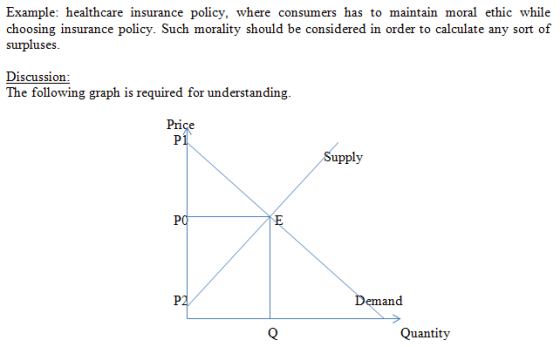
Demand curve is the policy requirement by a consumer and supply curve is the insurance policy provided by an insurance company.
These two curves meet at point E, indicating equilibrium. Corresponding equilibrium price is P0 and quantity is Q.
The maximum willingness-to-pay by the consumer is P1; therefore, the consumer surplus (CS) is [0.5 × Difference in price × Equilibrium quantity = 0.5 × (P1 – P0) × Q]. Such maximum willingness-to-pay depends on the risk associated with consumers (policy holder) – suppose the policy holder smokes heavily but he didn’t disclose it while taking a healthcare policy; this is a moral hazard in insurance policy; if the policyholder gets a policy by paying lesser amount of premium, which is P0, his CS would be very high; on the other hand, if there is no moral hazard, there CS would be low. Therefore, morality is very important while calculating CS.
The minimum acceptable price by an insurance company is P2; suppose this is applicable in case of normal policy having no moral hazard. Producer surplus (PS) is [0.5 × Difference in price × Equilibrium quantity = 0.5 × (P0 – P2) × Q]. Since the company doesn’t know the risk on consumer, its PS would be high, which is not appropriate; if the company able to know the risk-factor associated with the policyholder, the minimum acceptable price would have been higher and PS would be low. Therefore, morality is very important here too for calculating PS.
Add Answer to:
Give an example and discuss when morality should be
considered in calculating producer
and consumer surplus.
When prices rise above equilibrium: producer surplus falls and consumer surplus falls. consumer surplus falls and...
When prices rise above equilibrium: producer surplus falls and consumer surplus falls. consumer surplus falls and it is uncertain what happens to producer surplus. producer surplus falls and consumer surplus rises. producer surplus falls and it is uncertain what happens to consumer surplus.
When the efficient quantity is produced O A. producer surplus exceeds consumer surplus by the greatest...
 When the efficient quantity is produced O A. producer surplus exceeds consumer surplus by the greatest possible amount O B. consumer surplus exceeds producer surplus by the greatest possible amount O C. total producer surplus is zero . O D. total consumer surplus is zero. O E. the sum of consumer surplus and producer surplus is maximized
Give an example of a time that you have experienced consumer surplus. Be specific and explain...
Give an example of a time that you have experienced consumer surplus. Be specific and explain exactly how much surplus you experienced and why. Give another example of a time that you experienced producer surplus. Again be specific and explain how you achieved this.
Question 5 Welfare for a country is equal to consumer surplus consumer surplus minus producer surplus...
 Question 5 Welfare for a country is equal to consumer surplus consumer surplus minus producer surplus consumer surplus plus producer Surplus plus tariffrevenues consumer surplus plus producer Surplus minus tariff revenues Question 6 Use the graph below to answer this question: In autarky (before trade) consumer surplus is the area represented by the letter(s) (For this question and the following ones that use the same graph. Sis domestic supply. Dis domestic demand Pw is the world price is the tarif)
5) Shade in consumer surplus, producer surplus, and deadweight loss when Keurig is a monopolist. Does...
5) Shade in consumer surplus, producer surplus, and deadweight loss when Keurig is a monopolist. Does the monopoly increase total surplus or decrease total surplus?
If the producer surplus is $1000 and the consumer surplus is $300, social surplus is ________....
If the producer surplus is $1000 and the consumer surplus is $300, social surplus is ________. $700 -$700 $1300
Questions 3 & 4 are more important. Explain consumer and producer surplus and provide an exa...
Questions 3 & 4 are more important. Explain consumer and producer surplus and provide an example of each. What happens to the consumer surplus and producer surplus when price increases or decreases? Explain the relationship between the tax size and deadweight loss. When tax causes deadweight loss then why it is imposed in the first place? Who gains in this situation? Also if tax has to be imposed how to determine what size of tax will generate optimum tax revenue...
Illustrate (draw a graph) consumer and producer surplus using demand and supply graph and explain how total surplus (consumer surplus plus producer surplus) can be maximised at the equilibrium level.
Illustrate (draw a graph) consumer and producer surplus using demand and supply graph and explain how total surplus (consumer surplus plus producer surplus) can be maximised at the equilibrium level.
consumer and producer surplus Take Home 3 Math 1520 1. Consumer and Producer Surplus. Round answers...
 consumer and producer surplus
Take Home 3 Math 1520 1. Consumer and Producer Surplus. Round answers to the nearest whole number. a) Find the consumer and producer surpluses at the equilibrium (X.P). P. (*) - 6/78 - Demand price p.(x) = 3 102+x Supply price b) Find the new equilibrium and surpluses for the outward shift in demand P. (x)=683-X Demand price Ps(x) = 3/102 + x Supply price
consumer and producer surplus
Take Home 3 Math 1520 1. Consumer and Producer Surplus. Round answers to the nearest whole number. a) Find the consumer and producer surpluses at the equilibrium (X.P). P. (*) - 6/78 - Demand price p.(x) = 3 102+x Supply price b) Find the new equilibrium and surpluses for the outward shift in demand P. (x)=683-X Demand price Ps(x) = 3/102 + x Supply price
1. Find the equilibrium, price and quantity, Label consumer surplus, and producer surplus in the graph....
 1. Find the equilibrium, price and quantity, Label consumer surplus, and producer surplus in the graph. Calculate the area of consumer surplus, and producer surplus. $60 20 40 600
 When the efficient quantity is produced O A. producer surplus exceeds consumer surplus by the greatest possible amount O B. consumer surplus exceeds producer surplus by the greatest possible amount O C. total producer surplus is zero . O D. total consumer surplus is zero. O E. the sum of consumer surplus and producer surplus is maximized
 Question 5 Welfare for a country is equal to consumer surplus consumer surplus minus producer surplus consumer surplus plus producer Surplus plus tariffrevenues consumer surplus plus producer Surplus minus tariff revenues Question 6 Use the graph below to answer this question: In autarky (before trade) consumer surplus is the area represented by the letter(s) (For this question and the following ones that use the same graph. Sis domestic supply. Dis domestic demand Pw is the world price is the tarif)
 consumer and producer surplus
Take Home 3 Math 1520 1. Consumer and Producer Surplus. Round answers to the nearest whole number. a) Find the consumer and producer surpluses at the equilibrium (X.P). P. (*) - 6/78 - Demand price p.(x) = 3 102+x Supply price b) Find the new equilibrium and surpluses for the outward shift in demand P. (x)=683-X Demand price Ps(x) = 3/102 + x Supply price
consumer and producer surplus
Take Home 3 Math 1520 1. Consumer and Producer Surplus. Round answers to the nearest whole number. a) Find the consumer and producer surpluses at the equilibrium (X.P). P. (*) - 6/78 - Demand price p.(x) = 3 102+x Supply price b) Find the new equilibrium and surpluses for the outward shift in demand P. (x)=683-X Demand price Ps(x) = 3/102 + x Supply price
 1. Find the equilibrium, price and quantity, Label consumer surplus, and producer surplus in the graph. Calculate the area of consumer surplus, and producer surplus. $60 20 40 600
Most questions answered within 3 hours.
-
Where is the error in this code sequence?
String s1 = "Hello";
String s2 = "ello";...
asked 10 months ago -
Financial data for Joel de Paris, Inc., for last year
follow:
Joel de Paris, Inc.
Balance...
asked 10 months ago -
Consider this reaction:
Al2(SO4)3 (aq)+ BaCl3
(aq) Al2Cl6 (aq)- +
3BaSO4(s) . What is the...
asked 10 months ago -
Suppose that Savneet is considering increasing her
recent random sample from 20 car rentals to 40...
asked 10 months ago -
Trucks arrive at an unloading terminal at an average rate of 120
per hour.
Trucks arrive...
asked 10 months ago -
Why are methanol and ethanol completely soluble in water while
octanol is not very little soluble....
asked 10 months ago -
A facilities manager at a university reads in a research report
that the mean amount of...
asked 10 months ago -
When the CuSO4 is rehydrated by adding water to the anhydrous
compound, is this an endothermic...
asked 10 months ago -
A ray of sunlight is passing from diamond into crown glass; the
angle of incidence is...
asked 10 months ago -
A block of mass 0.249 kg is placed on top of a light, vertical
spring of...
asked 10 months ago -
how do the kidneys compensate in the presences of acidosis
a) trigger hyperventilate
b) reserve acid...
asked 10 months ago -
Question 501 pts
The rental rate of capital to the firm increases. Which of the
following...
asked 10 months ago