Briefly describe how analysts typically forecast each of the following items: Sales, Cost of Sales, Inventory,...
Briefly describe how analysts typically forecast each of the following items: Sales, Cost of Sales, Inventory, and Tax expense.
Homework Answers
Forecasting is the predicting the future. Although the future itself is unpredictable but in financial world forecasting shapes companies course of actions. Analyst forecasts almost each items of finance in order to make the plan effective.
!. Sales:-
Sales is the backbone of every organisation and it is utmost important. It s the revenue generating activity of the firm. The firms growth depends upon the sales. Analyst predicts the sales by following logical assumptions. Analyst often predicts a ten percent increase in sales year on year on a normal condition. But if the company is really doing well then the sales figures might go up even further. They also sees the competition level and the position of company in the market. if the competition is tough then there might be difficulty for the company to maintain and increase high level of sales or vice-versa.
2. Cost of sales:-
If the sales are increasing then the cost of sales will also go up. All the direct costs like material will increase. Apart from these indirect expenses will also increase. These will increase the cost of sales. If the operating efficiency is really well managed then only cost of sales will go down but that is an ideal condition. So, generally, if sales are increasing , cost of sales will also increase.
3. Inventory:-
Inventory is directly related with sales. To pace up with the high demand the company is required to maintain high levels of sales. High level of sale is not possible without keeping high level of inventory. So if the forecasted sales is high then the inventory will also be high.
4.Tax expense:-
Taxes are levied on the income of the company. If the income is high then the tax will be higher and vice-versa. Although the high levels of sales does not suggest high level of tax as taxes are levied on the income not on sales. But rising level of sales will generally give high level of income So, generally, if there are more sales then the company should prepare itself for the more taxes.
Add Answer to:
Briefly describe how analysts typically forecast each of the
following items: Sales, Cost of Sales, Inventory,...
Which one of the following items is typically an example of an indirect cost of a...
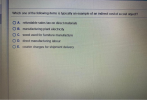 Which one of the following items is typically an example of an indirect cost of a cost object? O A. refundable sales tax on direct materials B. manufacturing plant electricity OC. wood used for furniture manufacture OD. direct manufacturing labour O E. courier charges for shipment delivery
Describe briefly cost of goods sold and the distinction between perpetual and periodic inventory procedures.
Describe briefly cost of goods sold and the distinction between perpetual and periodic inventory procedures.
1. Briefly describe the principal characteristics of the Estate and Gift taxes and how they differ...
 1. Briefly describe the principal characteristics of the Estate and Gift taxes and how they differ from the income tax. 2. List and briefly describe those transfers that constitute gifts subject to the Gift tax and those which may be exempt from either inclusion and/or taxation. 3. List and briefly describe those items that are included in arriving at the Gross Estate of a decedent. 4. What is the Unified Credit and describe how it affects the computation of the...
Identify each of the following items relating to sections of an income statement as Revenue from Sales, Cost of Goods So...
Identify each of the following items relating to sections of an income statement as Revenue from Sales, Cost of Goods Sold, Selling Expenses, General Expenses, Other Income , or Other Expenses. Utilities Expense Advertising Expense Purchases Discounts Sales Returns and Allowances Interest Income Freight In Depreciation Expense, Equipment Interest Expense Rent Expense Sales
3. Describe how unplanned inventory can influence equilibrium in the model where AE=(C+I+G+(X-M)) 4. Briefly describe...
3. Describe how unplanned inventory can influence equilibrium in the model where AE=(C+I+G+(X-M)) 4. Briefly describe the expenditure multiplier and state how it is computed. How is it different from the Tax multiplier? be descriptive and use key terms and examples
Following are the revenues and all expense items from a firm's income statement: Sales= 333,000 Cost...
Following are the revenues and all expense items from a firm's income statement: Sales= 333,000 Cost of Goods Sold= 200,000 Selling and General Expense= 61,500 Depreciation and Amortization= 24,000 Interest Expense= 6,000 Income Tax= 2,400 What is the firm's EBITDA interest coverage?
Classify each of the following items as revenues (R), expenses 1. Cost of sales 4. Owner...
 Classify each of the following items as revenues (R), expenses 1. Cost of sales 4. Owner withdraw 2. Service revenue 5. Rent expense 3. Wages expense 6. Rental revenue Classify each of the following items as assets (A), liabilities (L 1. Land 3. Equipment 2. Owner, Capital 4. Accounts payabl On December 31, Hawkin's records show the following ac December income statement for Hawkin. Classify each of the following items as assets (A), liabilities (L), or equity (EQ). 1. Land...
1. Briefly describe each of the following, and their role in determining how company accounts are...
 1. Briefly describe each of the following, and their role in determining how company accounts are prepared: (i) Legislation (ii) Accounting Standards (ii) Accounting Principles & Accounting Standlaren 161 [6]
2.) Briefly describe how each of the following results in market failure. a. Monopoly b. Externalities...
 2.) Briefly describe how each of the following results in market failure. a. Monopoly b. Externalities c. Asymmetric Information
Data Table a. Sales in April were $50,000. You forecast that monthly sales will increase 12%...
 Data Table a. Sales in April were $50,000. You forecast that monthly sales will increase 12% in May and an additional 4% in June b. Designer Dresses maintains inventory of $7.000 plus 30% of the sales revenues budgeted for the following month. Monthly purchases average 50% of sales revenue in that same month. Actual inventory on April 30 is $23,800. Sales budgeted for July are $70,000 c. Monthly salaries amount to $3,000. Sales commissions equal 10% of sales for that...
 Which one of the following items is typically an example of an indirect cost of a cost object? O A. refundable sales tax on direct materials B. manufacturing plant electricity OC. wood used for furniture manufacture OD. direct manufacturing labour O E. courier charges for shipment delivery
 1. Briefly describe the principal characteristics of the Estate and Gift taxes and how they differ from the income tax. 2. List and briefly describe those transfers that constitute gifts subject to the Gift tax and those which may be exempt from either inclusion and/or taxation. 3. List and briefly describe those items that are included in arriving at the Gross Estate of a decedent. 4. What is the Unified Credit and describe how it affects the computation of the...
 Classify each of the following items as revenues (R), expenses 1. Cost of sales 4. Owner withdraw 2. Service revenue 5. Rent expense 3. Wages expense 6. Rental revenue Classify each of the following items as assets (A), liabilities (L 1. Land 3. Equipment 2. Owner, Capital 4. Accounts payabl On December 31, Hawkin's records show the following ac December income statement for Hawkin. Classify each of the following items as assets (A), liabilities (L), or equity (EQ). 1. Land...
 1. Briefly describe each of the following, and their role in determining how company accounts are prepared: (i) Legislation (ii) Accounting Standards (ii) Accounting Principles & Accounting Standlaren 161 [6]
 2.) Briefly describe how each of the following results in market failure. a. Monopoly b. Externalities c. Asymmetric Information
 Data Table a. Sales in April were $50,000. You forecast that monthly sales will increase 12% in May and an additional 4% in June b. Designer Dresses maintains inventory of $7.000 plus 30% of the sales revenues budgeted for the following month. Monthly purchases average 50% of sales revenue in that same month. Actual inventory on April 30 is $23,800. Sales budgeted for July are $70,000 c. Monthly salaries amount to $3,000. Sales commissions equal 10% of sales for that...
Most questions answered within 3 hours.
-
Where is the error in this code sequence?
String s1 = "Hello";
String s2 = "ello";...
asked 10 months ago -
Financial data for Joel de Paris, Inc., for last year
follow:
Joel de Paris, Inc.
Balance...
asked 10 months ago -
Consider this reaction:
Al2(SO4)3 (aq)+ BaCl3
(aq) Al2Cl6 (aq)- +
3BaSO4(s) . What is the...
asked 10 months ago -
Suppose that Savneet is considering increasing her
recent random sample from 20 car rentals to 40...
asked 10 months ago -
Trucks arrive at an unloading terminal at an average rate of 120
per hour.
Trucks arrive...
asked 10 months ago -
Why are methanol and ethanol completely soluble in water while
octanol is not very little soluble....
asked 10 months ago -
A facilities manager at a university reads in a research report
that the mean amount of...
asked 10 months ago -
When the CuSO4 is rehydrated by adding water to the anhydrous
compound, is this an endothermic...
asked 10 months ago -
A ray of sunlight is passing from diamond into crown glass; the
angle of incidence is...
asked 10 months ago -
A block of mass 0.249 kg is placed on top of a light, vertical
spring of...
asked 10 months ago -
how do the kidneys compensate in the presences of acidosis
a) trigger hyperventilate
b) reserve acid...
asked 10 months ago -
Question 501 pts
The rental rate of capital to the firm increases. Which of the
following...
asked 10 months ago